Clear Sky Science · en
Activity drives self-assembly of passive soft inclusions in active nematics
Liquids That Never Sit Still
Imagine a liquid that never quite comes to rest—its internal components constantly push and pull, stirring up whirlpools and eddies all by themselves. Now imagine sprinkling tiny soft droplets into this restless sea and asking: will they spread out, line up, or gather into clusters? This study explores exactly that question, revealing how an unruly, energy-consuming fluid can be turned into a tool for building new “smart” materials that organize and reconfigure themselves without any external hands.
A Busy Fluid and Quiet Passengers
The work focuses on a special kind of fluid called an active nematic. In such materials, microscopic building blocks continuously consume energy, creating spontaneous flows and turbulence even without stirring. Into this busy background, the authors place many passive soft droplets—think of tiny liquid blobs that do not move by themselves but are carried and squeezed by the surrounding fluid. Using detailed computer simulations, they vary two main knobs: how strongly the active fluid is driven (its “activity”) and how many droplets are packed into a given area (their packing fraction). By scanning these knobs, they uncover a rich “map” of behaviors describing how the droplets arrange themselves.
From Calm Seas to Gels and Swirling Storms
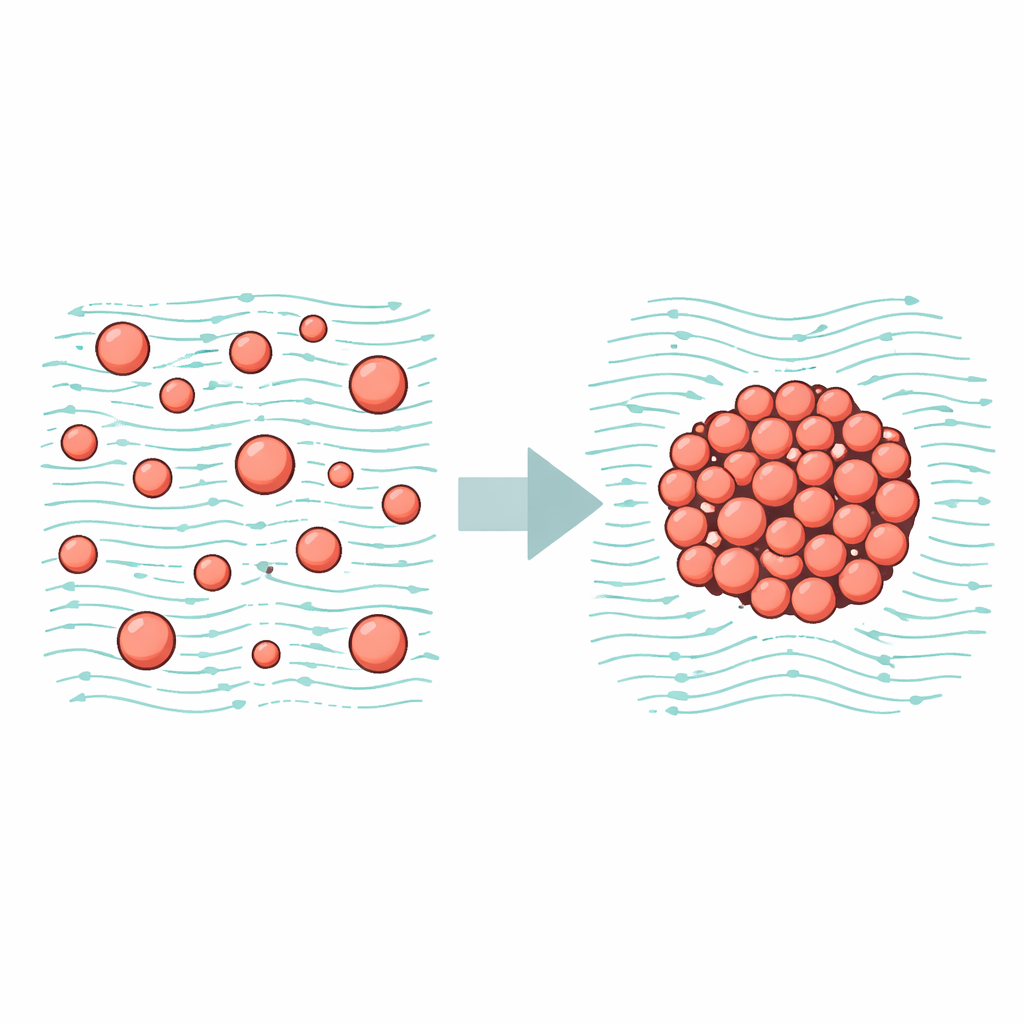
At very low activity, the fluid is almost calm. Droplets simply sit where they started, occasionally nudged by gentle elastic forces in the liquid. When more droplets are added, they begin to feel one another through subtle distortions in the surrounding fluid, forming tenuous chains and a space-spanning network reminiscent of a soft gel. This gel-like state traps the active fluid into small pockets, damping out large-scale motion. As the activity rises past a threshold, however, the situation changes dramatically. The fluid generates spontaneous jets and swirling flows that jostle droplets around. They temporarily form small clusters connected by invisible “bonds” in the liquid’s internal orientation, but the same restless jets can rip those clusters apart, leading to a restless state where groups constantly assemble and disassemble.
When Chaos Makes Droplets Stick Together
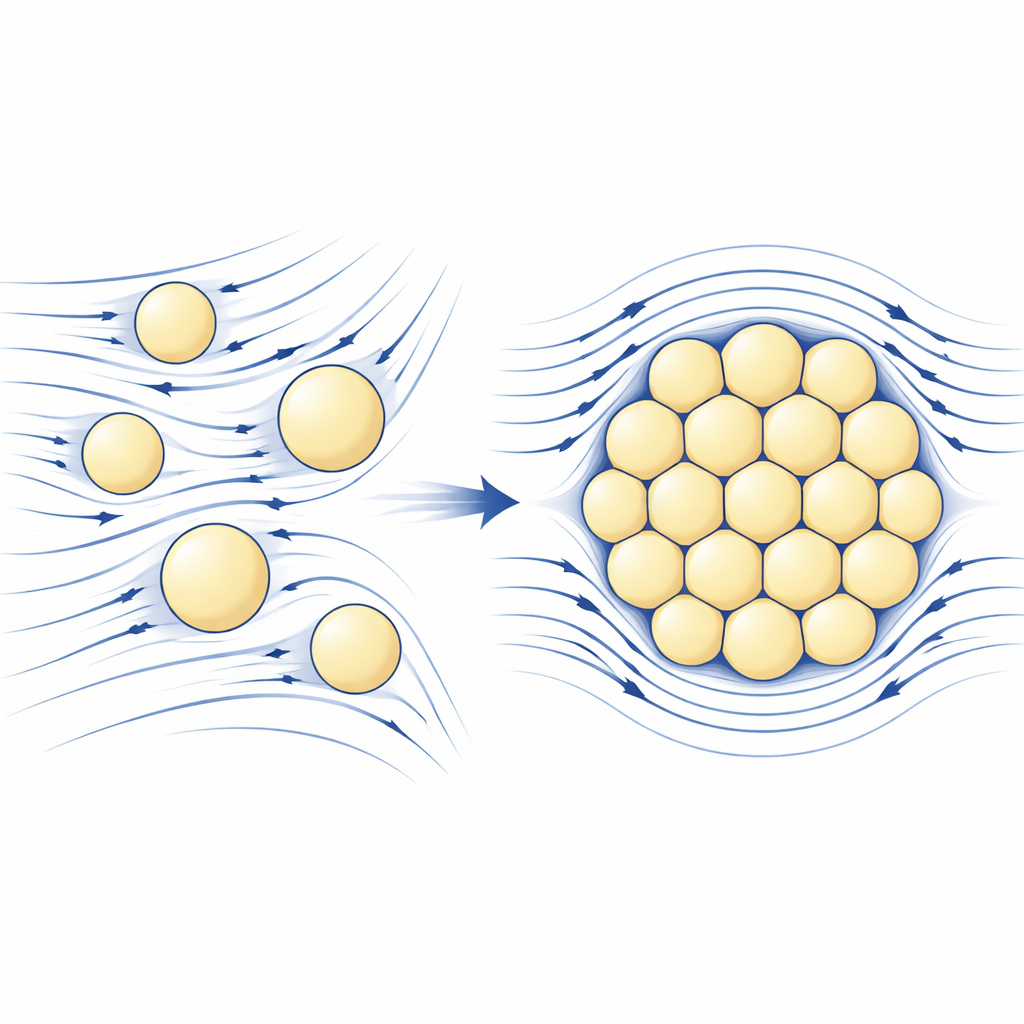
Pushing the activity still higher brings a surprising twist. One might expect ever-stronger flows to simply scatter droplets more violently, but the simulations show the opposite: droplets reorganize into a single dense cluster, a regime the authors call activity-driven deformability-induced phase separation, or active-DIPS. Here, the droplets’ softness is crucial. Strong flows in the active fluid press unevenly on droplets at the outer edge of a growing cluster, deforming them and creating a pressure gradient that effectively squeezes all droplets toward the center. Inside the cluster, droplets are shielded from direct flow and can settle into a hexagon-like arrangement. The cluster remains compact and stable while the surrounding fluid stays turbulent and lively, with smaller vortices swirling around it.
Tuning Motion and Memory
The authors also study how droplets move over time and how the system responds when activity is changed on purpose, like turning a knob on a machine. At low activity, droplets barely wander; at higher activity, they diffuse through space, carried by the self-generated flows. In the fully clustered active-DIPS state, the large droplet aggregate moves more sluggishly than individual droplets did in the turbulent regime. By tracking how far droplets travel on average, and how much kinetic energy is in the fluid versus in the droplets, the researchers show that transitions between calm, gel, clustering, turbulence, and active-DIPS regimes depend in subtle ways on both activity and crowding. They further demonstrate that surface tension—the tendency of droplets to keep a smooth, round shape—can destroy clusters if it becomes too strong, because stiffer droplets can no longer accommodate the intense squeezing from the active fluid.
Switching Structures on Demand
A particularly intriguing result comes from changing the activity over time rather than holding it fixed. Starting from a fully clustered active-DIPS state, the researchers gradually reduce the activity at different rates. If they quench it quickly, clusters survive, held together by defect structures in the surrounding fluid. If they lower it more slowly, the large cluster partially melts, giving a mixed state of a big aggregate plus scattered droplets. For very slow ramps, the structure eventually dissolves completely and the system returns to a disordered suspension. This history dependence—where the final state remembers how the activity was changed—suggests a way to “program” materials that can be switched between solid-like, clustered, and fluid-like states simply by modulating how much energy is pumped into the active fluid.
Why This Matters for Future Materials
In essence, this paper shows that a chaotic, energy-consuming liquid can be harnessed to assemble soft droplets into a variety of organized patterns, from gels to dense clusters, and that droplet softness is the key ingredient that stabilizes these structures at very high activity. By learning how activity, surface tension, and packing work together, scientists gain a blueprint for designing adaptive soft materials: emulsions that can change texture, lock in structures, or release them on demand. Such systems could one day underpin programmable filters, drug-delivery platforms, or bio-inspired devices where structure is not fixed, but actively sculpted by the flows within.
Citation: Sariyar, Y., Akduman, A.U., Negro, G. et al. Activity drives self-assembly of passive soft inclusions in active nematics. Nat Commun 17, 3289 (2026). https://doi.org/10.1038/s41467-026-69704-6
Keywords: active nematics, self-assembly, soft droplets, active turbulence, smart materials