Clear Sky Science · en
Emergent reactance induced by the deformation of a current-driven skyrmion lattice
Why twisting magnets matter for future electronics
Modern electronics mostly relies on controlling electric charge, but a new class of devices aims to use the quantum twists of electrons’ magnetism instead. This study explores exotic magnetic structures called skyrmions inside a tiny crystal of the material manganese silicide (MnSi). The researchers show that when these whirls of magnetism are gently shaken by an alternating electric current, they generate a new kind of electrical response – an "emergent reactance" – that could one day be harnessed in ultra-small circuit elements playing roles similar to inductors and capacitors in today’s AC technology.
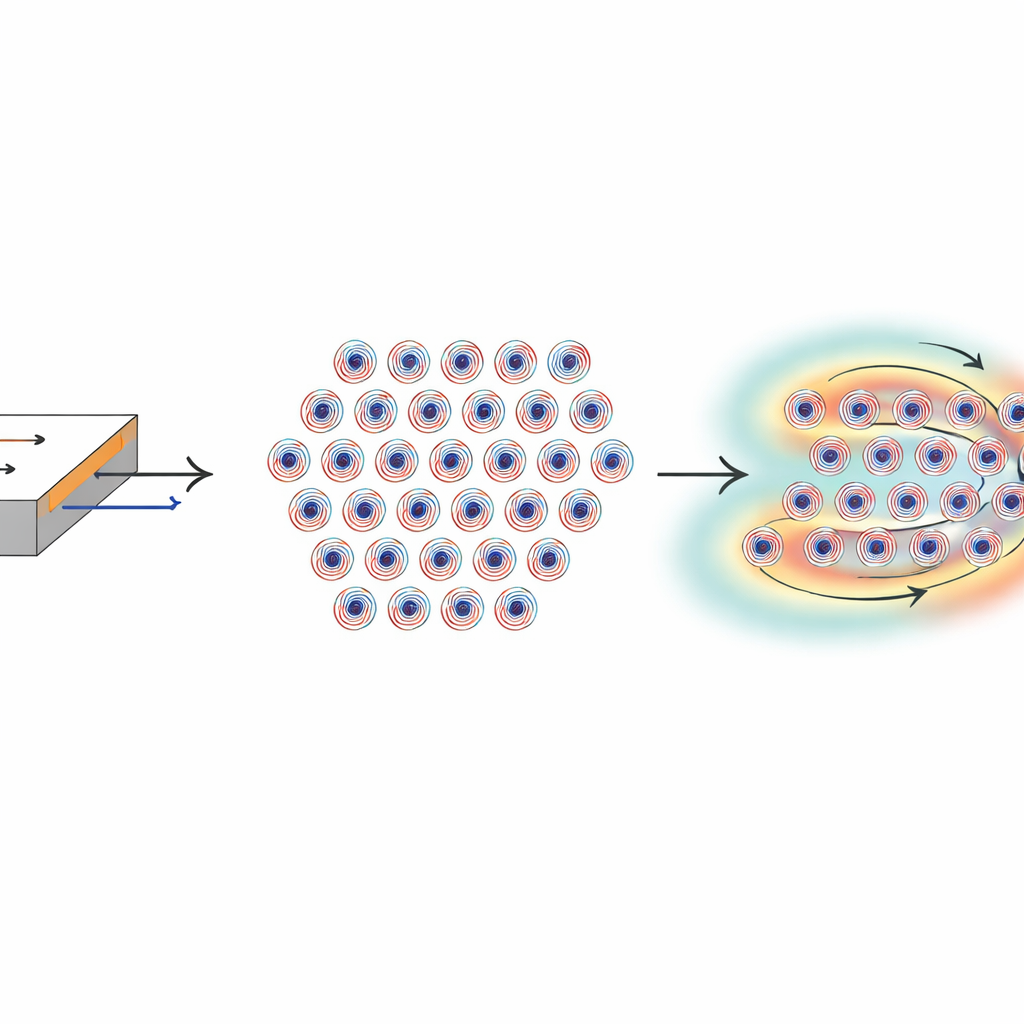
Magnetic whirlpools that steer electrons
Skyrmions are nanoscale whirlpools of magnetic moments that can arrange themselves into a regular lattice inside certain crystals. As electrons pass through this swirling pattern, they pick up an extra quantum phase, as if they were moving through an additional magnetic and electric field created purely by the texture of the magnet. This "emergent" field can bend electron paths and produce unusual signals in measurements of electrical resistance. Until now, most work has focused on effects that stay in step with the applied current, such as a special Hall signal that tracks how skyrmions slide through the material. The out-of-step, or reactive, part of the response – similar in spirit to how a coil or capacitor shifts the phase of AC current – had been theorized but not clearly demonstrated in a skyrmion lattice.
How the team stirred the skyrmion crystal
The authors fabricated a microscopic bar of MnSi, less than a micrometer thick, using focused ion beams and mounted it on a substrate designed to stabilize the skyrmion lattice over a wide temperature range. They then passed precisely controlled currents through the device while applying a magnetic field perpendicular to the film. Using lock-in techniques, they separated the normal, in-phase resistance from the out-of-phase component, known as reactance, along and across the direction of current flow. By varying both a steady current and a small superimposed alternating current, they could map how the skyrmion lattice responded in different dynamical regimes: pinned, slowly creeping, and freely flowing through defects in the crystal.
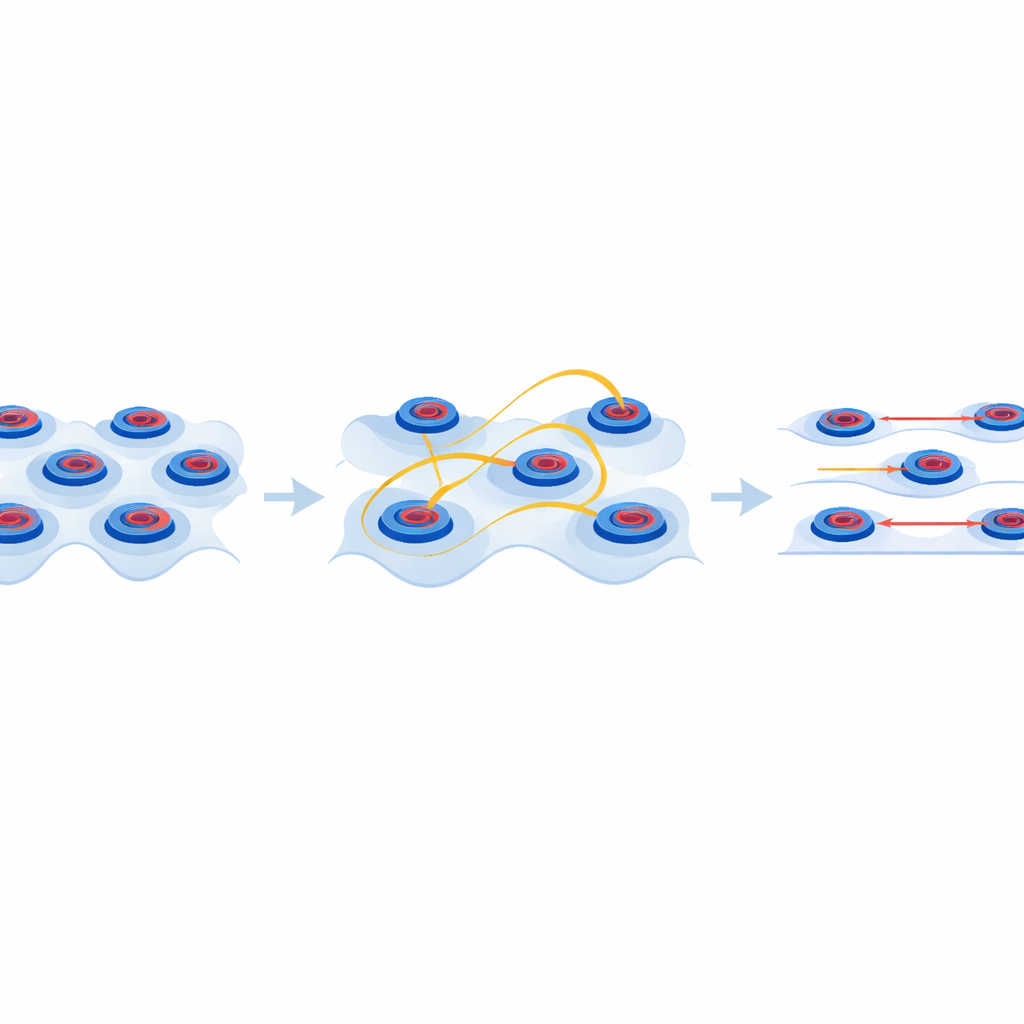
Skyrmion creep and the birth of emergent reactance
From changes in the Hall signal, the team reconstructed how fast the skyrmion lattice moved as the driving current increased. At low currents the lattice remained pinned; with stronger drive it entered a "creep" regime, in which individual skyrmions hopped between pinning sites and became distorted; at still higher currents the lattice flowed more smoothly. The key finding is that both transverse (sideways) and longitudinal (along-the-current) reactance signals appear only when the lattice is moving and most strongly when it is creeping. The transverse reactance is explained by the skyrmion lattice acquiring an effective mass: when distorted, it can store energy and respond sluggishly to the alternating drive, causing its motion – and the emergent electric field it produces – to lag behind the applied current. This lag directly shows up as an out-of-phase Hall response.
Internal flexing of skyrmions as an electrical handle
The longitudinal reactance, which appears along the direction of the applied current, cannot be explained simply by the sideways drift of the skyrmion lattice. Instead, the authors argue it arises from the internal deformation modes of the skyrmion pattern itself. In the creep regime, the regular lattice temporarily reshapes: the constituent spin spirals shift their phase and tilt their orientation. These subtle collective motions change in time as the drive oscillates, thereby generating an emergent electric field in line with the current. This mechanism naturally produces a longitudinal, out-of-phase signal even when the whole lattice is not moving rigidly, and also explains why similar reactance is absent in other magnetic phases of MnSi under the same conditions.
What this means for tomorrow’s tiny circuits
In everyday circuit design, reactance and phase control are the domain of coils and capacitors. This work shows that a lattice of magnetic skyrmions can provide an analogous function, but arising from quantum geometry rather than classical electromagnetism. Because skyrmions in MnSi can be driven into the creep regime at relatively low current densities, they offer an energy-efficient route to emergent reactance in nanoscale devices. The results highlight that not only the motion but also the internal flexibility of skyrmions is a valuable resource. Looking ahead, similar ideas may be applied to other intricate spin structures, potentially enabling a new generation of miniaturized components where the twisting of magnetism directly shapes the timing and phase of electrical signals.
Citation: Littlehales, M.T., Birch, M.T., Kikkawa, A. et al. Emergent reactance induced by the deformation of a current-driven skyrmion lattice. Nat Commun 17, 2921 (2026). https://doi.org/10.1038/s41467-026-69698-1
Keywords: magnetic skyrmions, emergent electromagnetism, spintronics, AC reactance, topological materials