Clear Sky Science · en
Subtypes of adolescent major depressive disorder characterized by divergent information dynamics in sensory-association cortices
Why teen depression and the senses matter
Adolescence is a time when the brain is rapidly rewiring itself, especially in regions that turn raw sights and sounds into complex thoughts and emotions. This study asks a simple but powerful question: are there different brain-based versions of major depression in teens, depending on how their brains move information from basic sensory areas to higher thinking regions? The answer may help explain why some adolescents experience more severe symptoms than others, and why treatments can work very differently from one teenager to the next.
Two different brain patterns in depressed teens
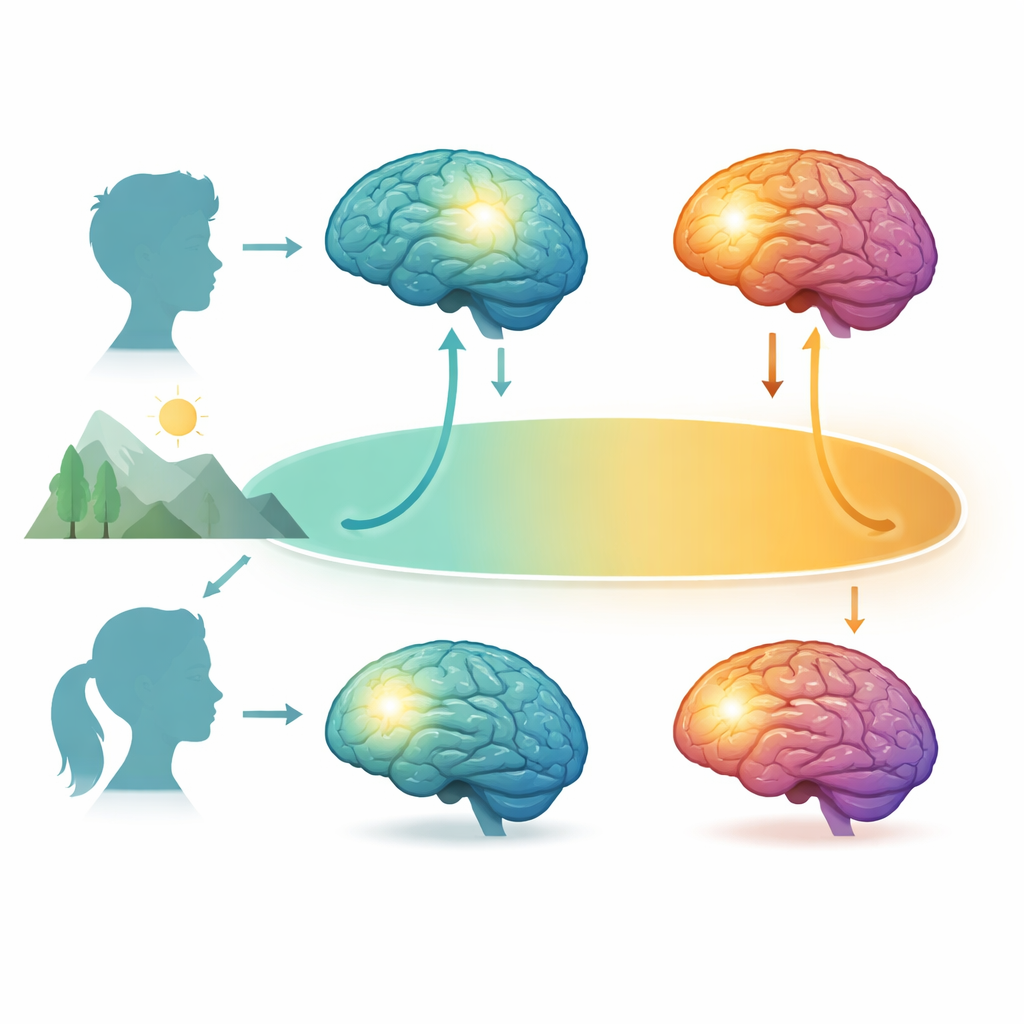
The researchers analyzed resting-state brain scans from more than 300 adolescents with major depressive disorder and over 200 healthy peers. Instead of looking at single spots in the brain, they examined smooth "gradients" that run from regions handling simple sensory input, like vision and movement, to association regions that support memory, planning, and social understanding. Using machine learning, they found that depressed teens naturally split into two subgroups. In one subtype, the main disruptions clustered in sensory regions; in the other, the main changes appeared in higher-order association regions. Both patterns still followed the brain’s normal overall layout, but in subtly different, clinically meaningful ways.
Bottom-up versus top-down information flow
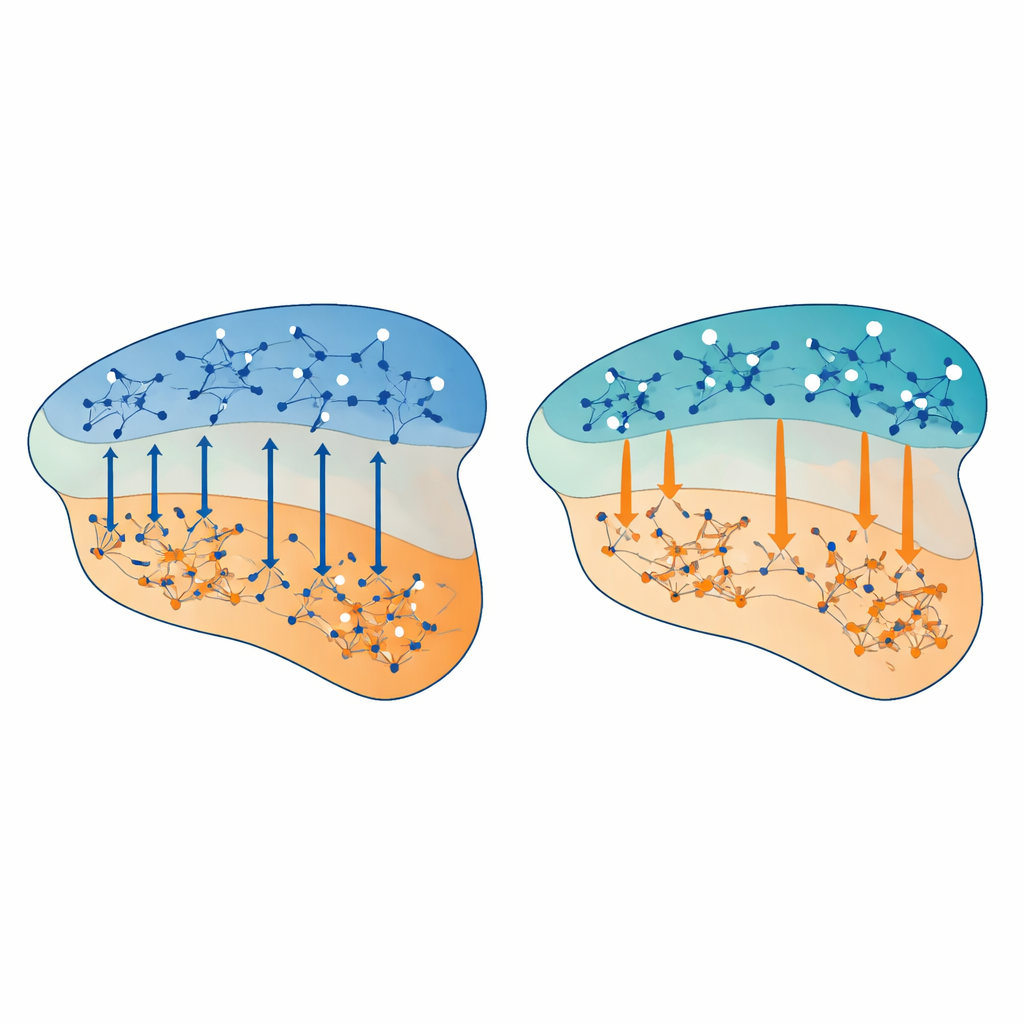
Next, the team studied how activity appears to flow between sensory and association zones. In the first subtype, brain signals tended to move in a "bottom-up" fashion: from sensory cortices upward into association areas. This subtype also showed more isolated, modular networks and less overall efficiency, a pattern suggesting that sensory signals may be overemphasized yet poorly integrated into a coherent whole. In the second subtype, the dominant pattern was "top-down": association regions more strongly drove sensory regions. Network efficiency in this group sat between the first subtype and healthy teens, hinting that higher-order areas may be working harder to compensate for other weaknesses.
Different ways of combining and repeating information
The authors then asked how brain regions share information over time. Using a framework that separates "synergy" (new information that only appears when regions work together) from "redundancy" (overlapping, repeated information), they found that both subtypes showed reduced synergy and increased redundancy in sensory areas compared with healthy teens. However, the first subtype had especially high redundancy in these regions, pointing to repetitive, possibly rigid processing of sensory input. In association regions, both subtypes again showed reduced synergy, but the second subtype stood out for its elevated redundancy there, suggesting that higher-level networks might be overbuilt yet inefficient, trying to stabilize thinking and emotion with repetitive signaling.
Development, symptoms, and biology behind the subtypes
Adolescence normally brings a gradual shift from sensory-dominated to association-dominated brain organization. In both depressed subtypes, age-related changes deviated from this typical track, but in different ways: the first subtype followed an axis tied more closely to motor and auditory systems, while the second tracked the usual sensory-to-association path more strongly. Clinically, teens in the first subtype reported more severe depression and anxiety and more childhood trauma, especially emotional and physical neglect. At the molecular level, both subtypes’ brain changes lined up with specific chemical messenger systems and sets of genes, but each subtype pointed to different biological processes—one more related to structural growth and plasticity, the other to cellular stress handling and the fine-tuning of synaptic communication.
What this means for understanding teen depression
Taken together, the study suggests that adolescent depression is not a single brain condition but at least two distinct patterns along the axis that links sensation to thought. One subtype appears driven by disrupted handling of sights, sounds, and bodily signals pushing upward into an inefficient network, and is tied to more severe symptoms and trauma. The other shows stronger influence from higher-order regions pushing downward, with somewhat better overall integration but its own weaknesses in how information is combined. By tying these patterns to development, symptoms, and underlying biology, the work offers a roadmap toward more precise diagnosis and, ultimately, tailored treatments that match a teen’s specific brain subtype rather than treating all depression as the same.
Citation: Liu, X., Wan, B., Wu, X. et al. Subtypes of adolescent major depressive disorder characterized by divergent information dynamics in sensory-association cortices. Nat Commun 17, 3055 (2026). https://doi.org/10.1038/s41467-026-69697-2
Keywords: adolescent depression, brain networks, sensory processing, information flow, precision psychiatry