Clear Sky Science · en
Mach-Zehnder atom interferometry with non-interacting trapped Bose-Einstein condensates
Measuring Tiny Forces with Waves of Matter
Imagine using waves made not of water or light, but of atoms, to feel incredibly small changes in gravity or other forces. This study shows how to turn clouds of ultra-cold atoms into a new kind of measuring device, one that can sense tiny differences in force over distances of just a few millionths of a meter. By carefully controlling how these atoms are split, held, and recombined, the researchers build a highly stable “atom interferometer” that keeps its quantum phase intact for almost a full second—an unusually long time for such delicate systems.
Turning Ultra-Cold Atoms into a Precision Tool
The work is based on Bose–Einstein condensates, special clouds of gas cooled so close to absolute zero that thousands of atoms act together as a single, coherent wave. These matter waves are excellent candidates for precision measurements because they spread very little in momentum and can be shaped and steered with light. Traditionally, some of the best atom interferometers let such clouds fall freely, for example in tall towers or even in space, to measure gravity. But free-fall devices are bulky. Trapping the atoms in place—while still letting their waves interfere—opens the door to compact, chip-scale instruments that could eventually fit in labs, vehicles, or even portable navigation systems.
Building a Double-Path Matter-Wave Sensor
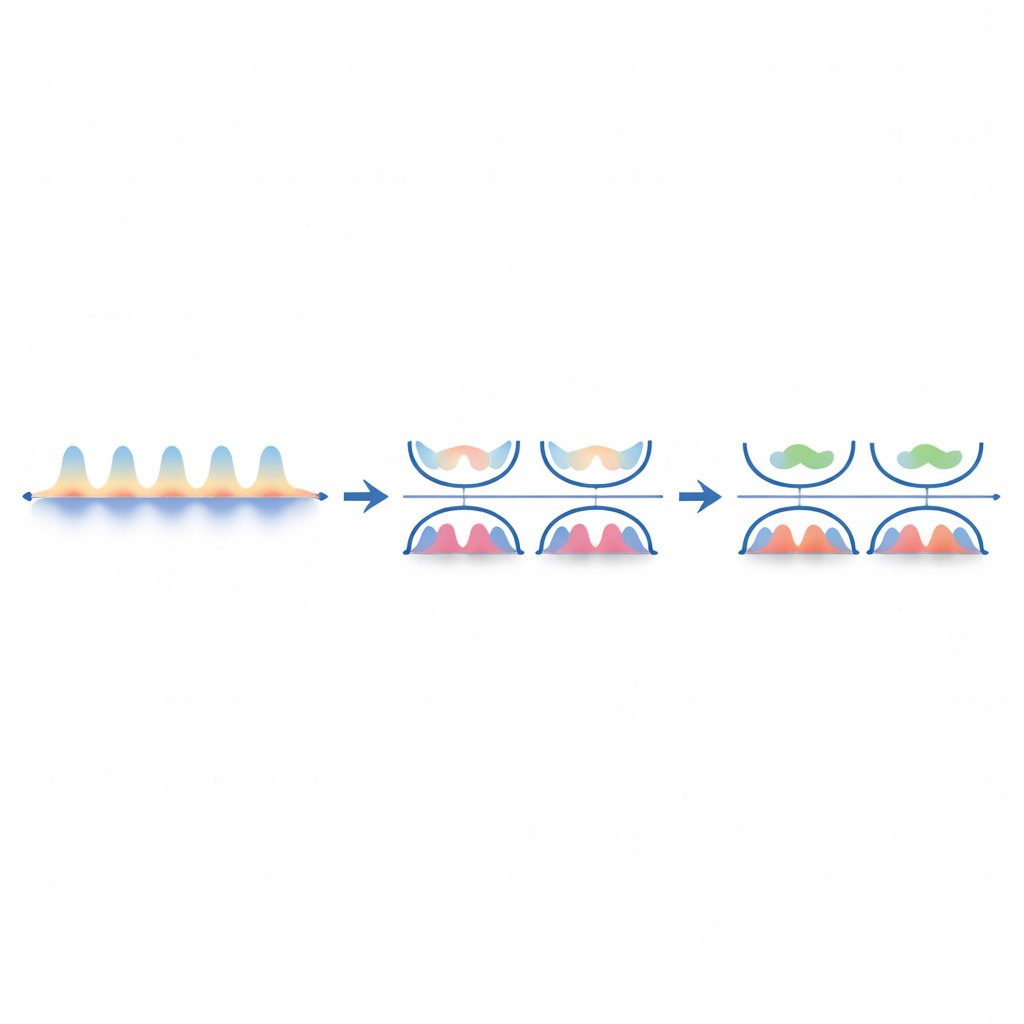
The authors design a new way to confine and split the condensate using three carefully tuned laser patterns that form an array of tiny “double wells.” Each double well acts like a miniature track with two paths: left and right. A Bose–Einstein condensate is first loaded into a series of single wells, then each is smoothly transformed into a pair, acting as a beam splitter that divides the atom wave into two parts separated by about five micrometers. After this first split, the two parts sit in their wells for a chosen time, during which any external force—such as gravity or a controlled light-induced push—changes the relative phase between them. A second, tunneling-based beam splitter then recombines the two paths by briefly lowering the barrier between wells, and the final number of atoms in each side tells how much phase was accumulated.
Canceling Collisions and Comparing Neighbors
A major challenge in using dense, trapped atom clouds is that atoms collide with each other, blurring the interference pattern and limiting how long the device stays coherent. The team overcomes this by tuning the interactions between atoms essentially to zero using a magnetic control technique known as a Feshbach resonance. In this non-interacting regime, the condensate behaves more linearly, allowing clean beam splitting through quantum tunneling with nearly perfect contrast. However, once collisions are suppressed, the setup becomes very sensitive to tiny imperfections in the trapping potential. To tame this, the researchers run several identical interferometers side-by-side in the same laser pattern and compare their outputs. Any disturbance that shifts all wells the same way is treated as a common signal and is canceled out, leaving only the small differences between neighboring sensors—a configuration known as a gradiometer.
Fighting Noise with a Quantum Echo
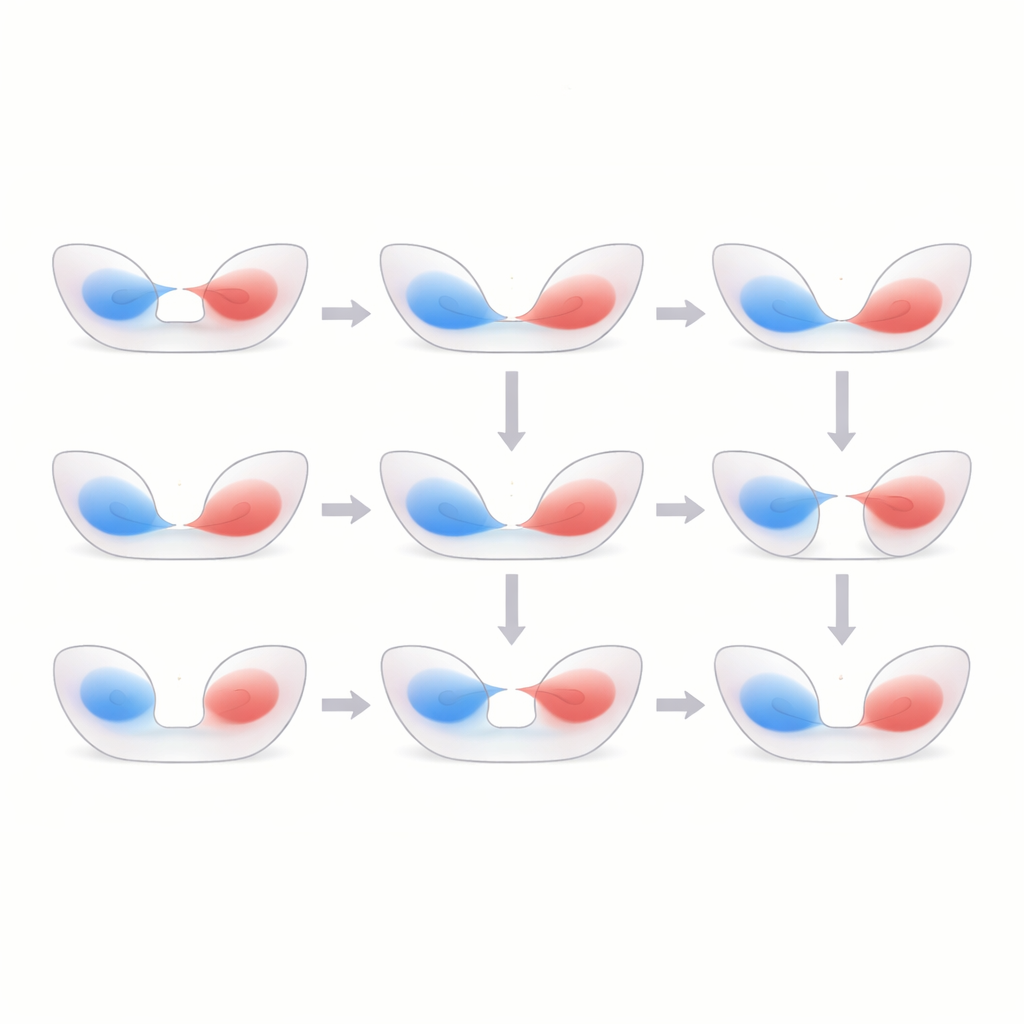
Even after removing most atom–atom interactions and comparing neighboring sensors, slow drifts and technical noise can still scramble the phase over long times. To push the performance further, the researchers borrow an idea from nuclear magnetic resonance called a spin echo. In the middle of the interferometer sequence, they apply an extra tunneling pulse that effectively swaps the populations between the left and right wells in each double well. This “echo” reverses the effect of certain kinds of static or slowly varying disturbances, so that by the end of the sequence these unwanted phase shifts cancel out. With this protocol and fine tuning of the magnetic field, the interferometer maintains usable coherence for interrogation times approaching one second—almost two orders of magnitude longer than previous trapped condensate devices of this kind.
What This Means for Future Sensors
By showing that atom waves can be split, held, recombined, and compared in tightly confined double wells without losing coherence for hundreds of milliseconds, this work establishes a powerful new platform for quantum sensing. The trapped-atom gradiometer demonstrated here can, in principle, map tiny variations of forces such as gravity or electromagnetic fields over micrometer distances, far smaller than a human hair. Because the same setup can both dial in interactions to create quantum-entangled states and switch them off to protect the measurement, it is especially well suited for future sensors that beat the so-called shot-noise limit. In practical terms, this approach moves compact, ultra-sensitive atom-based instruments a step closer to real-world applications in precision metrology, materials studies near surfaces, and advanced navigation.
Citation: Petrucciani, T., Santoni, A., Mazzinghi, C. et al. Mach-Zehnder atom interferometry with non-interacting trapped Bose-Einstein condensates. Nat Commun 17, 3948 (2026). https://doi.org/10.1038/s41467-026-69692-7
Keywords: atom interferometry, Bose-Einstein condensate, quantum sensing, gravity gradiometer, spin echo