Clear Sky Science · en
Moisture-responsive crystallization strategy for efficient CsPbI3 solar cells fabricated under high-humidity conditions
Turning Humid Air from Problem to Power
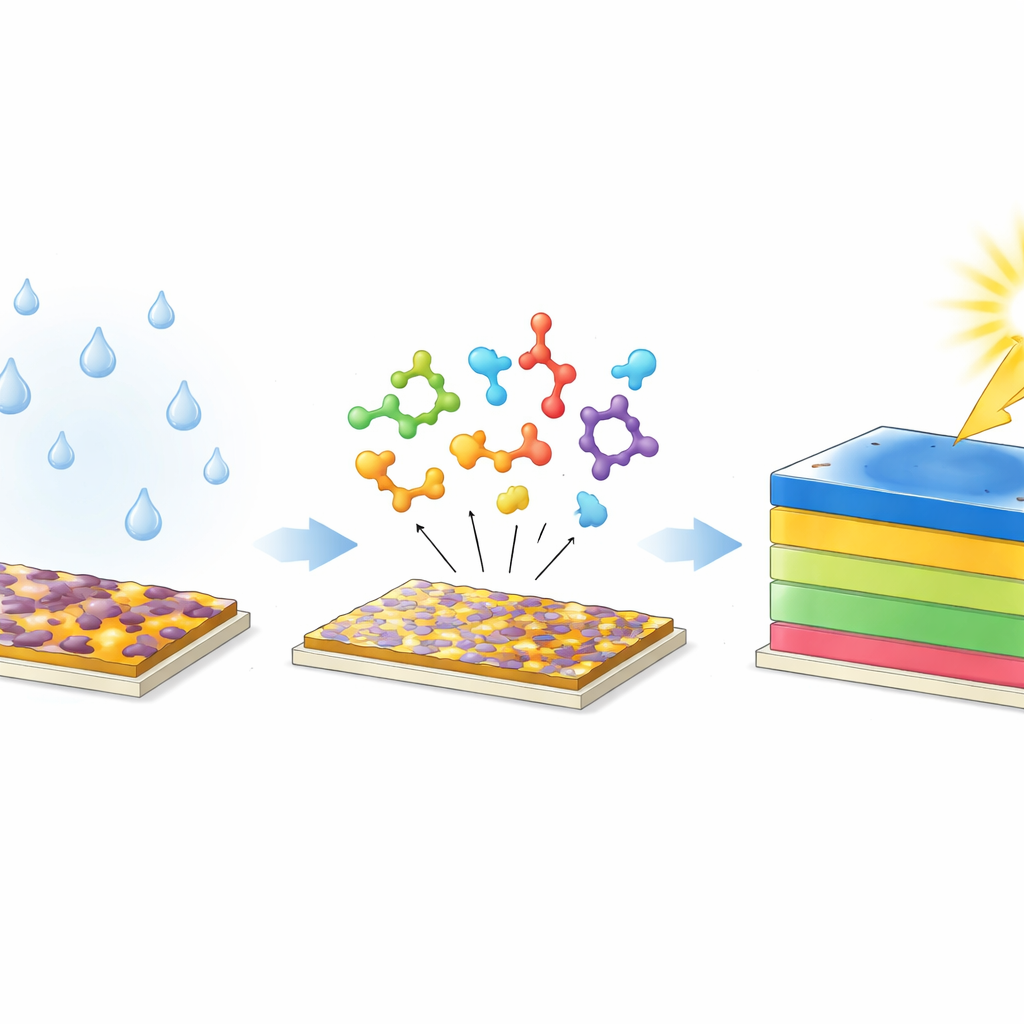
Solar cells made from a crystalline material called CsPbI3 promise low-cost, highly efficient solar power, but there is a catch: they normally must be made in very dry, carefully controlled rooms. Moisture in the air can wreck their crystal structure during fabrication, undermining performance and raising costs. This study shows how a clever chemical helper can flip humidity from a harmful enemy into a useful ally, allowing high-performance CsPbI3 solar cells to be made in ordinary, relatively humid air.
Why This Solar Material Is So Fragile
CsPbI3 is an inorganic perovskite, a family of materials known for soaking up sunlight exceptionally well. In its desirable “black” form, CsPbI3 converts light to electricity efficiently and is chemically robust. However, the small size of the cesium ions strains the crystal lattice, making it prone to slip into a less useful “yellow” form that barely absorbs light. Water molecules in the air speed up this unwanted phase change by helping create tiny vacancies and distortions in the crystal. As a result, most high-efficiency CsPbI3 devices must be manufactured in dry, inert environments with relative humidity below about 40%, which is costly and difficult to scale for mass production.
A Moisture-Smart Additive Joins the Mix
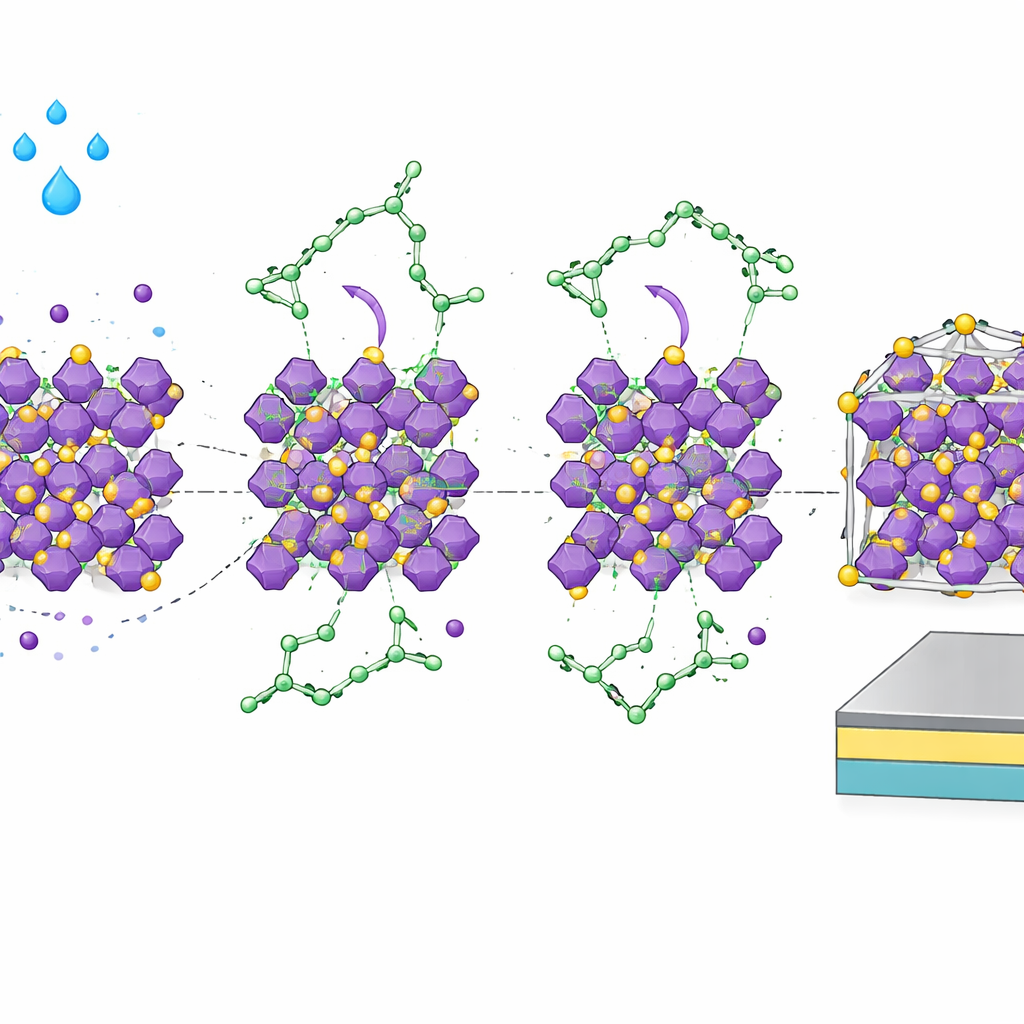
The researchers tackle this challenge by adding a small organosilane molecule, propyltriethoxysilane (PTES), directly into the liquid “ink” used to coat thin CsPbI3 films. PTES has a special relationship with water: in humid air it slowly reacts with moisture, forming siloxane groups that can bind both to parts of the perovskite and to an intermediate compound (DMAPbI3) that forms during crystal growth. In doing so, PTES helps pull out dimethylammonium (DMA+) ions from the intermediate and makes it easier for cesium ions to take their place, speeding up the transformation into the desired black CsPbI3 phase. At the same time, the hydrolyzed PTES molecules begin to stitch themselves into a network around and within the forming crystal.
How the Invisible Network Builds Better Crystals
As fabrication continues in air with about 55% relative humidity, PTES-derived groups link together to form Si–O–Si and Si–O–Pb bridges, creating a crosslinked, partly hydrophobic scaffolding in and around the perovskite grains. Measurements using X-ray diffraction, Raman spectroscopy, electron microscopy, and surface analysis reveal that this network reduces internal strain, smooths the film surface, and lowers the density of atomic defects such as missing iodine atoms. The crystals become larger, more uniform, and structurally more stable, with fewer sites where water and oxygen can start degradation. At the electronic level, the energy landscape inside the film shifts in a way that favors efficient separation and transport of charges, lengthens the lifetime of photo-generated carriers, and reduces non-radiative losses.
From Lab Film to Working Solar Device
When these PTES-treated films are assembled into full solar cells, their performance jumps noticeably compared with untreated devices made under the same humid conditions. Under 55% relative humidity in ordinary air, the improved cells reach a power conversion efficiency of 21.00% and an unusually high fill factor of 86.1%, indicating that most of the generated charge is successfully collected. By adjusting humidity and processing conditions, the team pushes efficiencies even higher, achieving 21.85% at 25% relative humidity and 22.60% (certified 22.02%) when the film is spin-coated in nitrogen and then heated in ambient air. Larger-area devices also perform well, and long-term tests show that PTES-treated cells retain a large fraction of their original output under light and humidity, far outlasting control devices.
What This Means for Future Solar Panels
In everyday terms, the study introduces a smart “molecular scaffold” that turns troublesome moisture into a helpful partner during solar-cell fabrication. PTES captures and removes unwanted ions, guides the growth of the right crystal form, and then locks that structure in place with a moisture-resistant network. This allows high-efficiency CsPbI3 solar cells to be manufactured in much less restrictive environments without sacrificing performance or stability. If scaled up, such a strategy could lower production costs and simplify factory designs, bringing durable, all-inorganic perovskite solar panels closer to real-world deployment.
Citation: Dai, W., Li, J., Gou, Y. et al. Moisture-responsive crystallization strategy for efficient CsPbI3 solar cells fabricated under high-humidity conditions. Nat Commun 17, 3363 (2026). https://doi.org/10.1038/s41467-026-69687-4
Keywords: perovskite solar cells, CsPbI3, humidity-tolerant fabrication, crystal additives, stable photovoltaics