Clear Sky Science · en
Flatbands from bound states in the continuum for orbital angular momentum localization
Trapping Twisted Waves of Sound
Imagine being able to park a swirling tornado of sound or light inside a tiny building block of a material, holding its structure in place instead of letting it spread out. This paper shows how to do exactly that for sound waves that carry orbital angular momentum—a corkscrew-like twist in their wavefronts—by designing special materials where such waves naturally stand still instead of dispersing.
Why Flat Energy Landscapes Matter
In many modern materials, waves—whether of electrons, light, or sound—travel through a repeating lattice much like ripples across a pond. Usually, different wavelengths move at different speeds, so energy spreads out. In so-called flatband materials, the energy of these waves no longer depends on their motion: the “band” is flat. This makes waves stop propagating and instead become neatly confined to just a few repeating units. Such confinement can boost interactions and is key to phenomena ranging from unusual electronic phases to robust signal storage. However, up to now this compact trapping has mostly worked for relatively simple waves, and not for those with rich internal structure such as orbital angular momentum (OAM), where the wavefront actually twists around an axis like a tiny whirlpool.
From Hidden States to Designer Lattices
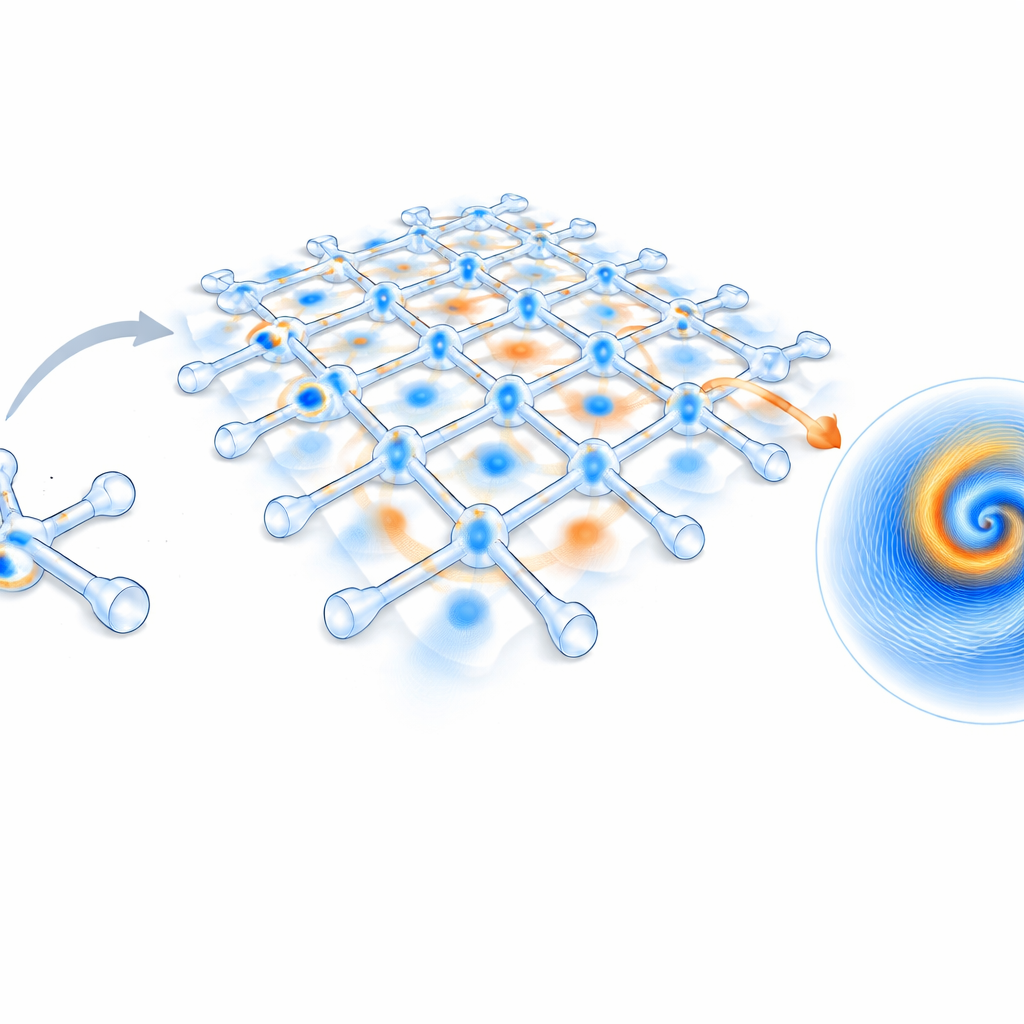
The authors propose a general recipe to create flatbands that are not only localized but also highly “degenerate,” meaning many distinct wave patterns share exactly the same energy. They start from a single open unit built from acoustic waveguides—tubes that guide sound—which supports both leaky modes that radiate out and special non-leaky modes known as bound states in the continuum (BICs). These BICs are trapped even though, in principle, they could radiate away. When such units are repeated and connected into a lattice, the leaky modes combine into ordinary, energy-dispersing bands, while each BIC in a unit cell turns into a completely flat band that remains confined to that cell. By tailoring how many tubes and junctions the unit has, the researchers can design flatbands with multiple independent trapped modes at the same frequency in two or even three dimensions.
Building and Testing Acoustic Crystals
To turn this idea into reality, the team 3D-printed air-filled acoustic structures from rigid resin. In a two-dimensional version, each unit cell contains four resonators connected by channels, arranged in a square lattice. Measurements of how sound responds across the sample show nearly dispersionless bands around 5 kilohertz, confirming the presence of four overlapping flatbands. Because these bands arise from four BIC-like patterns within each cell, experimenters can excite different combinations of them by driving the input channels with carefully tuned phases. With all four inputs in step, the system acts as a flatband filter: it selects the special flatband frequency from a broadband pulse and traps sound in a small cluster of resonators without it spreading through the lattice.
Locking In Twisted Sound and 3D Topological Shapes
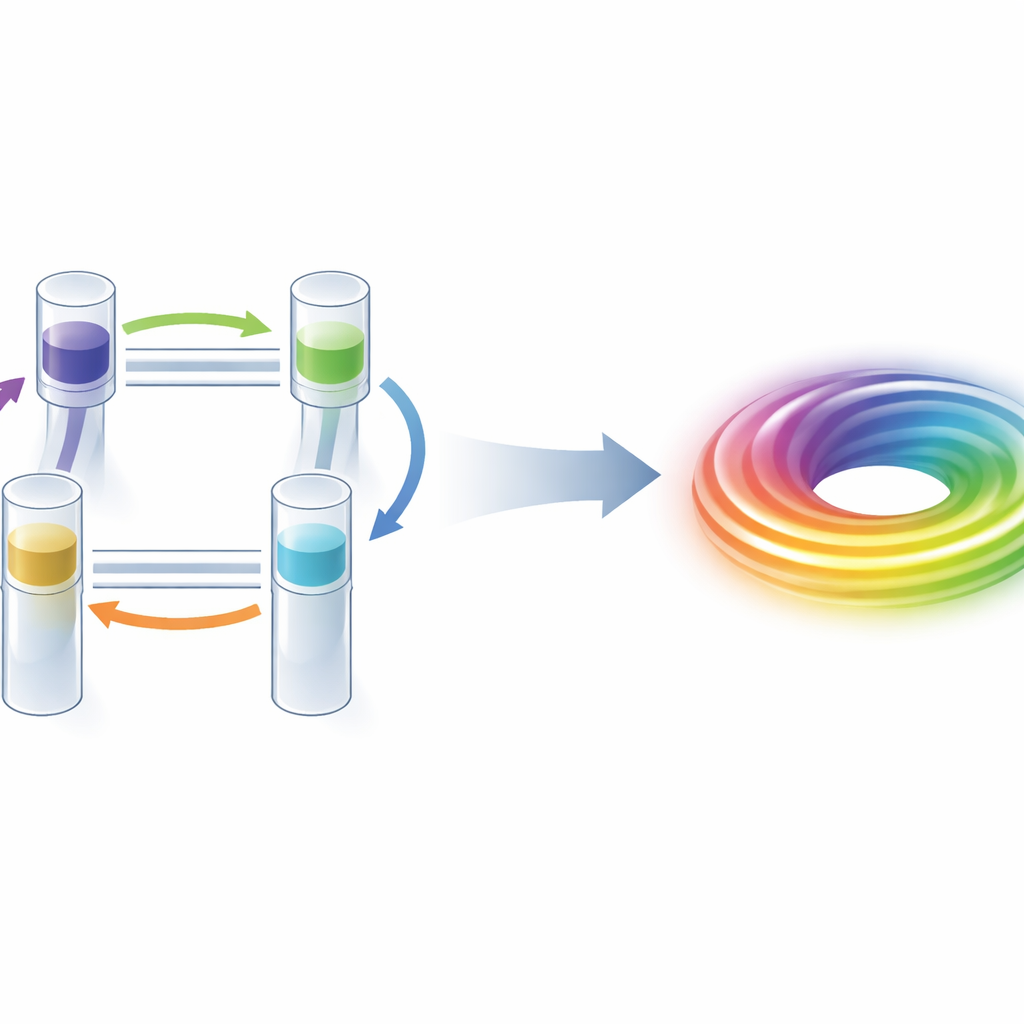
The real power of the approach appears when the researchers program relative phase shifts among the inputs. By driving four connected resonators around a square with a steadily rotating phase—like four paddles pushing water in sequence—they create a compact vortex of sound carrying orbital angular momentum, either clockwise or counterclockwise, all locked inside a single unit cell. They then push the concept further in a three-dimensional lattice whose unit cell supports twelve BIC-based modes, forming twelve-fold degenerate flatbands. In this 3D crystal they can localize twisted sound along any chosen direction, including diagonals through the lattice, and even assemble multiple such localized vortices into extended, knotted topological structures shaped like tori and Hopf links, where the phase of the sound field winds in space in a controlled, quantized way.
What This Means for Future Wave Technologies
By showing how to design flatband materials that can store complex, vortex-like wave patterns in tightly confined regions, this work greatly expands what kinds of waves can be trapped and manipulated on demand. Instead of just holding simple standing waves, these structures can capture and preserve the twisting structure of orbital angular momentum in two and three dimensions. That opens the door to compact devices for robust information storage and transfer using structured sound or light, new forms of particle manipulation based on controlled vortices, and scalable platforms for building highly organized, topologically rich wave patterns across many different physical systems.
Citation: Zhu, W., Zou, Hy., Ge, Y. et al. Flatbands from bound states in the continuum for orbital angular momentum localization. Nat Commun 17, 3065 (2026). https://doi.org/10.1038/s41467-026-69669-6
Keywords: flatband materials, orbital angular momentum, acoustic crystals, bound states in the continuum, topological waves