Clear Sky Science · en
Polymer matrix drives thermal stimulation-caused dynamic phosphorescence in dispersed chromophores
Glowing Plastics with a Hidden Twist
Imagine a plastic film that keeps softly glowing long after you switch off a UV flashlight, and whose color and duration of afterglow subtly change with temperature. Such materials could act as invisible barcodes, secret inks, or simple, reusable temperature sensors. This study reveals how the plastic itself – the polymer matrix that holds light‑emitting molecules – can finely tune that afterglow, making it brighter, longer‑lived, and even useful for encrypting information.
How Light Lingers After the Lights Go Out
Most everyday glow‑in‑the‑dark materials store energy in special “triplet” excited states and then release it slowly as a dim afterglow called phosphorescence. Keeping these triplet states alive at room temperature is tricky because heat usually helps them lose energy invisibly as vibration rather than light. The authors explore a rarer route called thermally stimulated delayed phosphorescence, where gentle heating actually helps promote energy within the molecule, recycling it between closely spaced triplet states so that more of it comes back out as visible light instead of being wasted.
Designing the Light‑Emitting Building Blocks
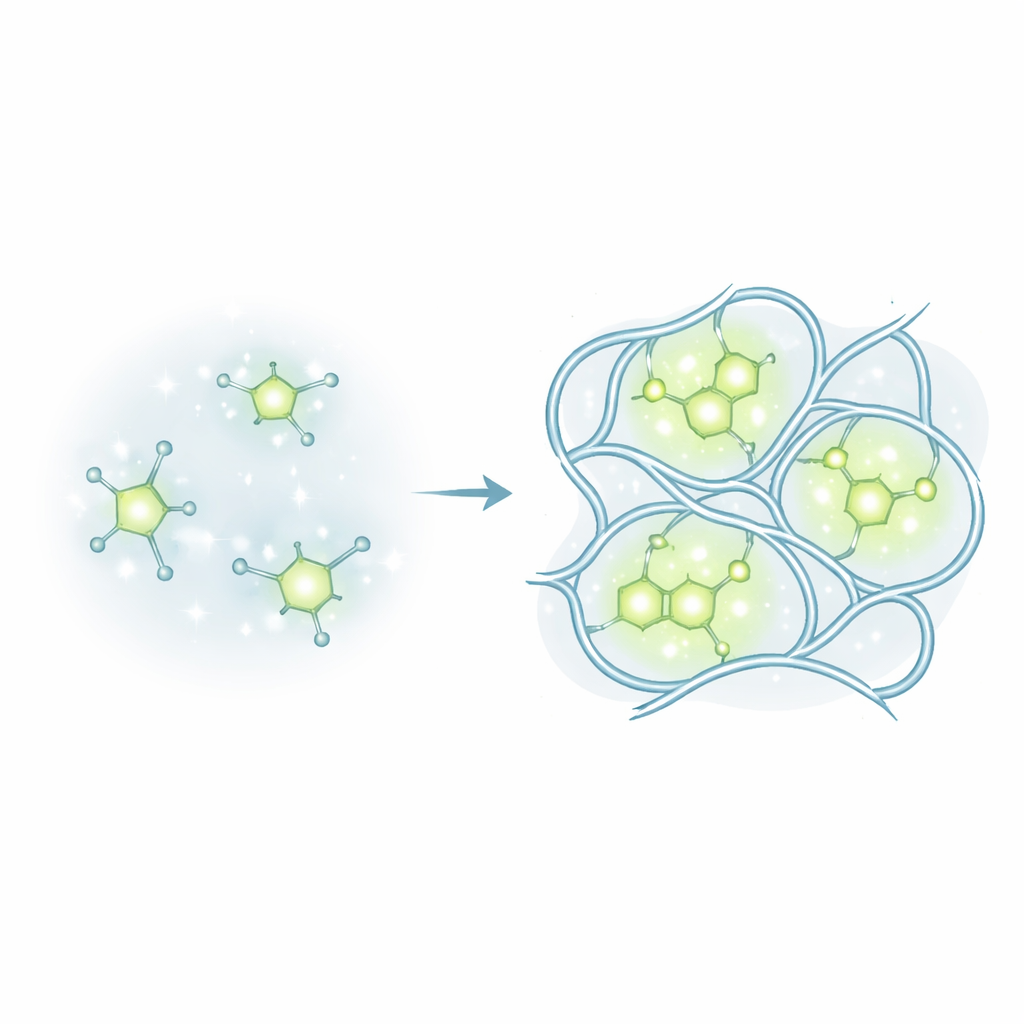
The team built a family of metal‑free organic emitters based on borylaniline, in which an electron‑rich amine group donates charge to an electron‑poor boron center. They created three closely related molecules: one with a rigid, “locked” structure and two in which a ring attached to nitrogen can twist into several shapes, or conformers. These molecules were then highly diluted and trapped inside different plastics, mostly the common transparent polymer PMMA, so that each light‑emitting unit behaved like an isolated guest inside a solid host rather than as part of a clump or crystal.
When the Plastic Host Takes Control
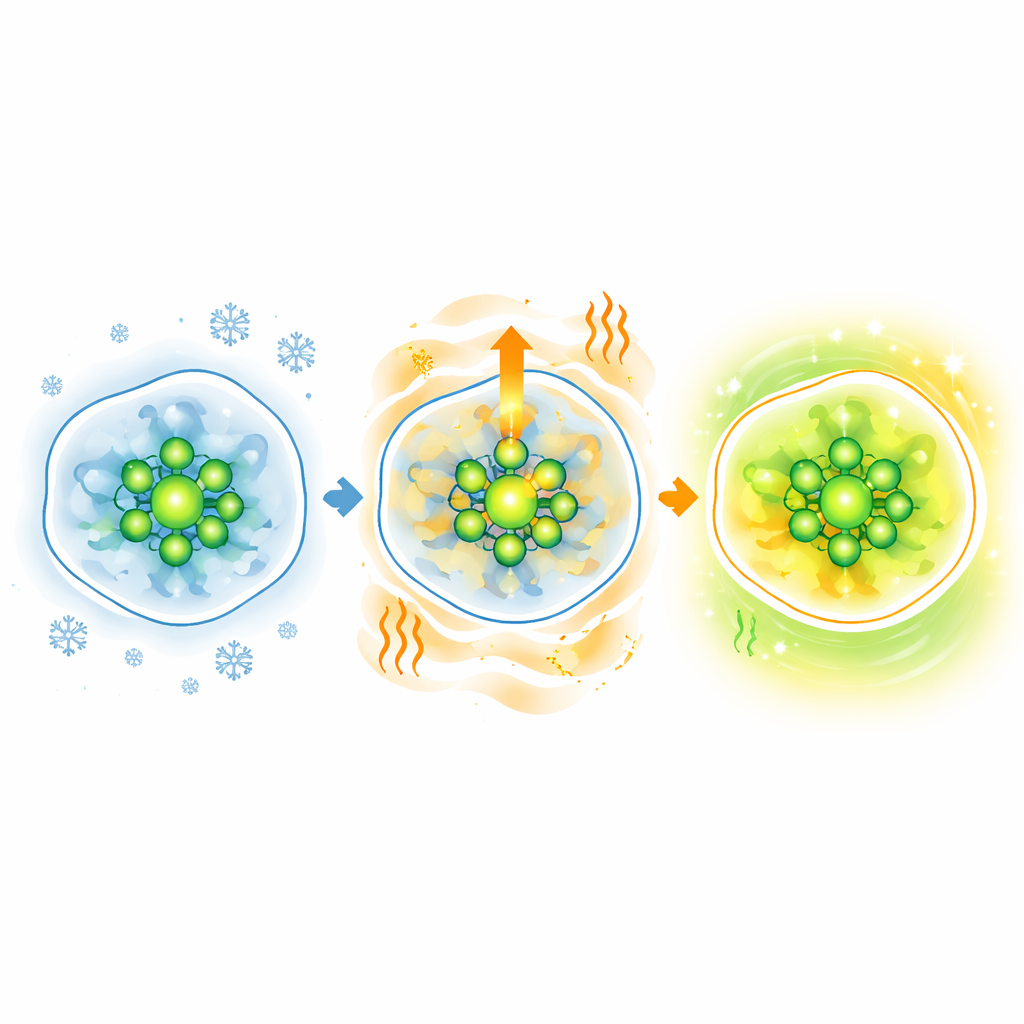
By measuring how the films absorbed and emitted light from 77 kelvin (liquid‑nitrogen cold) up to room temperature, the researchers found that PMMA provides an especially favorable environment. At low temperature, the chromophores in PMMA show a redder, slower phosphorescence band from a low‑lying triplet state. As the sample warms, a bluer, higher‑energy delayed emission band grows in while the low‑energy band fades, indicating that heat is driving population up into a nearby higher triplet state that can radiate efficiently. Quantum yields reach up to about 92% at 298 K, meaning almost all the absorbed energy returns as light – a rare performance for purely organic room‑temperature afterglow.
How the Matrix Shapes Energy Pathways
The same molecules behave quite differently in other hosts. In a related acrylic plastic (PBMA), the higher‑energy emission weakens at higher temperature, hinting that extra non‑radiative loss pathways appear. In non‑polar polystyrene, the two triplet states are pushed farther apart in energy, the delayed band shifts to higher energy, and the afterglow decays faster. Crystalline solids of the emitters show yet another behavior: shorter‑lived, red‑shifted emission without strong thermal tuning. Quantum‑chemical calculations back these trends, showing that the local electric fields and steric “cages” provided by each polymer shift the energies and mixing of singlet and triplet states. For the more flexible molecules, the matrix even lifts the degeneracy of different conformers in the triplet state, creating thermally accessible shapes that alter triplet–triplet communication and help sustain the dynamic phosphorescence.
From Subtle Physics to Secret Messages
Because the afterglow color and brightness depend sensitively on temperature and on how long the emission persists, these polymer films can serve as simple visual thermometers and as tools for anti‑counterfeiting. The authors demonstrate a “hidden” Morse‑code message written with two inks that have nearly identical glow colors but different phosphorescence lifetimes; the code appears only in a narrow time window after the UV lamp is switched off. Overall, the work shows that choosing the right plastic host is as important as designing the emitter itself, and that polymer matrices can act like finely tuned scaffolds that steer excited‑state energy, enabling bright, temperature‑switchable afterglow in economical, metal‑free materials.
Citation: Ghosh, S., Nandi, R.P., R, S. et al. Polymer matrix drives thermal stimulation-caused dynamic phosphorescence in dispersed chromophores. Nat Commun 17, 2936 (2026). https://doi.org/10.1038/s41467-026-69664-x
Keywords: room temperature phosphorescence, polymer matrix, organic afterglow, thermally stimulated emission, anti-counterfeiting