Clear Sky Science · en
Half-integer thermal conductance in integer quantum Hall states
Why this strange kind of heat flow matters
In many futuristic ideas for quantum computers, a special kind of quantum state is expected to leave a clear heat signature: a “half‑step” in how well it conducts heat. This work shows that the very same half‑step can appear in a much more ordinary setting, built from well‑understood materials. That means experimentalists must be far more careful when claiming that such a thermal signal proves the existence of exotic quantum matter.
Heat along the edges of a flat world
In a strong magnetic field, electrons in a thin sheet of material can organize into a quantum Hall state. The interior becomes quiet and insulating, while electric charge and heat move only along the edges in one direction, like cars on a one‑way highway. In the simplest, so‑called integer quantum Hall states, theory and experiments agree that the thermal conductance of each edge is locked to whole‑number steps set by fundamental constants. A half‑integer value has therefore been regarded as a “smoking gun” for far more unusual, non‑Abelian states of matter that host Majorana modes—objects that are their own antiparticles and are sought after for fault‑tolerant quantum computing.
Mimicking an exotic signal with a clever device
The authors designed a device using bilayer graphene, a stack of two graphene sheets encapsulated in insulating boron nitride and controlled by graphite gates. By adjusting voltages on a global back gate and a local top gate, they created a narrow region where electron‑like and hole‑like quantum Hall states meet, forming what is known as an n‑p‑n junction. In this region, several edge channels run side by side along the internal boundaries and can exchange both charge and energy. The team chose a particular combination of filling factors—numbers that count the available edge channels—so that theory predicts an effective electrical conductance equal to exactly one‑half of the usual quantum unit when the channels fully mix. They then embedded this junction into a three‑armed layout with a central floating contact that can be heated without allowing a net flow of charge, enabling precise measurements of how much heat escapes along each set of edge channels. 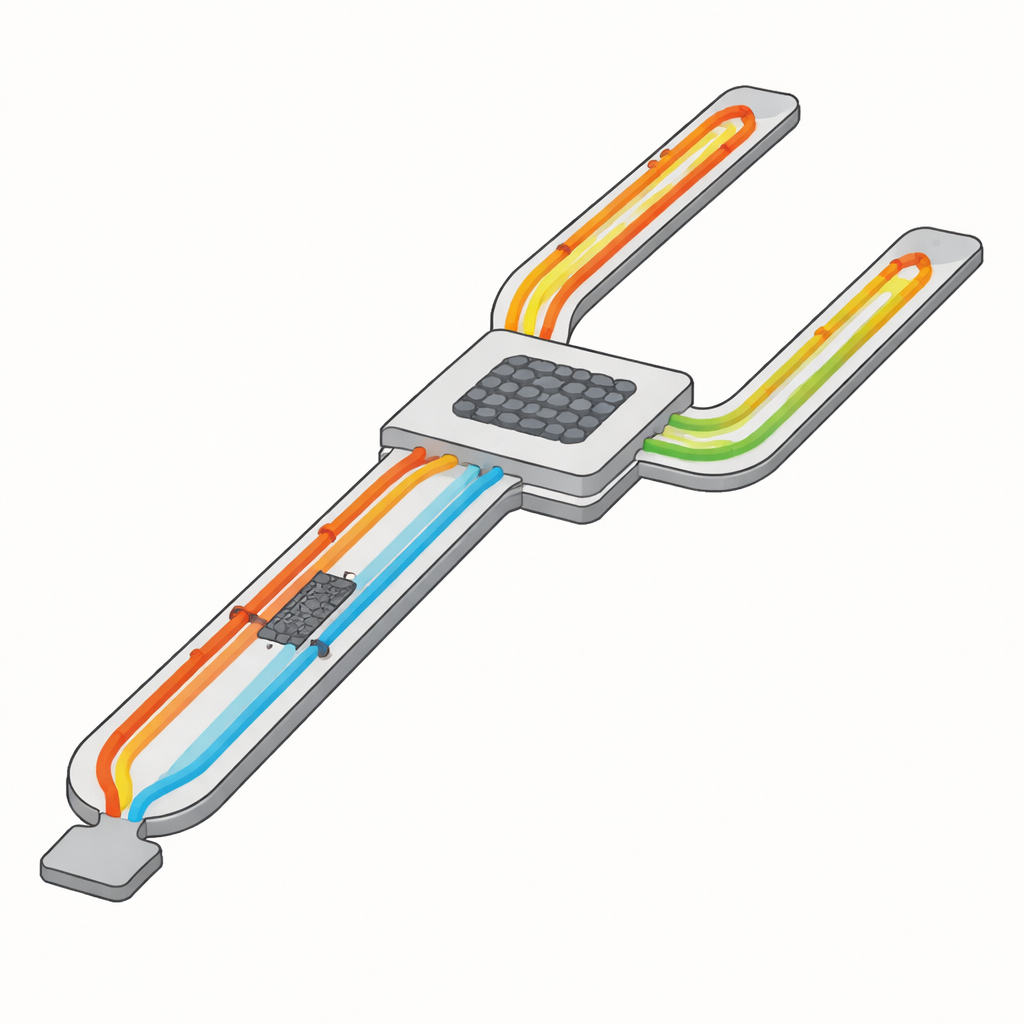
Watching engineered edges carry half as much heat
To probe thermal conductance, the researchers injected equal and opposite currents into the floating contact through two of the arms. This method raised the electronic temperature of the contact while keeping its electrical potential at zero, avoiding unwanted noise that would otherwise mask the delicate thermal signal. Tiny fluctuations in voltage—the Johnson‑Nyquist noise—were picked up at distant contacts and analyzed to infer the temperature increase. First, they verified that for ordinary, “uni‑polar” gate settings, the thermal conductance followed the expected integer steps and obeyed the Wiedemann–Franz law linking heat and charge transport. Then they turned to the key “bi‑polar” setting, where two edge channels from one side meet a single, oppositely charged channel from the other. In this configuration, careful analysis of the noise in multiple arms showed that the junction itself carried heat as if it were only half of a standard channel, even though all underlying states are of the ordinary, Abelian type. 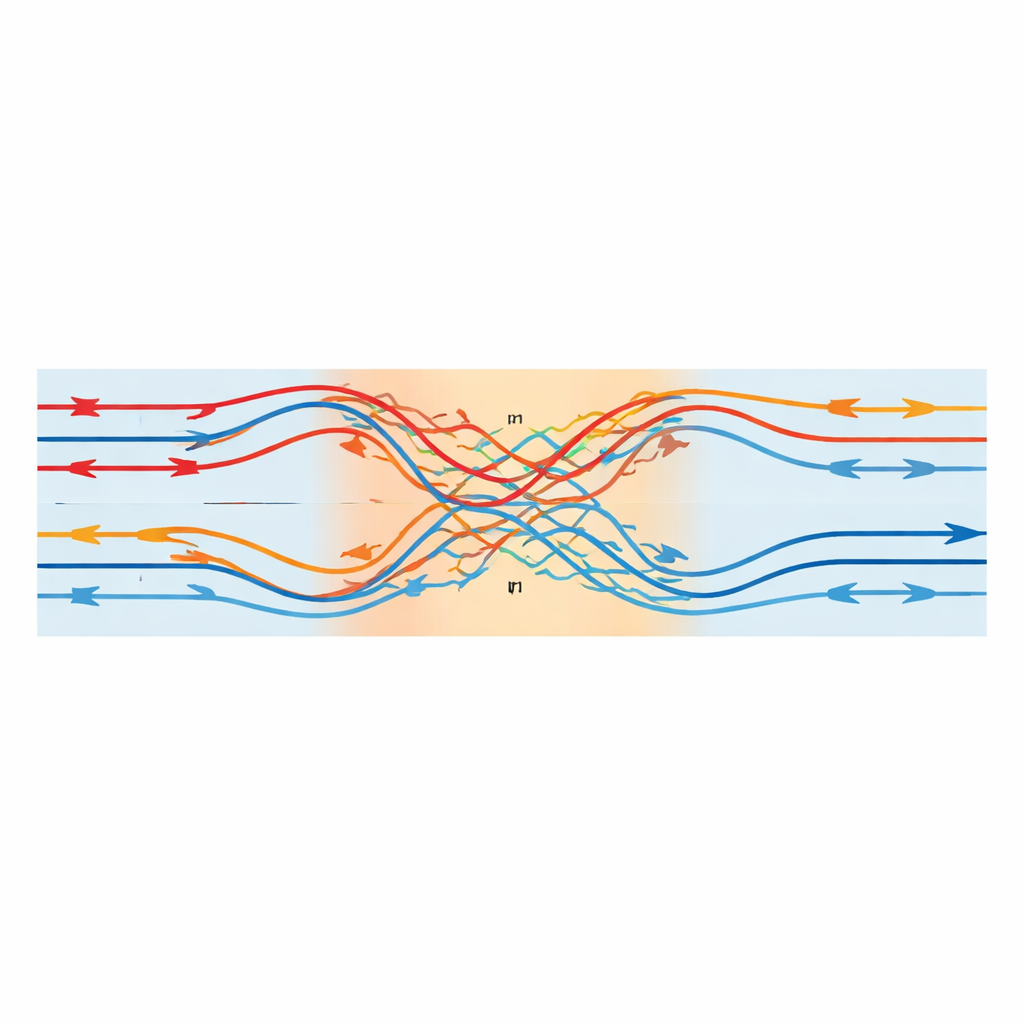
How mixing at the junction fakes a fractional signal
The central insight is that the half‑integer thermal conductance does not require any hidden Majorana mode. Instead, it emerges from mundane but robust equilibration: over a junction several micrometers long, the co‑propagating electron and hole edges in bilayer graphene share charge and energy so completely that the outgoing channels behave like new, effectively “fractional” carriers. Because the spin and valley properties of these edges can be matched using electric and magnetic fields, equilibration occurs along the whole interface, not just at its ends. The resulting heat flow is insensitive to local imperfections, making the half‑integer plateau as stable as one would expect from a truly topological state, yet arising from straightforward dynamics.
Rethinking what a thermal signature really proves
By showing that a carefully engineered but otherwise conventional quantum Hall device can display a robust half‑integer thermal conductance, this study undercuts the idea that such a signal is an exclusive fingerprint of non‑Abelian phases and Majorana modes. It demonstrates that equilibration and device geometry alone can mimic the thermal behavior long thought to betray exotic topology. For future experiments that hunt for new quantum states using heat transport, this work sets a higher bar: researchers must rule out similar equilibration‑based mechanisms before claiming the discovery of truly non‑Abelian matter.
Citation: Roy, U., Manna, S., Chakraborty, S. et al. Half-integer thermal conductance in integer quantum Hall states. Nat Commun 17, 2853 (2026). https://doi.org/10.1038/s41467-026-69659-8
Keywords: quantum Hall, thermal conductance, bilayer graphene, edge states, Majorana alternatives