Clear Sky Science · en
Earth system simulations suggest that the Proterozoic ocean was greener but less productive
When the Ancient Ocean Glowed Green
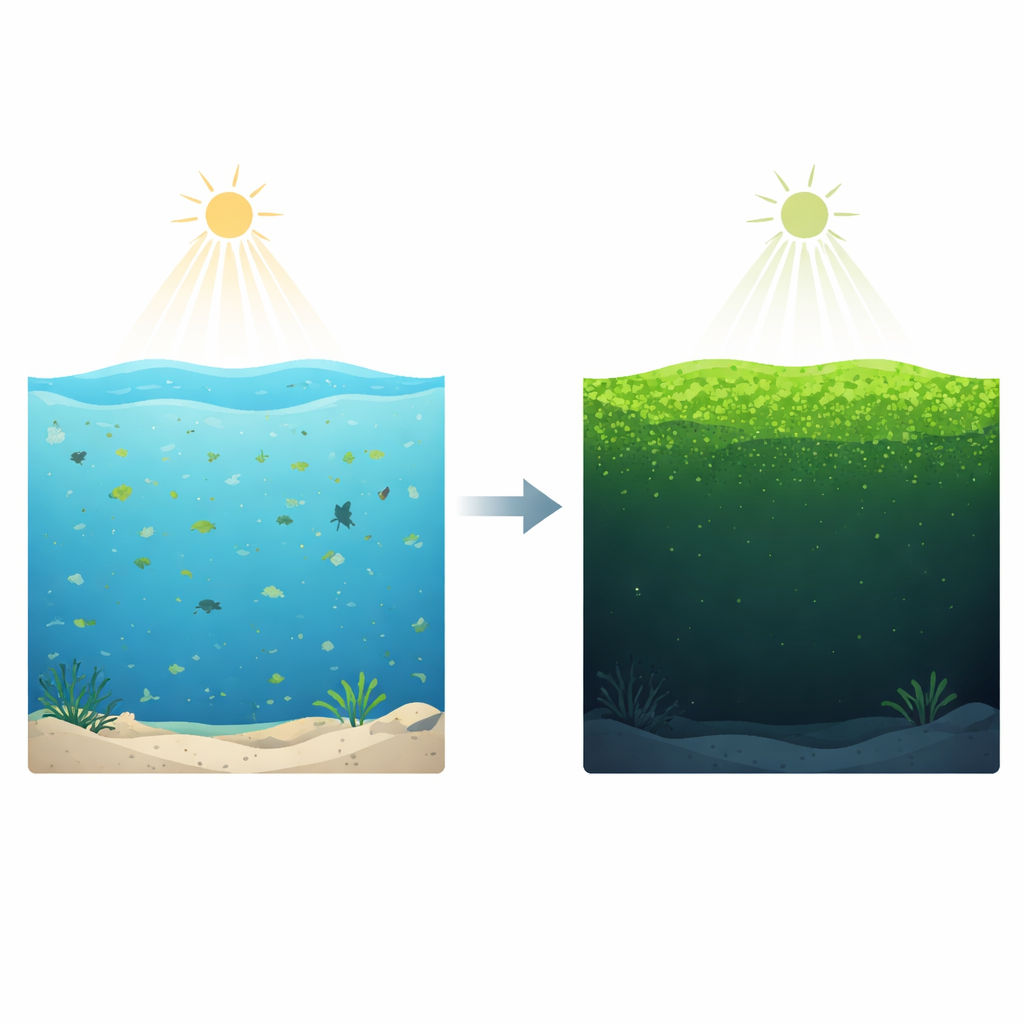
Imagine looking down from space at Earth more than a billion years ago and seeing oceans that were not deep blue, but a vivid green. This study uses a state-of-the-art climate and ocean model to ask a deceptively simple question: if early seas were packed with microscopic plant life but almost no animals to eat them, how would that have changed the color and vitality of the planet’s oceans? The answer reshapes how we picture Earth’s past and the conditions that set the stage for animal life.
A World Before Ocean Animals
The time slice explored here is the Proterozoic Eon, spanning roughly 2.5 billion to 540 million years ago. During this era, tiny photosynthetic organisms—akin to today’s cyanobacteria and small algae—dominated the seas, while animal-like grazers such as zooplankton had not yet appeared. Geological clues suggest that ocean productivity, the rate at which these microbes turned sunlight and nutrients into organic matter, was lower than today but still far from negligible. Yet estimates of how much biomass they produced, and how it was distributed in the water column, remained highly uncertain. The authors tackle this gap with a full Earth system simulation that couples atmosphere, ocean circulation, sea ice, and marine chemistry, and then adjusts it to reflect ancient continents, dimmer sunlight, and low oxygen levels.
Greener Seas from the Surface Up
In their virtual Proterozoic world, the researchers remove diatoms and zooplankton—groups that had not yet evolved—and allow only small phytoplankton and nitrogen-fixing microbes to grow. Under a range of realistic nutrient conditions, the model consistently produces much more plant biomass near the surface than in today’s ocean. Globally averaged chlorophyll in the upper 150 meters is about 1.5 to 2.5 times higher, and in the very top layers it can exceed modern values by an order of magnitude across much of the low-latitude ocean. Because no predators are present to crop back these blooms, the upper ocean becomes crowded with microscopic plants, turning simulated seas a deep, persistent green almost everywhere that is ice-free and warm enough.
Why More Plants Can Mean Less Growth
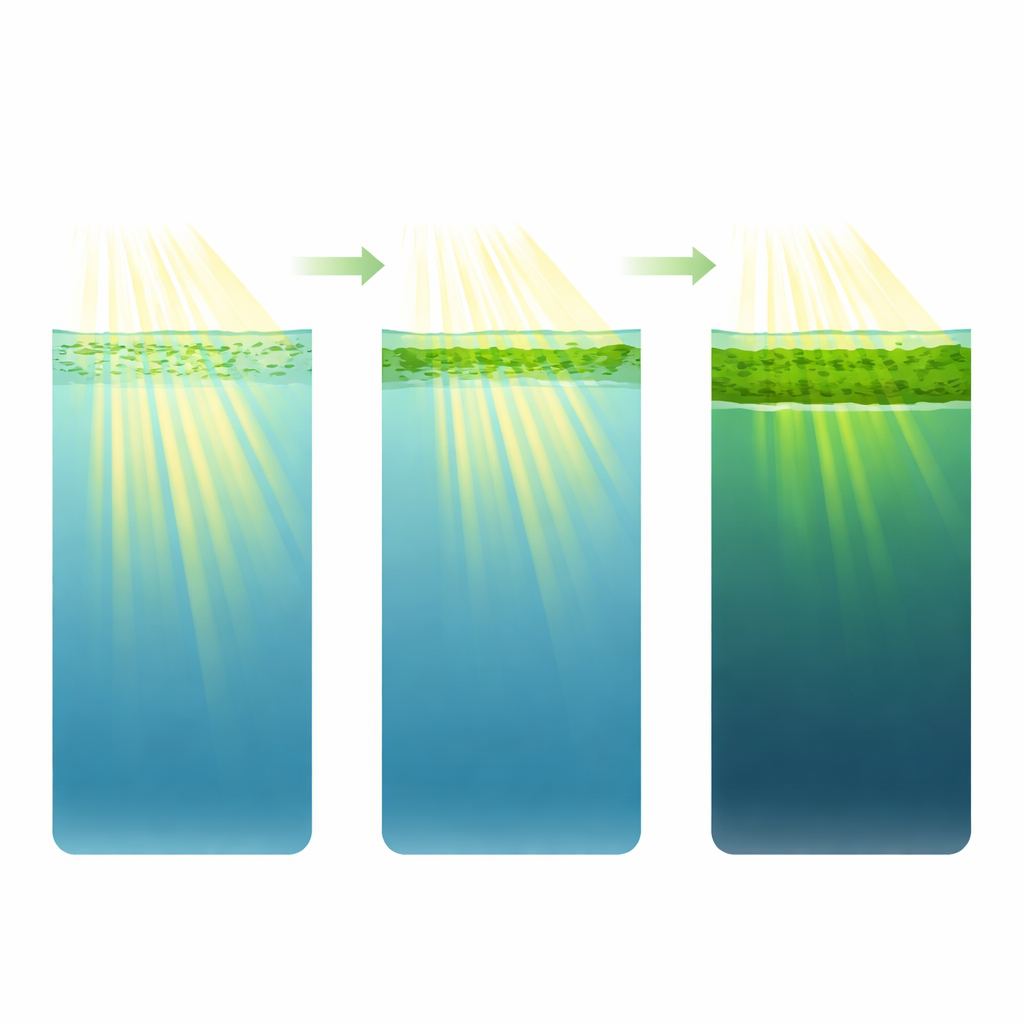
Counterintuitively, this lush green surface does not translate into a more productive ocean overall. The model shows that total global primary production in the Proterozoic ocean was only about 60 percent of modern values in warm periods and roughly 30 percent during colder, ice-extended states. The key reason is light. When so much chlorophyll accumulates near the surface, it acts like a sunshade, soaking up sunlight before it can reach deeper layers where photosynthesis could otherwise occur. The sunlit, or euphotic, layer shrinks from about 80 meters on average today to only 30–40 meters in the simulated Proterozoic ocean. This “self-shielding” means that although surface waters are teeming with life, the darker waters below contribute much less to global productivity. Low levels of nitrate under a low-oxygen atmosphere and the absence of efficient diatom producers further restrict the total output of organic matter.
Clues from Modern Blooms and Model Tests
Modern analogs support this picture. Today, heavily fertilized coastal zones and lakes sometimes experience intense algal blooms that turn the water green and actually reduce plant growth below the surface, precisely because light is stripped out in the top few meters. Experiments where predators are removed from food webs show that phytoplankton can explode in abundance, again leading to shading of deeper communities. The authors also stress-tested their simulations by varying key ingredients such as vertical mixing, sunlight strength, and nutrient supplies of nitrogen, phosphorus, and iron. Across a broad and geologically plausible range, the same pattern persisted: absent strong grazers, the ancient ocean’s surface becomes greener while total productivity tends to stay lower than, or at best comparable to, today—unless phosphorus levels were extremely high or extremely low.
What This Means for the Rise of Animals
For a non-specialist, the main message is that early Earth’s oceans may have looked more vibrant from the top while actually running on a leaner energy budget overall. A thick blanket of microscopic plants crowded the sunlit skin of the sea, limiting the depth over which photosynthesis could operate. Combined with low nutrients and the lack of modern high-performance producers like diatoms, this kept global productivity below present-day levels. Even so, the thriving near-surface phytoplankton communities implied by the simulations are consistent with fossil hints of substantial life in Proterozoic seas. These green but relatively underpowered oceans likely set the environmental backdrop against which oxygen slowly rose and, eventually, animal life emerged.
Citation: Liu, P., Liu, Y., Dong, L. et al. Earth system simulations suggest that the Proterozoic ocean was greener but less productive. Nat Commun 17, 2854 (2026). https://doi.org/10.1038/s41467-026-69654-z
Keywords: Proterozoic ocean, phytoplankton, primary productivity, self-shading, Earth system modeling