Clear Sky Science · en
Coherent microwave comb generation via the Josephson effect
Turning Tiny Circuits into Precision Rulers of Time
Modern technologies, from GPS to fiber-optic networks, rely on exquisitely precise measurements of time and frequency. This study shows how a microscopic superconducting circuit can generate a "frequency comb"—a ruler made of evenly spaced colors of microwave light—using almost no power. Such on-chip combs could become key building blocks for future quantum computers and ultra-sensitive detectors, helping shrink room-filling lab equipment down to chip scale.
A Color Ruler for Measuring Frequencies
A frequency comb is like a spectral picket fence: a set of equally spaced, phase-locked tones that lets scientists link radio waves, microwaves, and light with extreme accuracy. Optical frequency combs have already revolutionized precision metrology and atomic clocks, but they are bulky and work at very high frequencies. Many quantum devices, especially superconducting and spin-based qubits, instead operate below about 8 gigahertz, squarely in the microwave range used by conventional electronics. Building a compact, low-loss comb directly on a chip at these frequencies would make it far easier to control and read out large arrays of qubits inside cryogenic refrigerators.
A Tiny Superconducting Loop as a Comb Source
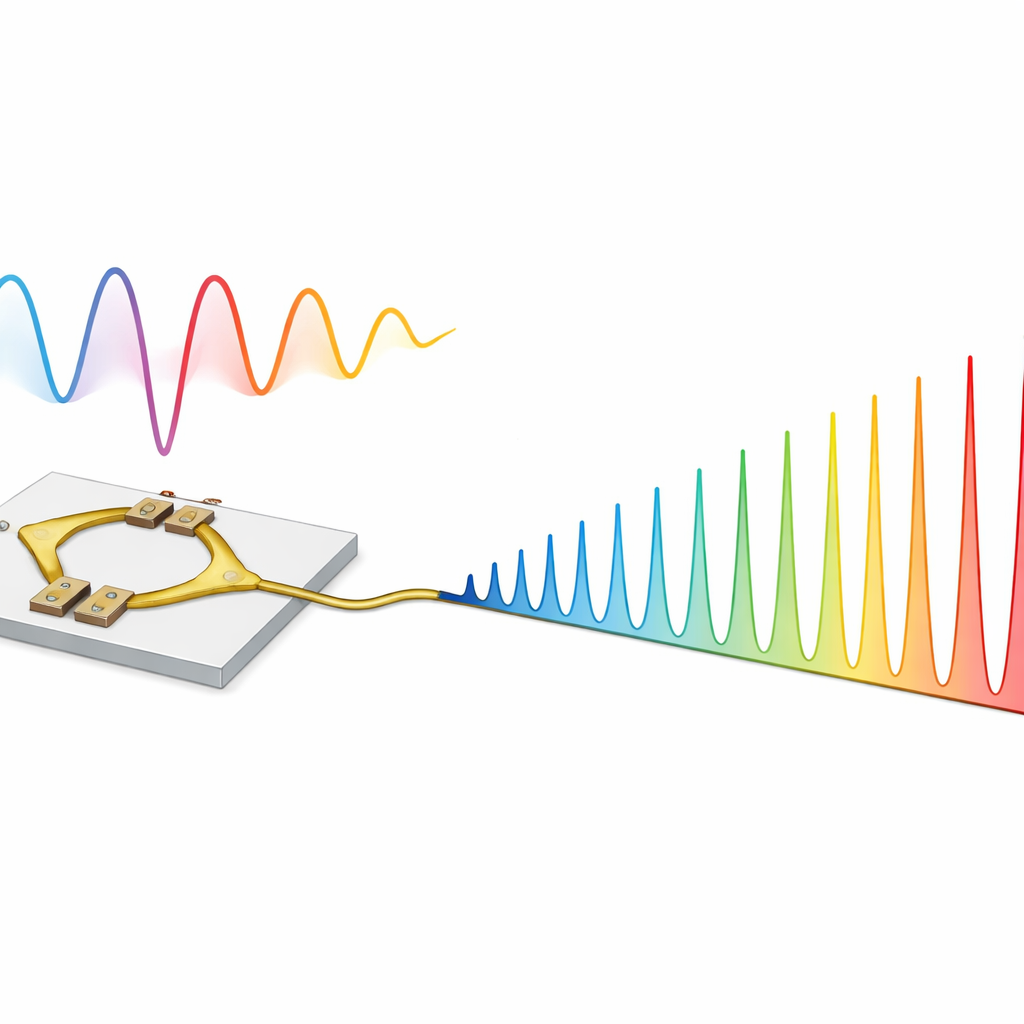
The authors realize such a comb generator using a device called a dc Superconducting Quantum Interference Device, or SQUID, fabricated from aluminum on a chip. The SQUID is essentially a small superconducting loop interrupted by two Josephson tunnel junctions. A nearby on-chip line sends an oscillating magnetic flux through the loop while a transmission line carries the electrical signal away. When the static flux bias is tuned near half of a magnetic flux quantum and a sinusoidal magnetic drive is applied, the quantum phase across the SQUID evolves in time. Because of the Josephson effect, this changing phase produces a train of sharp voltage pulses of alternating sign, which travel into the microwave circuitry.
From Pulses in Time to a Comb in Frequency
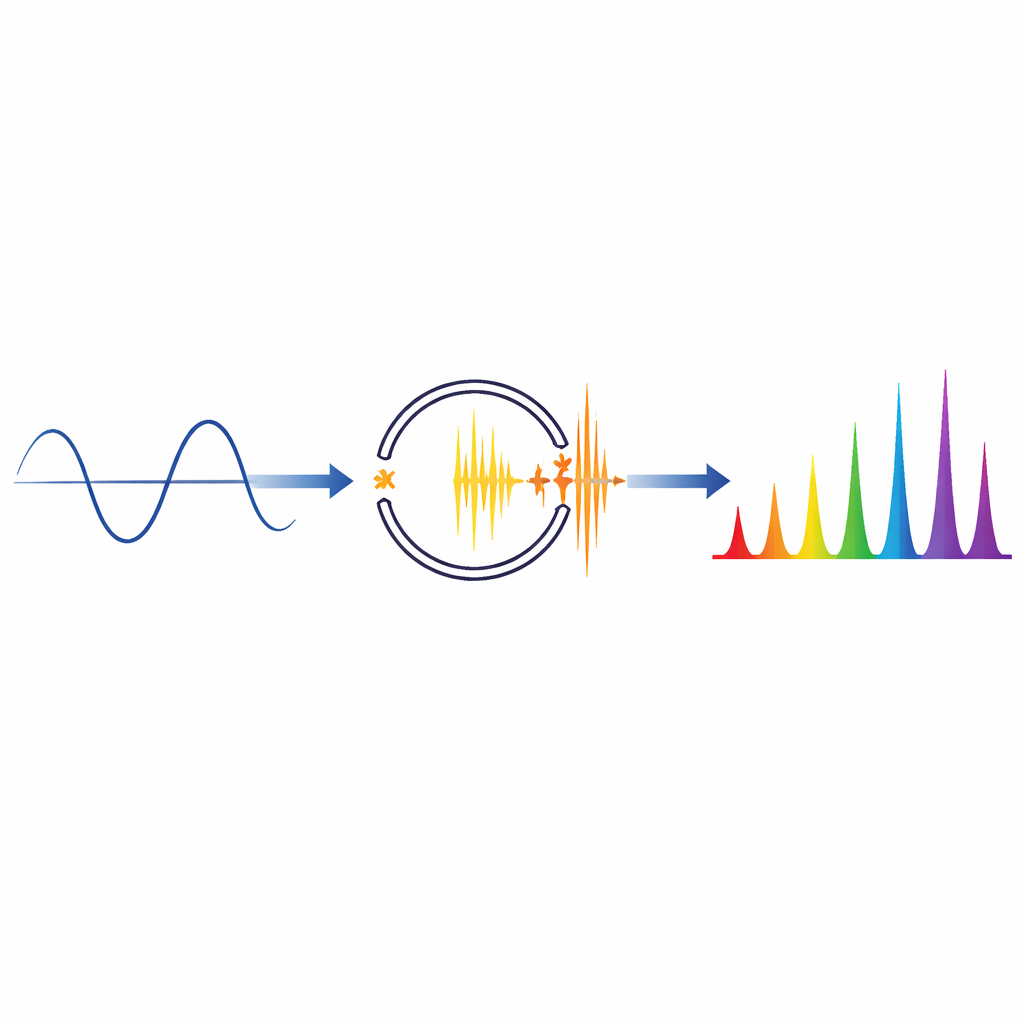
Any repeating pattern in time translates, via Fourier analysis, into a set of evenly spaced tones in frequency. In this device, the repetition rate of the voltage pulses is set directly by the drive frequency, and the sharpness of each pulse determines how many harmonics appear. The team measures the emitted spectrum in the 4–8 gigahertz C-band and observes dozens of narrow, regularly spaced lines at integer multiples of the drive frequency, up to at least the 46th mode. Importantly, no resonant cavity is used: the comb spacing is simply the pump frequency, which can in principle be swept from gigahertz into the terahertz range. The spectrum also has no extra frequency offset, simplifying how it can be linked to reference clocks.
Coherence, Control, and Gentle Power Use
To qualify as a true frequency comb, the lines must not only be equally spaced but also maintain stable relative phases. The researchers probe individual harmonics with high-resolution spectrum analyzers and a heterodyne setup that records both in-phase and quadrature components. They find extremely narrow linewidths, limited by the measurement instrument to about a third of a hertz, implying coherence times of several seconds. By inserting a controllable phase shifter in the drive line, they show that changing the phase of the pump rotates the phases of the comb lines in proportion to their order, confirming a fixed, tunable phase relationship across modes. Circuit simulations agree closely with the measured dependence of harmonic power on magnetic flux and drive strength. Thanks to the superconducting nature of the device, the energy dissipated per pulse is minuscule, leading to total power levels around 10⁻¹⁸ watts at typical operating conditions—negligible compared with the cooling power of modern dilution refrigerators and far below that of cryogenic CMOS electronics.
Toward Chip-Scale Tools for Quantum Technology
By demonstrating a coherent, tunable microwave frequency comb from a micrometer-scale SQUID, this work opens a route to integrating precision frequency tools directly alongside quantum processors and sensors. The absence of a cavity, the extremely low dissipation, and the small footprint make the design attractive for scalable cryogenic electronics, such as multiplexed qubit control, frequency-comb spectroscopy of on-chip devices, and multi-qubit entangling operations. Future designs that adjust SQUID symmetry or geometry could boost output power and extend the accessible frequency range, bringing compact, solid-state frequency combs closer to practical deployment in quantum technologies.
Citation: Greco, A., Ballu, X., Giazotto, F. et al. Coherent microwave comb generation via the Josephson effect. Nat Commun 17, 2972 (2026). https://doi.org/10.1038/s41467-026-69652-1
Keywords: frequency combs, superconducting circuits, Josephson effect, microwave quantum technology, SQUID devices