Clear Sky Science · en
Enhanced superconductivity and mixed-dimensional behaviour in infinite-layer samarium nickelate thin films
Why shrinking crystals matter
Superconductors—materials that carry electricity with zero resistance—promise lossless power grids, superfast electronics and powerful magnets. Most known superconductors only work at frigid temperatures, and scientists still do not fully understand why some compounds perform better than others. This article explores a new member of a hot research family: nickel-based superconductors that resemble the famous copper-oxide (cuprate) materials. The authors show that carefully squeezing the crystal structure of samarium nickelate thin films can boost their superconducting temperature and even change how electrons move through the material.
Building new ultrathin superconductors
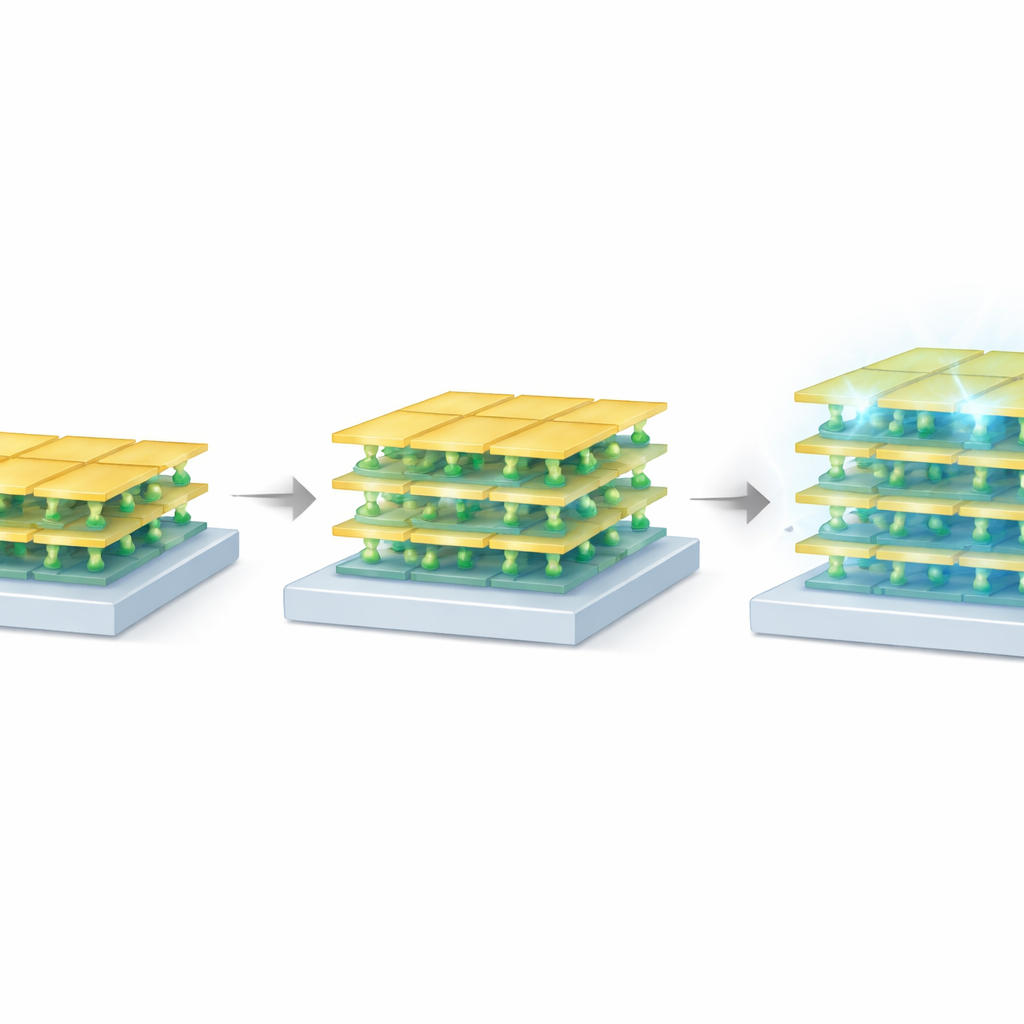
The researchers focus on “infinite-layer” nickelates, a class of compounds where nickel and oxygen form flat, repeating sheets separated by rare-earth atoms such as samarium, europium, calcium and strontium. These materials are challenging to make, especially when using smaller rare-earth elements. The team grew ultrathin films, only about 9 nanometers thick, on specially chosen LSAT crystal substrates using pulsed laser deposition, then converted them into the superconducting infinite-layer form using a controlled chemical reduction step. They achieved phase-pure samarium-based nickelates, including Sm1−xSrxNiO2, which had not previously been demonstrated as a superconductor.
How crystal spacing boosts superconductivity
By mixing samarium with different amounts of strontium, calcium and europium, the team could subtly change the average size of the rare-earth ions and, in turn, the spacing between the nickel–oxygen sheets along the crystal’s vertical (c-axis) direction. X-ray diffraction and atomic-resolution electron microscopy confirmed that the films were structurally clean and that the c-axis spacing could be pushed as low as about 3.26 ångströms—among the smallest values reported for this family. Transport measurements showed that these compressed structures reached superconducting transition temperatures up to 32.5 kelvins, higher than many earlier nickelate films. When the authors compared their results with data from lanthanum-, praseodymium- and neodymium-based nickelates, a broad trend emerged: as the c-axis distance shrinks across the family, the superconducting temperature tends to rise.
Electrons in between two and three dimensions
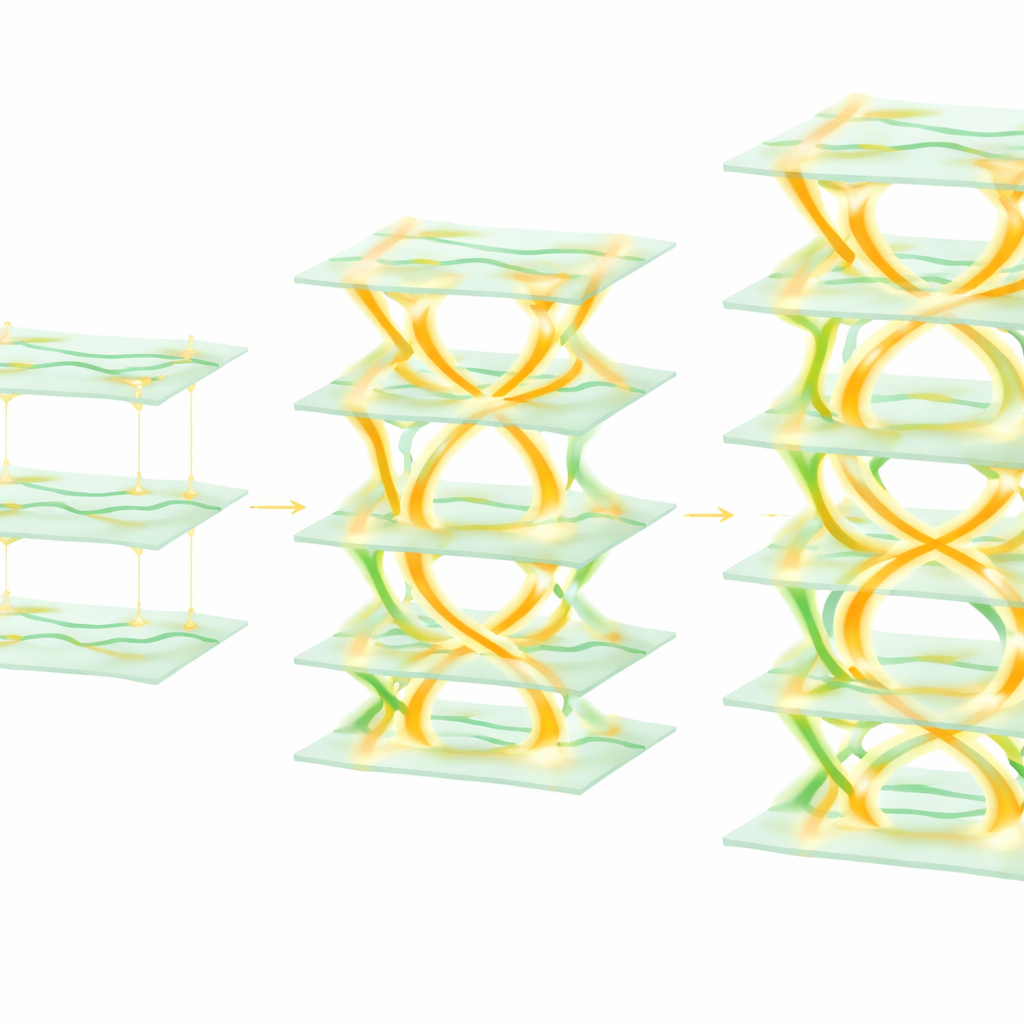
Superconductivity in layered materials is often thought of as essentially two-dimensional, with electrons mainly gliding within the flat sheets. However, the story here is more nuanced. The authors applied strong magnetic fields, rotated at different angles relative to the films, and tracked how superconductivity disappeared. The results fit neither a purely two-dimensional nor a purely three-dimensional model. Instead, the data reveal a mixed “2D/3D” behavior: electrons remain highly mobile within the planes but also form significant connections between them. As the amount of europium in the films increases, the response to magnetic fields signals a stronger three-dimensional component, suggesting that interlayer coupling is being enhanced.
Magnetism, orbital mixing and unusual field effects
Europium brings more than just smaller ionic size—it also carries strong local magnetic moments. In the europium-containing samples, the researchers observed a striking negative magnetoresistance: applying a magnetic field actually reduced the electrical resistance just above the superconducting transition, even though such fields typically weaken superconductivity. This behavior is consistent with magnetic moments in the rare-earth layer scattering conduction electrons less once a field aligns them. Resonant inelastic X-ray scattering experiments further showed strengthened mixing between nickel 3d orbitals and rare-earth 5d orbitals, especially those pointing out of the planes. This enhanced orbital hybridization offers a microscopic picture for how shrinking the lattice and choosing specific rare-earth ions can tighten the electronic links between layers.
Design rules for better superconductors
Putting these results together, the study points to clear design principles for future nickelate superconductors. Using smaller rare-earth ions to reduce the spacing between nickel–oxygen planes tends to raise the superconducting temperature, likely by strengthening coupling between layers and between nickel and rare-earth orbitals. At the same time, magnetic ions such as europium can introduce novel field responses and push the system toward more three-dimensional superconductivity. For non-specialists, the key message is that by treating the crystal lattice as an adjustable scaffold—tuning its spacing, composition and magnetic character—researchers can systematically push nickelate materials toward higher-temperature and more exotic forms of superconductivity.
Citation: Yang, M., Wang, H., Tang, J. et al. Enhanced superconductivity and mixed-dimensional behaviour in infinite-layer samarium nickelate thin films. Nat Commun 17, 2761 (2026). https://doi.org/10.1038/s41467-026-69650-3
Keywords: nickelate superconductors, thin film materials, crystal lattice tuning, high temperature superconductivity, quantum materials