Clear Sky Science · en
Strongly coupled interface ferroelectricity and interface superconductivity in amorphous LaAlO3/KTaO3(111)
Electric switches that work without staying plugged in
Imagine an electrical switch that does not need a constant power supply to remember whether it is on or off, and that can also control a superconductor—materials that carry electricity with zero resistance. This paper reports just such a possibility at the hidden boundary between two insulating oxides, where an unusual electric order and superconductivity coexist and strongly influence one another. Understanding and harnessing this behavior could lead to ultra‑efficient, non‑volatile electronic components and new kinds of quantum devices.
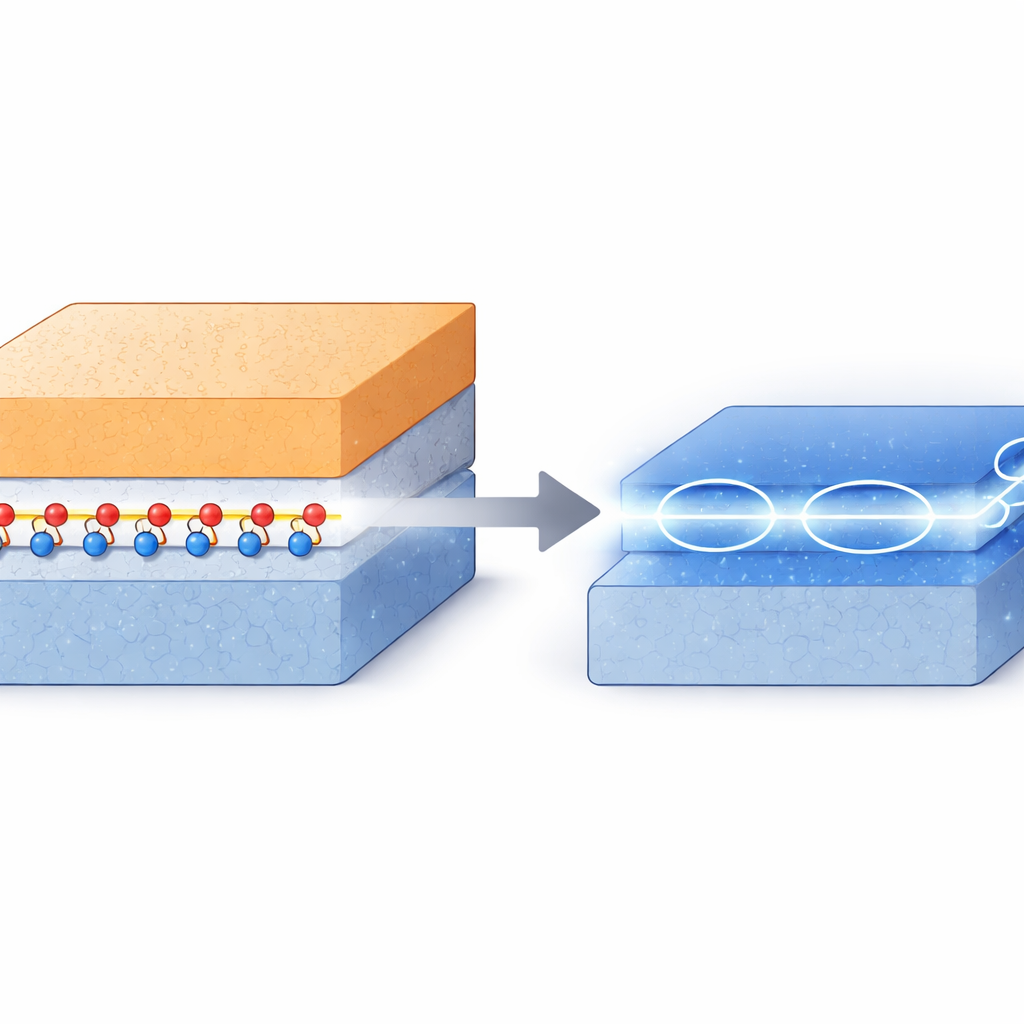
A special boundary between two quiet materials
The researchers study a thin, glass‑like layer of lanthanum aluminate laid on top of a crystal of potassium tantalate, cut along a particular surface direction. On their own, both materials act as electrical insulators, but at the razor‑thin interface where they meet, something remarkable happens: a sheet of mobile electrons forms, only a few billionths of a meter thick, that can become superconducting at very low temperatures. The team asks an even deeper question—can this conducting sheet also host a built‑in electric polarization, meaning that positive and negative charges are slightly shifted relative to each other in a way that can be flipped like a tiny switch?
Hidden atomic shifts and missing atoms
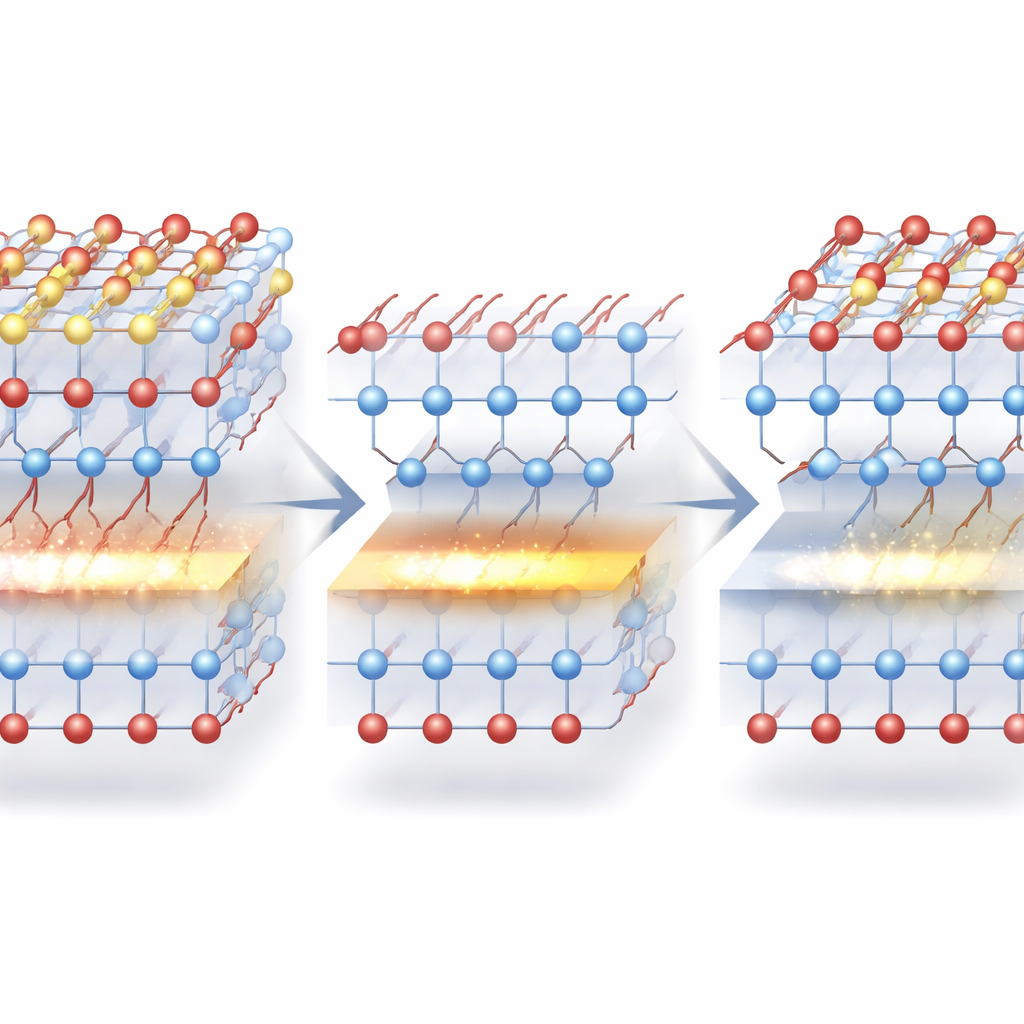
Using advanced electron microscopy that can see individual atoms, the authors find that potassium atoms near the interface are noticeably displaced from their usual positions within the crystal lattice. At the same time, some oxygen atoms are missing in the same region, forming vacancies that help stabilize this displacement. Together, these shifts create a net electric polarization lying largely in the plane of the interface. The effect is strongest within just a few atomic layers and fades away deeper inside the crystal, showing that the electric order is tightly confined to the boundary where the two materials touch.
Light and nanoscale probes reveal a flip‑able electric state
To test whether this polarization is truly ferroelectric—meaning it can be reversed by an applied voltage and remain stable—the team combines optical and mechanical probing techniques. By shining an infrared laser on the sample and detecting light at exactly twice the incoming frequency, they observe a strong signal that persists from cryogenic temperatures up to room temperature, indicating a broken symmetry associated with electric polarization. Separately, they use a sharp conductive tip to apply small voltages while sensing tiny vibrations of the surface. This method reveals characteristic hysteresis loops and allows the researchers to write and erase square‑shaped domains where the polarization direction has been flipped. These written patterns remain for many hours, far outlasting any simple charging effects, confirming robust, switchable ferroelectric order at the interface.
One order tames another: controlling superconductivity
The most striking discovery emerges when the team writes ferroelectric patterns directly within a device used to measure electrical resistance. As they sweep the tip voltage to drive the polarization through a full switching cycle, the resistance of the interface changes dramatically—by more than a factor of one hundred thousand between opposite polarization states. At low temperatures, this change is even more dramatic: in one polarization orientation the interface becomes superconducting, while in the opposite orientation the superconductivity essentially disappears, only to reappear when the polarization is switched back. These changes are non‑volatile: once written, the new state remains even after the writing voltage is removed and the sample is cooled down separately.
How the boundary reshapes the flow of electrons
The authors explain this coupling by considering how electric polarization, atomic disorder, and oxygen vacancies work together to shape the energy landscape at the interface. When polarization points one way, it effectively deepens the potential well that holds the sheet of electrons, increasing their density and allowing them to move freely enough to form a superconducting state. Flipping the polarization partially empties or reshapes this well, scattering electrons more strongly and redistributing vacancies, which together reduce conductivity and suppress superconductivity. Because this reconfiguration does not require a continuous external field, the interface acts like a built‑in, rewritable control knob for quantum behavior.
Why this matters for future technologies
By showing that ferroelectricity and superconductivity can coexist and strongly interact at an engineered oxide boundary, this work opens a path toward devices where superconducting properties are turned on and off with non‑volatile electric switches. Such structures could serve as building blocks for ultra‑low‑power memory, reconfigurable quantum circuits, or new platforms to explore exotic superconducting states that arise when inversion symmetry is broken. In short, the quiet interface between two insulating crystals becomes a powerful arena where electric order and perfect conduction are woven together in a controllable way.
Citation: Dong, M.D., Cheng, X.B., Zhang, M. et al. Strongly coupled interface ferroelectricity and interface superconductivity in amorphous LaAlO3/KTaO3(111). Nat Commun 17, 2805 (2026). https://doi.org/10.1038/s41467-026-69641-4
Keywords: ferroelectricity, superconductivity, oxide interfaces, two-dimensional electron gas, quantum materials