Clear Sky Science · en
PAN2 maintains mRNA poly(A) tail homeostasis and regulates translation during spermiogenesis in mice
Why this study matters for male fertility
Many couples struggle with infertility, and in a large share of cases the underlying problem lies in how sperm cells are made. This study uncovers a crucial molecular “timing and quality-control” system inside developing sperm in mice. The researchers show that when this system fails, sperm cells stall midway through their transformation and males become completely infertile. Understanding this hidden layer of control may point toward new explanations for unexplained male infertility and, in the long run, new diagnostic or therapeutic ideas.
How cells decide when messages are used
Our cells rely on messenger RNA (mRNA) molecules, which act as temporary copies of genes and carry instructions for building proteins. Each mRNA ends in a tail made of many adenine building blocks, known as a poly(A) tail. These tails are not just decorations: their length helps determine how long a message survives and how actively it is translated into protein. Enzymes can either extend or trim these tails, keeping them within a healthy range. One such enzyme complex, PAN2–PAN3, performs the early trimming step, but until now its real-life role in mammals was poorly understood.
A key trimming enzyme for sperm development
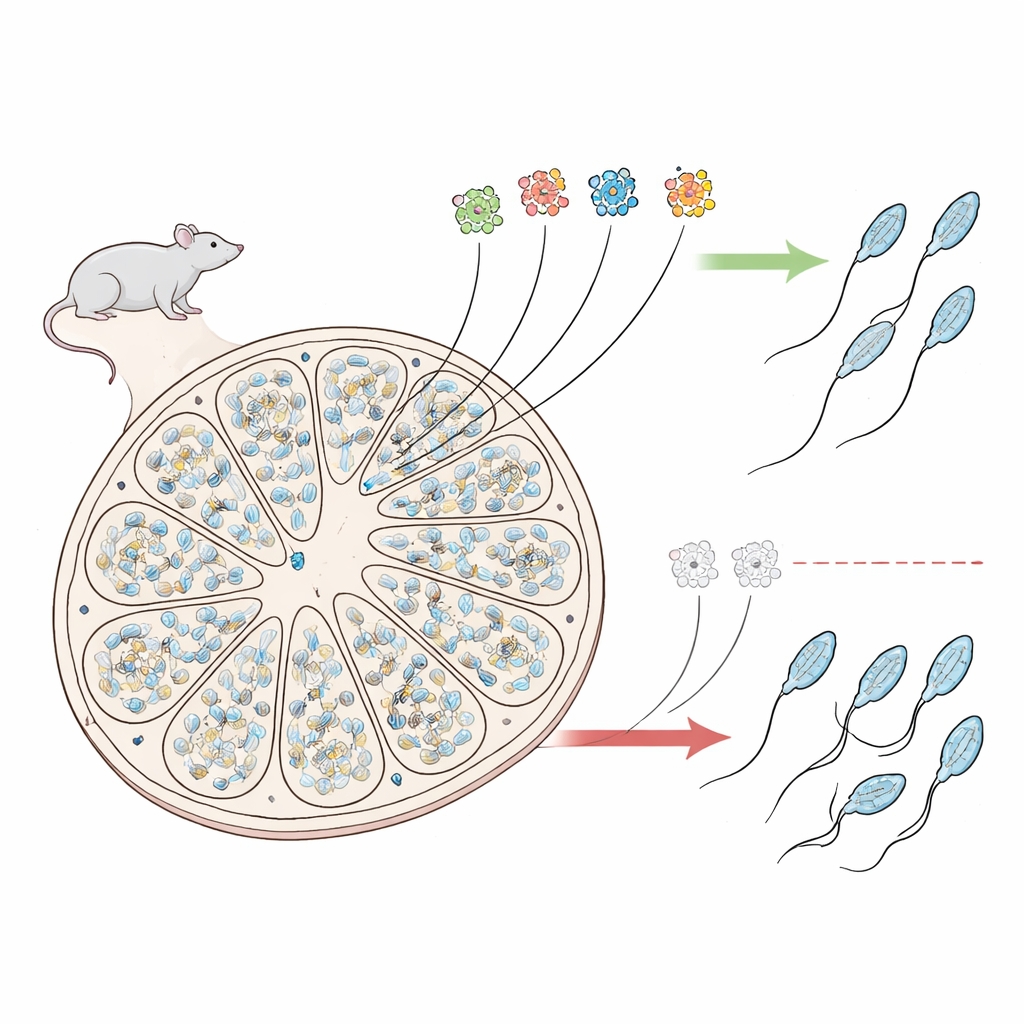
The authors focused on PAN2, the catalytic part of the PAN2–PAN3 complex, and asked what happens if it is removed specifically from male germ cells in mice. They engineered mice in which the Pan2 gene is switched off only in cells destined to become sperm. These males produced much smaller testes and no mature sperm in the epididymis, and they were completely infertile. Microscopic analysis revealed that early stages of sperm development, including the specialized meiotic divisions, proceeded normally. The trouble began later, when round spermatids should elongate and reshape into streamlined sperm: in the absence of PAN2, development stalled around step 8–9 of this process, and many germ cells underwent programmed cell death.
When tail lengths go out of balance
To understand what PAN2 does at the molecular level, the team used an advanced sequencing method (PAIso‑seq2) that reads both mRNA sequences and the exact lengths of their poly(A) tails. In normal mice, mRNA tails change in a tightly choreographed way as cells move from late meiotic stages to round spermatids, with a controlled increase in long-tailed messages. In PAN2‑deficient cells, this pattern collapsed. Many mRNAs acquired abnormally long tails, while others became unexpectedly short, indicating that overall tail “homeostasis” was lost. Importantly, these tail changes occurred without large shifts in the amounts of the underlying mRNAs, meaning the problem was not which messages existed, but how they were post‑processed and used.
Broken link between messages and proteins
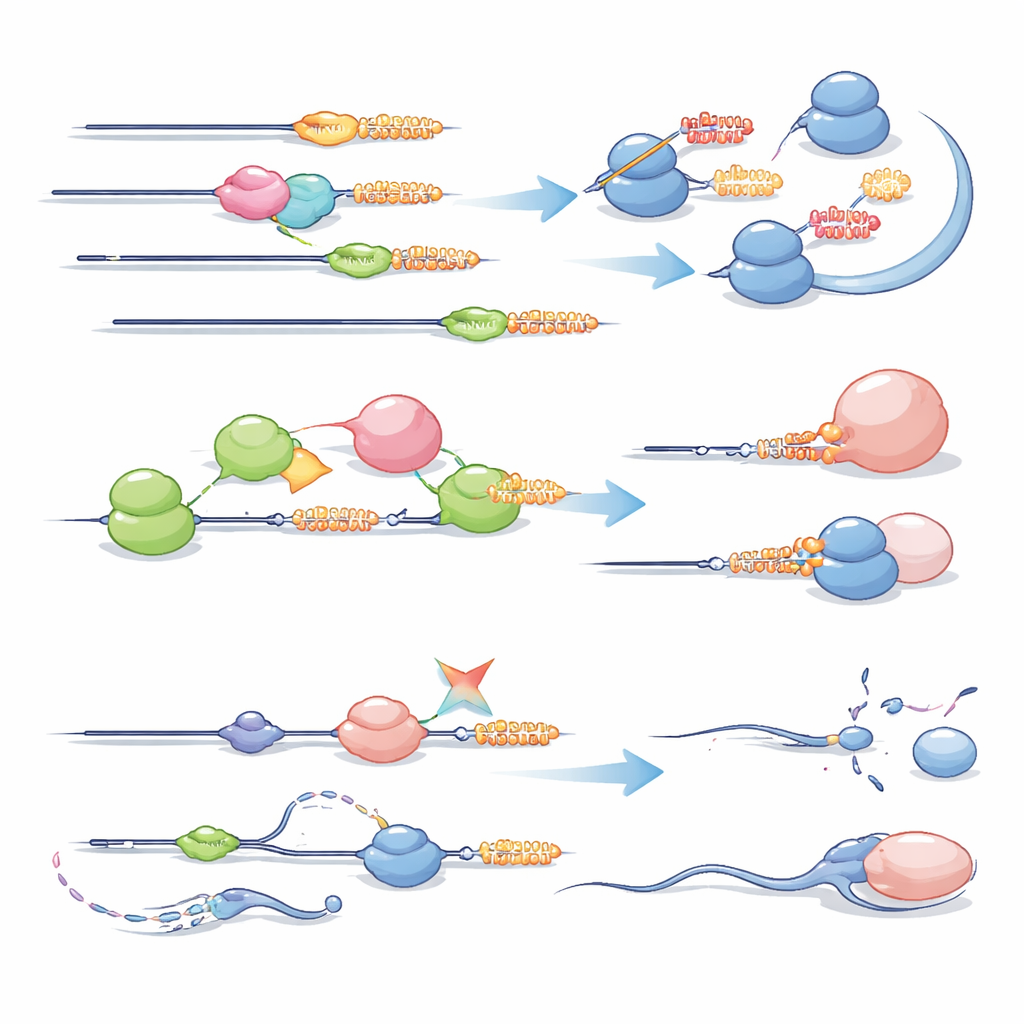
Because spermatids stop making new mRNAs and must instead translate stored ones, any disruption in how those messages are used can be devastating. Using mass spectrometry and a highly sensitive ribosome profiling method, the researchers showed that thousands of proteins were reduced in PAN2‑deficient round spermatids, and global translation efficiency dropped. Many missing proteins support structures such as the sperm tail, chromatin packing, and cell shape. The study further found that PAN2 physically associates with PABPC1, a protein that binds poly(A) tails and helps recruit the translation machinery, as well as with several translation initiation factors. When PAN2 was lost, the levels of these initiation factors fell, even though their mRNA levels and translation rates were largely unchanged, suggesting that PAN2 also helps stabilize parts of the protein‑making apparatus itself.
A new layer of control in sperm formation
Put simply, this work shows that PAN2 acts as a caretaker of mRNA tail length in developing sperm, ensuring that messages carry tails that are “just right” for efficient protein production during a critical window when transcription is shut off. Without PAN2, tail lengths become chaotic, key messages are no longer translated properly, many proteins vanish, and round spermatids cannot complete their transformation into mature sperm. Although the experiments were done in mice, the underlying mechanisms are shared across mammals, suggesting that subtle defects in similar tail‑trimming systems could contribute to human male infertility and might one day be targeted for diagnosis or intervention.
Citation: Wu, X., Wu, YK., Jia, MY. et al. PAN2 maintains mRNA poly(A) tail homeostasis and regulates translation during spermiogenesis in mice. Nat Commun 17, 2925 (2026). https://doi.org/10.1038/s41467-026-69639-y
Keywords: male infertility, spermatogenesis, mRNA regulation, poly(A) tail, translation control