Clear Sky Science · en
A unified symmetry framework for spin–ferroelectric coupling in altermagnetic multiferroics
Turning Electricity into a Spin Control Knob
Modern electronics moves charges around; spintronics aims to move and store information using the tiny magnetic moment, or spin, of electrons. A long-standing dream is to steer these spins simply with voltage, enabling memory and logic that consume far less power than today’s chips. This paper shows how a subtle property of crystals—symmetry—can be used as a design rule to connect electric polarization and electron spins in an emerging class of materials called altermagnetic multiferroics, opening a route to voltage-programmable spin-based devices.
Materials with Two Switches in One
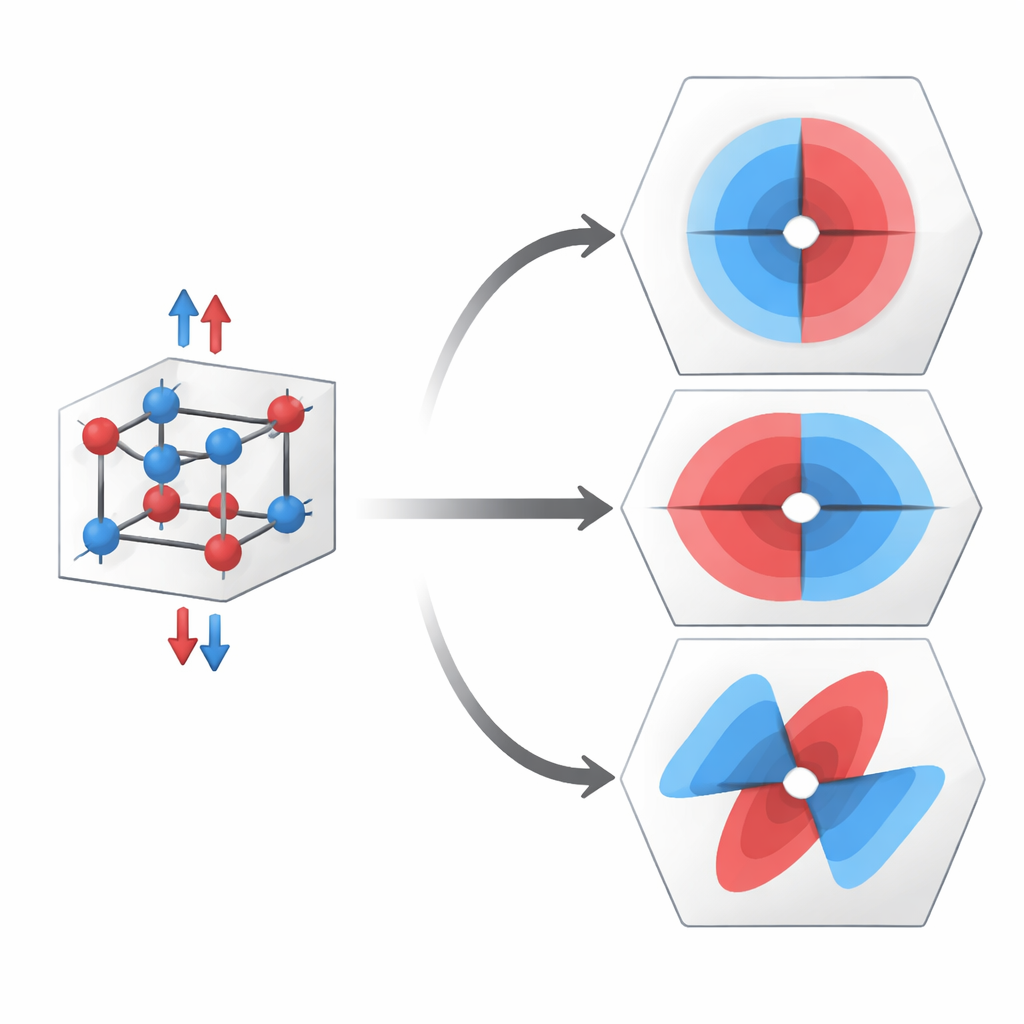
Multiferroic materials host at least two kinds of order at once, typically electric polarization and magnetism. In many known systems these orders barely talk to each other, so changing the electric state has only a weak effect on magnetism. Altermagnetic multiferroics are different. Their crystal lattice contains two sets of atoms whose spins point in opposite directions, arranged so that certain rotations or mirror operations swap one spin sublattice with the other. This special arrangement produces spin-split electronic bands even though the overall magnetization cancels out. At the same time, the material can carry a built-in electric polarization that can be flipped with an applied voltage. The key question the authors tackle is: when does flipping this polarization actually reshuffle the spin-resolved electronic structure, and when does it leave it essentially untouched?
Three Basic Ways Spins Can Respond
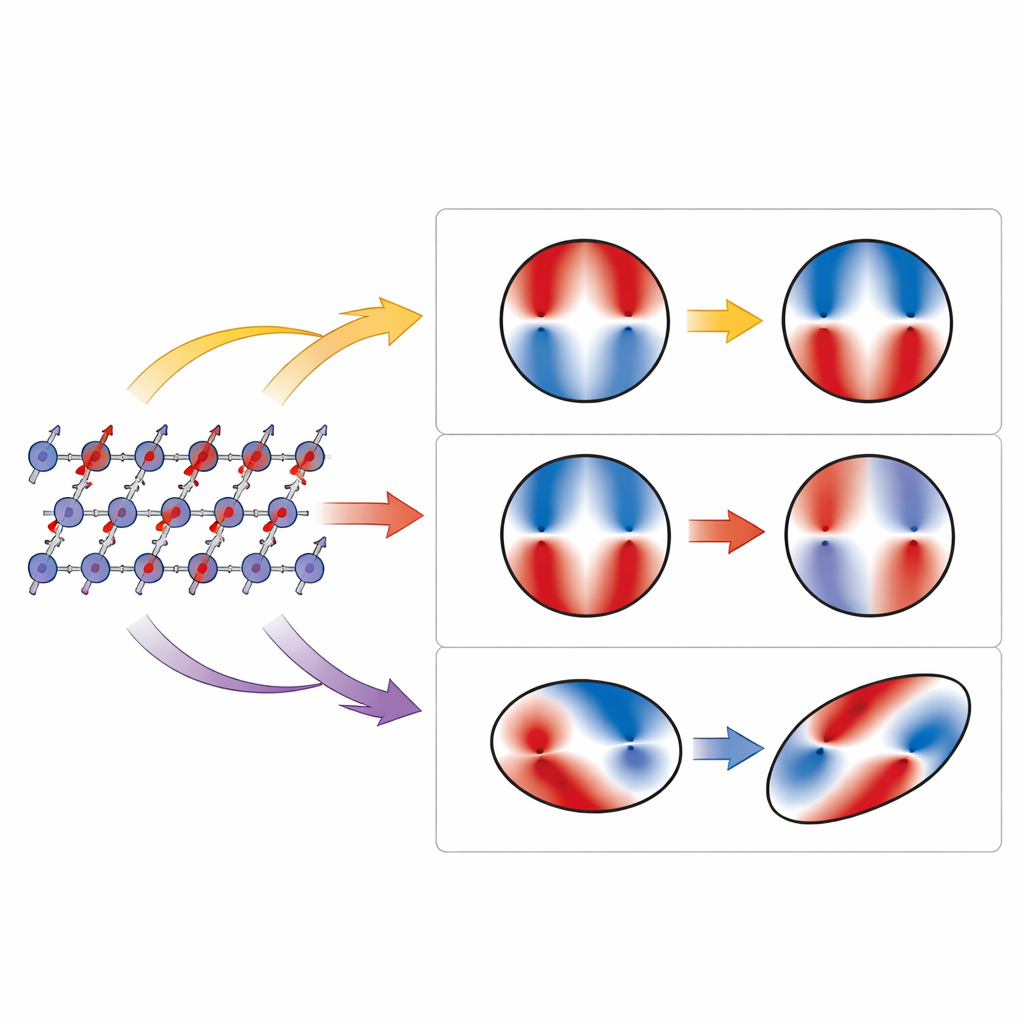
The authors develop a symmetry-based classification that reduces the complicated mathematics of crystal operations to three intuitive scenarios. They examine how the operation that reverses electric polarization relates to the material’s “spin symmetry group,” which encodes how spin-up and spin-down states transform in momentum space. If the polarization switch belongs to a subgroup that leaves each spin sublattice unchanged, the spin-split bands are identical before and after switching—this is Type I, a decoupled case with no spectral fingerprint. If the switch behaves like a rotation or mirror that exchanges the two spin sublattices, the entire spin spectrum is effectively flipped—spin-up where spin-down used to be and vice versa. This strong, global response is Type II, which the authors liken to a pseudo time-reversal or pseudo spin-flip. Finally, if the switch does not match any symmetry that preserves or swaps the sublattices, it simply drags the spin texture to new positions in momentum space, distorting it in a direction-dependent way. This momentum-remapping behavior defines Type III coupling.
A Test Case in an Ultrathin Crystal
To show that this framework is more than abstract algebra, the team turns to a two-layer crystal of MnPS3, a material where electric polarization arises from sliding one atomic sheet relative to the other. Because the top layer can move along several distinct trajectories, the same material supports multiple polarization switching paths, each tied to a different symmetry operation. Using first-principles electronic-structure calculations, the authors track how these paths reshape the spin-split bands. One path behaves as a decoupled Type I case: the spin pattern in momentum space is unchanged when the polarization reverses. A second path yields Type II behavior, with a nearly perfect flip of spin-up and spin-down features across the Brillouin zone. A third produces a rotated and anisotropic spin texture characteristic of Type III. These differences are not just visible in band plots; when the authors compute spin-resolved electrical conductivity, each coupling type leaves a distinct signature in transverse spin currents.
Extending the Rules to a Classic 3D Material
The study then examines BiFeO3, a well-known three-dimensional multiferroic used as a benchmark system. Here, electric polarization is tied to shifts of heavy ions and rotations of oxygen octahedra. The authors show that if polarization reversal proceeds through a path equivalent to simple inversion of the structure, the spin-split bands do not change, fitting Type I behavior. But if the reversal is accompanied by a specific two-fold rotation, the roles of the opposite spin channels are exchanged, matching Type II coupling. This example demonstrates that the same symmetry rules apply beyond atomically thin crystals and that the decisive factor for spin control is not just the presence of polarization but the precise symmetry of the switching pathway.
From Abstract Symmetry to Practical Devices
By distilling the complex interplay between lattice geometry, electric polarization, and spins into three symmetry-determined types of response, the authors provide a clear map for engineers seeking voltage-controlled spintronic devices. Instead of relying on heavy elements and relativistic spin–orbit effects, designers can focus on how ferroelectric switching operations sit inside a material’s symmetry group to predict whether spins will ignore, flip, or be reshaped by an applied voltage. In this way, ferroelectric symmetry ceases to be a static structural label and becomes a tunable control knob, guiding the search for low-power, nonvolatile memory and logic technologies built on altermagnetic multiferroics.
Citation: Sun, W., Wang, W., Yang, C. et al. A unified symmetry framework for spin–ferroelectric coupling in altermagnetic multiferroics. Nat Commun 17, 3101 (2026). https://doi.org/10.1038/s41467-026-69635-2
Keywords: altermagnetism, multiferroics, spintronics, ferroelectric switching, magnetoelectric coupling