Clear Sky Science · en
Vulnerability of short-term memory in a mouse model of Alzheimer’s disease
Why this memory study matters
Short-term memory lets us hold information in mind for just a few seconds—long enough to remember a phone digit we just heard or to finish a sentence we started. In Alzheimer’s disease, this fragile form of memory is often one of the first things to falter. This study uses a refined mouse model of Alzheimer’s disease to ask a simple but important question: why does short-term memory in a diseased brain crumble so easily when the world gets noisy and distracting?
How the brain juggles brief memories
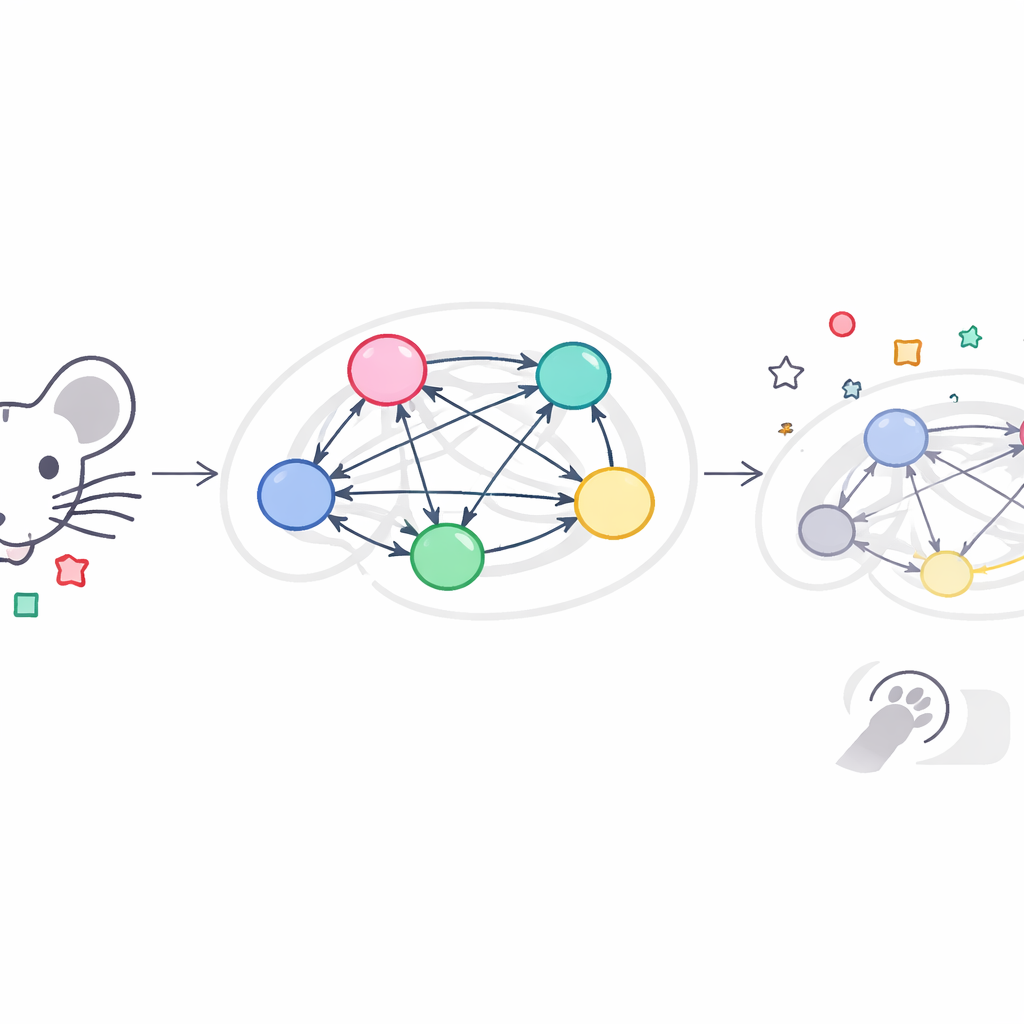
To explore this, researchers trained mice to perform a delayed-response task that mimics everyday mental juggling. A brief touch to the whiskers signaled whether a reward would later appear on the left or right. The mice then had to wait several seconds before licking in the correct direction. During this waiting period, their brains had to keep the side of the touch “online” as a short-term memory to guide the upcoming action. Using a powerful two-photon microscope, the team recorded activity from thousands of individual nerve cells spread across eight areas on the top of the brain that help turn sensations into movements.
When distractions reveal hidden weakness
At first glance, mice carrying Alzheimer-linked gene changes (APP-KI mice) performed the task about as well as healthy mice. The difference emerged when the scientists made the task more realistic by adding brief distracting touches during the waiting period. Healthy mice became only mildly less accurate. In contrast, the APP-KI mice were thrown off much more strongly, especially when distractions arrived late in the delay. Zooming in on the brain activity showed why: in healthy mice, many neurons kept a clear preference for “left” or “right” throughout the delay, even with distractions. In APP-KI mice, this selectivity faded more easily, particularly in regions that help link sensation to decision, such as the posterior parietal and frontal motor areas.
Networks that fall apart under pressure
The team then asked how groups of neurons across the cortex work together as a network. Using advanced mathematical tools, they compressed the complex activity patterns into simpler “trajectories” that trace how the brain’s internal state moves during each trial. In healthy mice, these trajectories for left and right choices stayed well separated, even when distractors were present. In APP-KI mice, the trajectories were more easily nudged toward the wrong side by extra sensory input. Further analyses showed that, compared with controls, APP-KI brains had weaker functional links both within an area and between areas. Computer models trained to mimic the recorded activity confirmed that reducing these connections made the decision-related states less stable, so that small perturbations could flip the network from the “left” to the “right” choice pattern.
Loss of backup routes in space and time
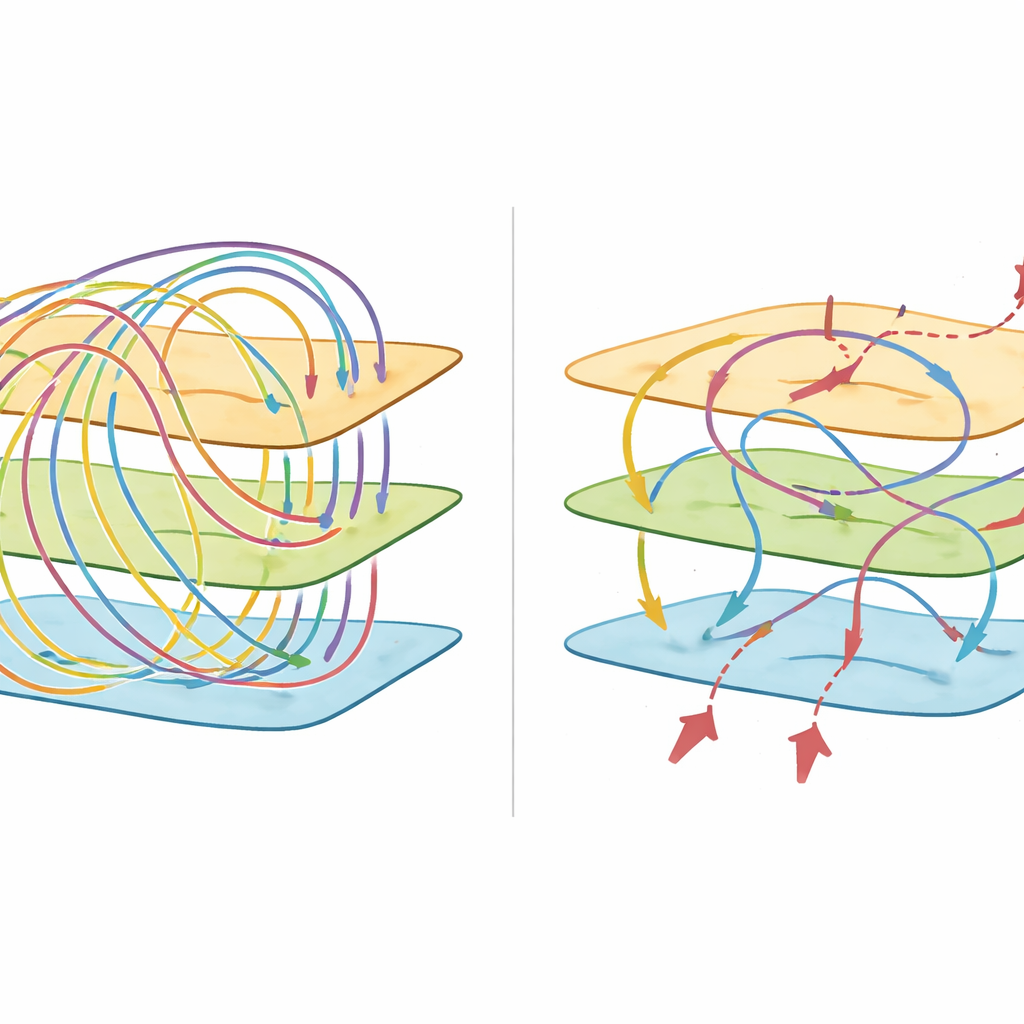
A key insight from this work is that healthy brains do not rely on just one precise route to move information from one area to another. Instead, multiple partially overlapping pathways can carry essentially the same message, both across different brain regions and at different time points during the delay. This property, called degeneracy, acts as a built-in backup system: if one route is disturbed, another can still deliver the needed information. By carefully examining how activity in one region predicted activity in others, the researchers found that APP-KI mice had fewer of these shared pathways. Signals from a given source region were less likely to drive similar patterns in multiple targets, and activity patterns changed more abruptly over time. In effect, the diseased networks were leaner and more brittle, with fewer ways to reroute information when distractions hit.
What this means for understanding Alzheimer’s
For a layperson, the takeaway is that early memory problems in Alzheimer’s may stem less from an inability to form short-term memories at all, and more from a loss of the brain’s safety nets. In the APP-KI mice, the basic circuits for holding a brief memory still work under ideal, quiet conditions. But the fine web of connections that normally stabilizes these circuits and provides alternate routes—across space and through time—has thinned out. As a result, everyday distractions more easily derail the flow of information needed to guide behavior. This study links microscopic changes in connectivity to a very human complaint: the feeling that, in a noisy world, it is suddenly much harder to keep a thought in mind.
Citation: Li, C., Chia, X.W., Xu, G. et al. Vulnerability of short-term memory in a mouse model of Alzheimer’s disease. Nat Commun 17, 2927 (2026). https://doi.org/10.1038/s41467-026-69619-2
Keywords: Alzheimer’s disease, short-term memory, neural connectivity, cortical networks, distractor vulnerability