Clear Sky Science · en
Valence-tuned electron bridge enables high-yield multi-electron HMF oxidation over spinel catalysts
Turning Plants into Everyday Products
Modern life runs on plastics, most of which are made from oil. Scientists are keen to replace these fossil-based materials with plastics made from plants, which could cut carbon emissions and reduce reliance on petroleum. This article explores a new way to turn a plant‑derived molecule called HMF into FDCA, a key ingredient for making a promising bio‑plastic known as PEF. The challenge is that this chemical makeover demands a series of tightly choreographed electron movements, and until now those electrons have been frustratingly slow to move. The researchers describe how they redesigned a common oxide mineral so that electrons can race through it, dramatically boosting the yield of FDCA from biomass. 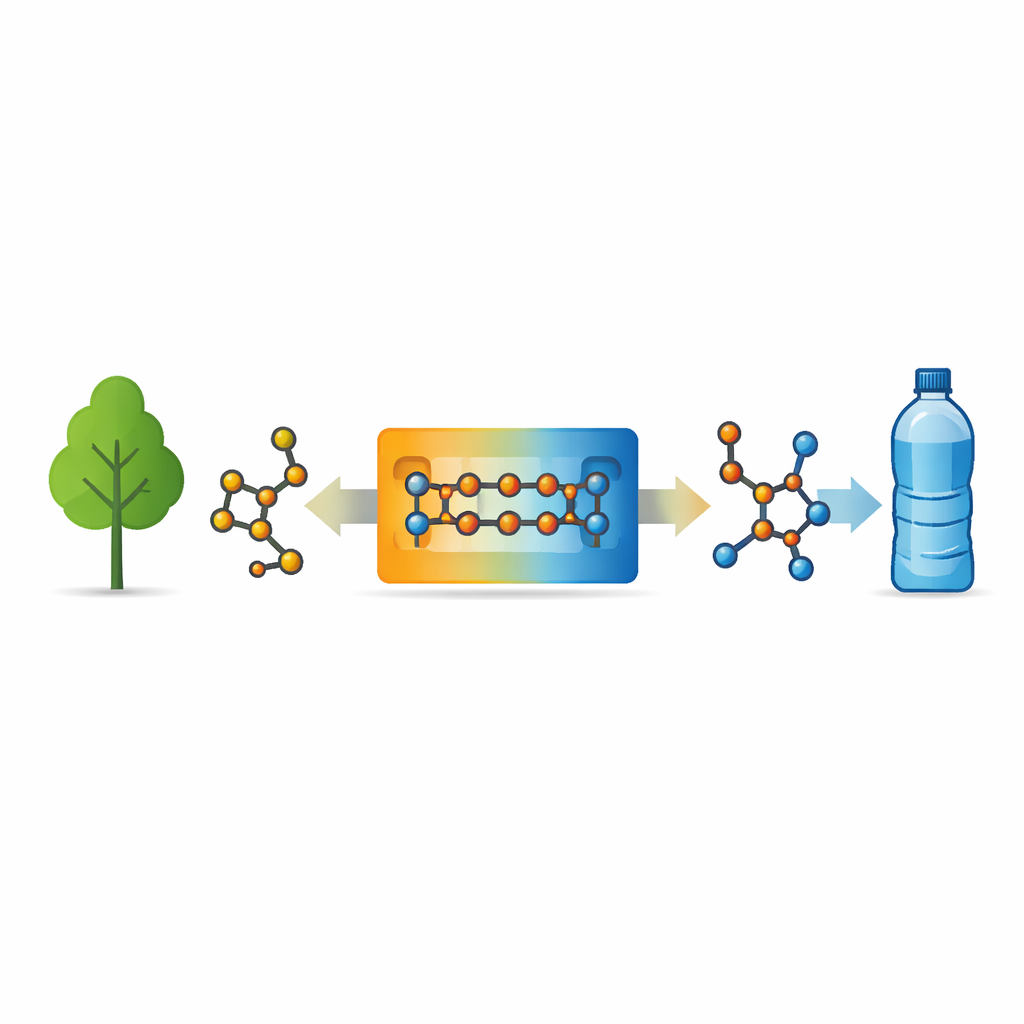
From Sugar-Like Molecule to Green Plastic
HMF can be made from sugars found in biomass such as wood or agricultural waste. If HMF is efficiently converted into FDCA, manufacturers can use it to produce PEF, a plastic that can, in principle, replace fossil‑based PET in bottles and packaging. The HMF‑to‑FDCA reaction is attractive because it links renewable carbon from plants with familiar everyday products. However, the chemistry is demanding: six electrons must be stripped away from HMF in a stepwise fashion, generating several short‑lived intermediates along the way. If electrons do not move quickly and cleanly through the catalyst, these intermediates build up, side reactions occur, and the final FDCA yield drops—a major roadblock for green plastics.
Why Electron Traffic Gets Stuck
To speed up this chemistry, scientists have turned to “spinel” oxides, a family of mixed metal materials known for their flexible redox behavior. In these materials, metals such as cobalt and manganese sit in two kinds of sites inside an oxygen framework. Earlier work showed that cobalt–manganese spinels can oxidize HMF, but it was not clear how the two metals cooperate, or how to tune their roles. In many conventional versions, manganese sits mostly in a form that distorts the crystal lattice, like a bent gear in a machine. This distortion disrupts the pathways through which electrons move, making multi‑electron reactions sluggish and limiting how far the reaction can proceed toward FDCA.
Designing a Better Electron Highway
The authors tackled this problem by deliberately adjusting how oxidized the manganese atoms are during synthesis. By carefully controlling the reaction in an ammonia‑rich solution, they converted much of the manganese into a more highly charged state and stabilized a symmetric, cubic version of the spinel. In this structure, chains of manganese, oxygen, and cobalt atoms line up to form what the team calls an electron bridge. Advanced microscopes, X‑ray techniques, and spectroscopy show that these bridges shorten and strengthen the metal–oxygen bonds and spread electrons more evenly across the structure. Quantum‑mechanical calculations reveal that the empty electron slots on manganese sit at just the right energy to accept electrons from HMF, then hand them off directionally to cobalt through the oxygen links.
How the New Catalyst Changes the Reaction
Using this valence‑tuned spinel, the researchers tested HMF oxidation in water under oxygen pressure. The redesigned material drove the reaction almost all the way to completion, achieving a FDCA yield of 98.1% within three hours and far outperforming both a less‑optimized spinel and single‑metal oxides. The improved catalyst not only pulled electrons more strongly from HMF, but also transported them across the surface with less resistance, lowering the energy barriers for breaking key C–H and O–H bonds in the reaction pathway. Computer simulations and kinetic measurements agreed that these bond‑breaking steps, especially the first hydrogen removal, become easier on the new electron bridge, explaining the faster and more selective formation of FDCA. 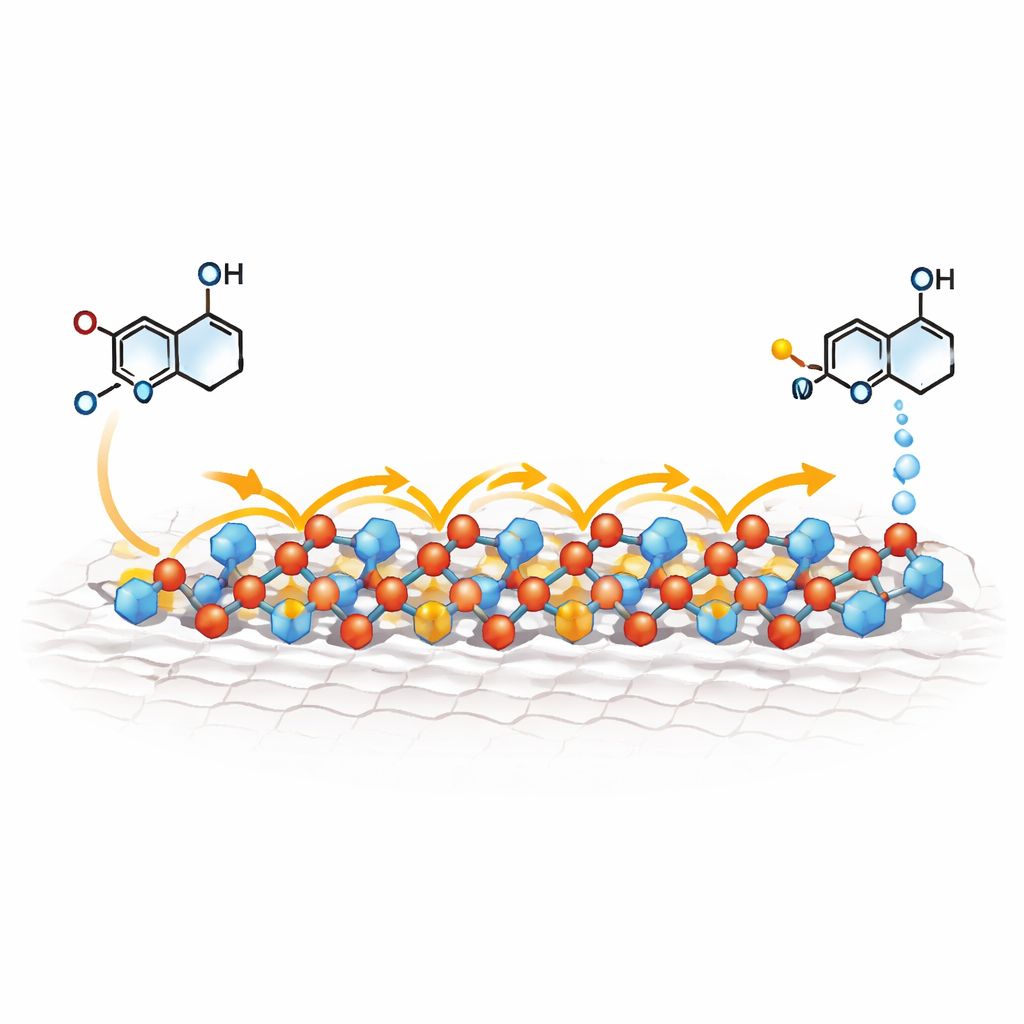
From Atomic Tuning to Greener Materials
In simple terms, the team has shown that arranging atoms so they act like a well‑aligned wire—an electron bridge—can transform a modest catalyst into a highly efficient one. By shifting manganese into the right oxidation state and suppressing lattice distortions, they created a smooth route for electrons to travel during the six‑electron upgrade of HMF to FDCA. This design principle, demonstrated here for a single biomass‑derived reaction, offers a roadmap for building other low‑cost, metal‑oxide catalysts that move electrons cooperatively. Such advances bring plant‑based plastics closer to practical reality and illustrate how fine‑tuning matter at the atomic level can ripple outward to more sustainable materials in daily life.
Citation: Hu, ZT., He, G., Tao, X. et al. Valence-tuned electron bridge enables high-yield multi-electron HMF oxidation over spinel catalysts. Nat Commun 17, 3090 (2026). https://doi.org/10.1038/s41467-026-69615-6
Keywords: bio-based plastics, heterogeneous catalysis, spinel oxides, electron transfer, 5-hydroxymethylfurfural