Clear Sky Science · en
A Stellar magnesium to silicon ratio in the atmosphere of an exoplanet
Why this distant world matters
When we look at planets around other stars, one of the biggest questions is what they are made of and how they formed. For rocky worlds like Earth, we often assume their ingredients match those of their parent star, because we cannot yet sample their interiors directly. This study uses a blazing-hot gas giant, WASP-189b, as a natural laboratory to test that assumption by measuring key rock-forming elements—magnesium, silicon, and iron—in the planet’s atmosphere and comparing them to its star.
A furnace-like planet as a test bed
WASP-189b is an “ultra-hot Jupiter,” a giant planet that swings very close to its bright host star and reaches dayside temperatures above 3,000 degrees Celsius. At such extremes, many rocky materials that would normally form clouds or solid grains instead remain as gas high in the atmosphere. This unusual state lets astronomers detect individual atoms of metals like iron and magnesium in the planet’s glowing dayside, something impossible for cooler worlds. By studying this furnace-like atmosphere, scientists can directly probe rock-forming elements that usually stay hidden deep inside planets.

Catching a faint planetary glow
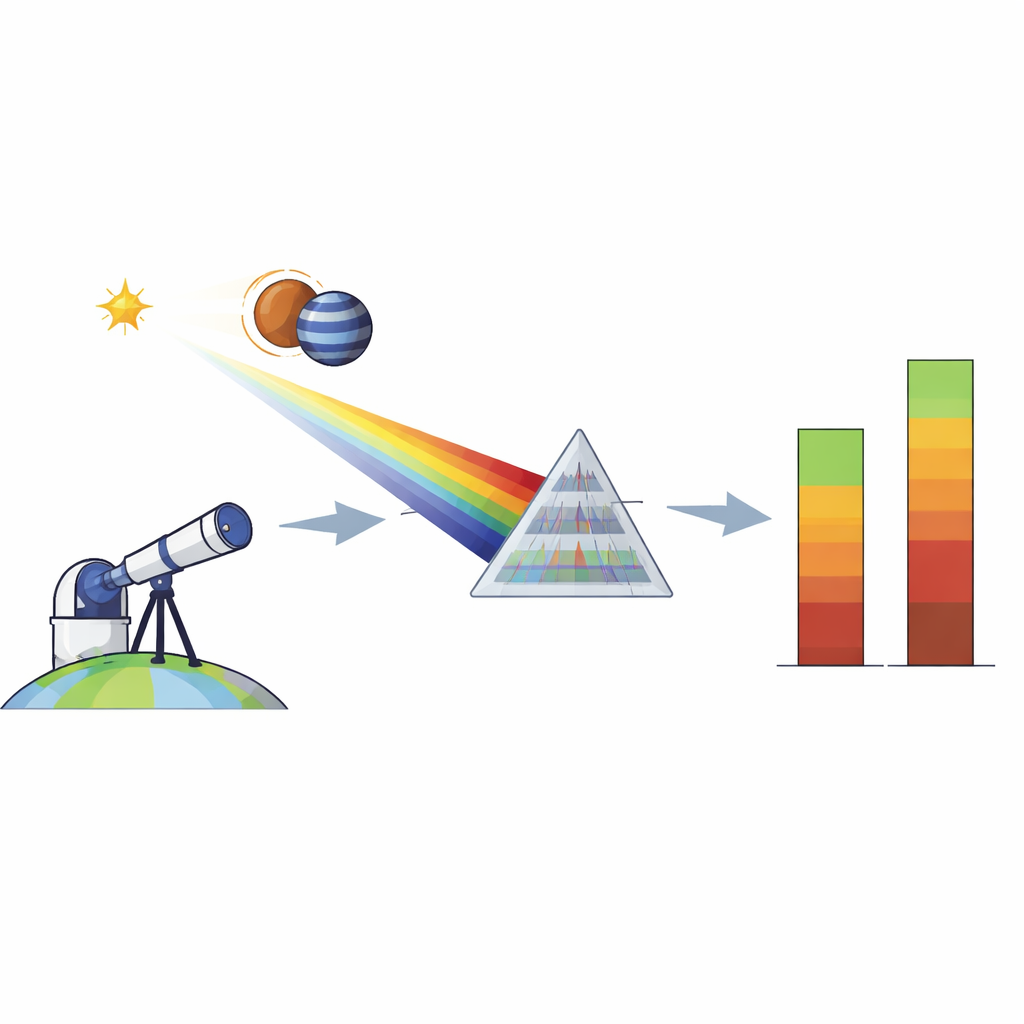
The team observed WASP-189b with a highly sensitive infrared spectrograph on the Gemini South telescope in Chile. As the planet orbits, its light is Doppler-shifted—stretched and squeezed—by its motion. The instrument records this light at very high spectral resolution, splitting it into thousands of narrow color channels. Most of what it sees is the star and Earth’s own atmosphere, so the researchers used mathematical filtering techniques to strip away those dominant signals. What remains is a faint but repeatable pattern of spectral lines that moves in step with the planet, revealing its atmospheric fingerprint.
Reading the planet’s chemical fingerprint
By cross-correlating the cleaned data against detailed computer models, the scientists confidently detected several gases in WASP-189b’s atmosphere: neutral iron, magnesium, and silicon, along with water vapor, carbon monoxide, and hydroxyl (a fragment of water). They then used Bayesian retrieval methods—essentially a sophisticated form of curve fitting with error bars—to infer how much of each element must be present to match the observations. From these measurements, they derived the ratios of magnesium to silicon, iron to magnesium, and silicon to iron, as well as how strongly heavier “rocky” elements are enriched relative to more volatile ones like carbon and oxygen.
Rocks that echo the star
The key result is that WASP-189b’s magnesium, silicon, and iron appear in nearly the same proportions as in its parent star, within the uncertainties of the measurements. In simple terms, the mix of rock-forming elements in the planet’s atmosphere mirrors the stellar recipe, even though the overall amount of heavy material is somewhat higher and the blend of rocks versus ices is shifted. The team finds a magnesium-to-silicon-iron mixture similar to that seen in certain meteorites from our own Solar System and compatible with the kind of mineralogy that shapes Earth-like mantles. This agreement suggests that the material forming both the star and its planets kept a consistent rocky composition in the original disk of gas and dust.
What this means for other worlds
For many smaller, rocky exoplanets we cannot yet probe their interiors or even their full atmospheres. Instead, modelers often assume that the bulk rock composition of a planet follows that of its host star for key elements like magnesium, silicon, and iron. This study provides the first direct observational support for that assumption in another planetary system: at least for WASP-189b, the planet’s rock-forming ratios really do echo the star’s. That gives astronomers more confidence when using stellar chemistry to infer the inner structure and mineral makeup of distant rocky worlds that we cannot yet measure directly.
Citation: Sanchez, J.A., Smith, P.C.B., Kanumalla, K. et al. A Stellar magnesium to silicon ratio in the atmosphere of an exoplanet. Nat Commun 17, 2902 (2026). https://doi.org/10.1038/s41467-026-69610-x
Keywords: exoplanet atmospheres, ultra-hot Jupiters, planet formation, elemental abundances, rock-forming elements