Clear Sky Science · en
Guest-induced porous gating of a fluorescent nonporous adaptive crystal for efficient radioactive iodine sorption
Why catching iodine matters
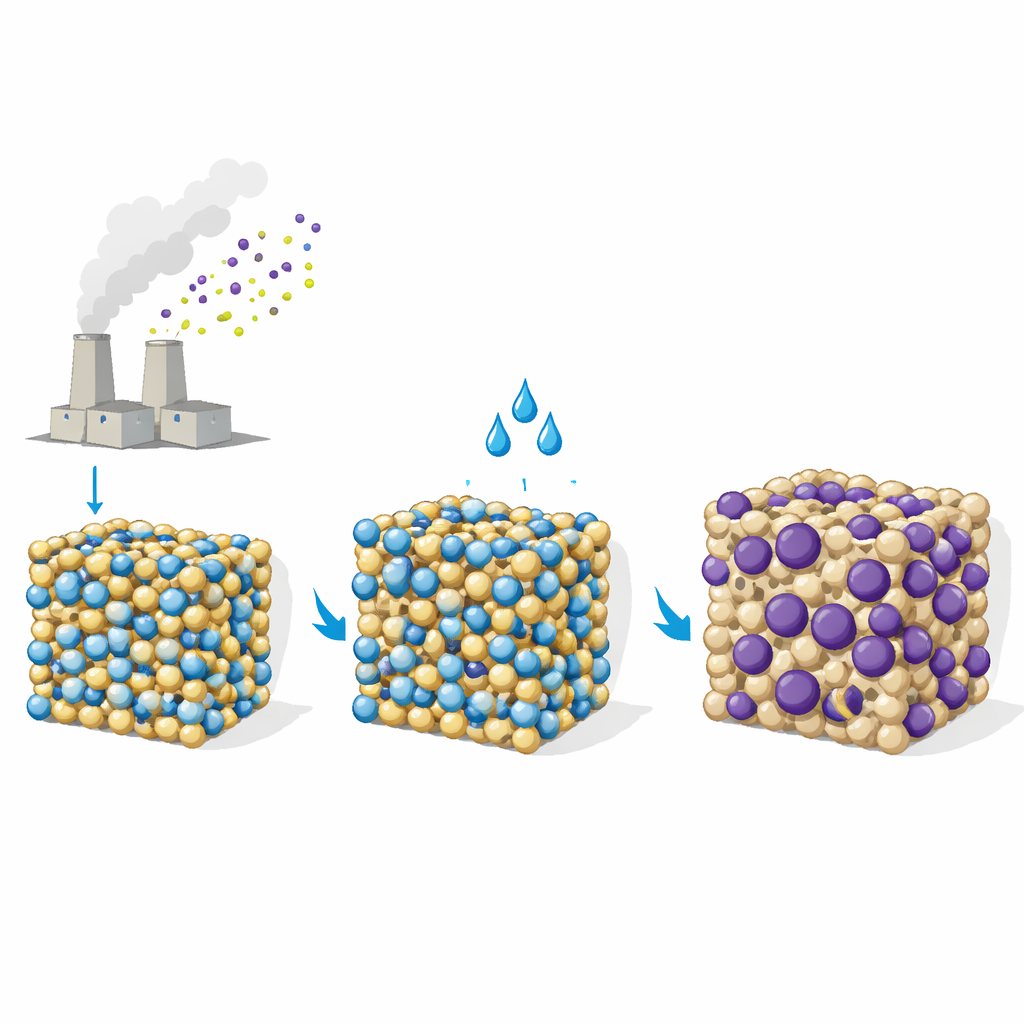
Nuclear power offers low-carbon electricity, but it also produces radioactive iodine, a form of the element that can move easily through air and water and build up in the human body. Safely trapping this iodine is essential for making nuclear energy cleaner and safer. This study describes a new crystal made from a simple organic molecule that can switch its internal structure when it encounters water, opening tiny passageways that let it soak up large amounts of iodine and hold it securely.
A smart crystal built from a simple molecule
The researchers focused on a small organic molecule called BiPyBz, chosen because it can glow under light and form crystals with well‑defined structures. When BiPyBz is dissolved in a common solvent and allowed to assemble on its own, it first forms slender rod‑shaped crystals that shine orange (named CryRod). Over about a day, these rods gradually disappear and are replaced by squarer crystals that glow green (called CryQuad). Careful monitoring showed that the rods are a short‑lived form, while the green crystals are the more stable end point of the self‑assembly process.
How water opens hidden pathways
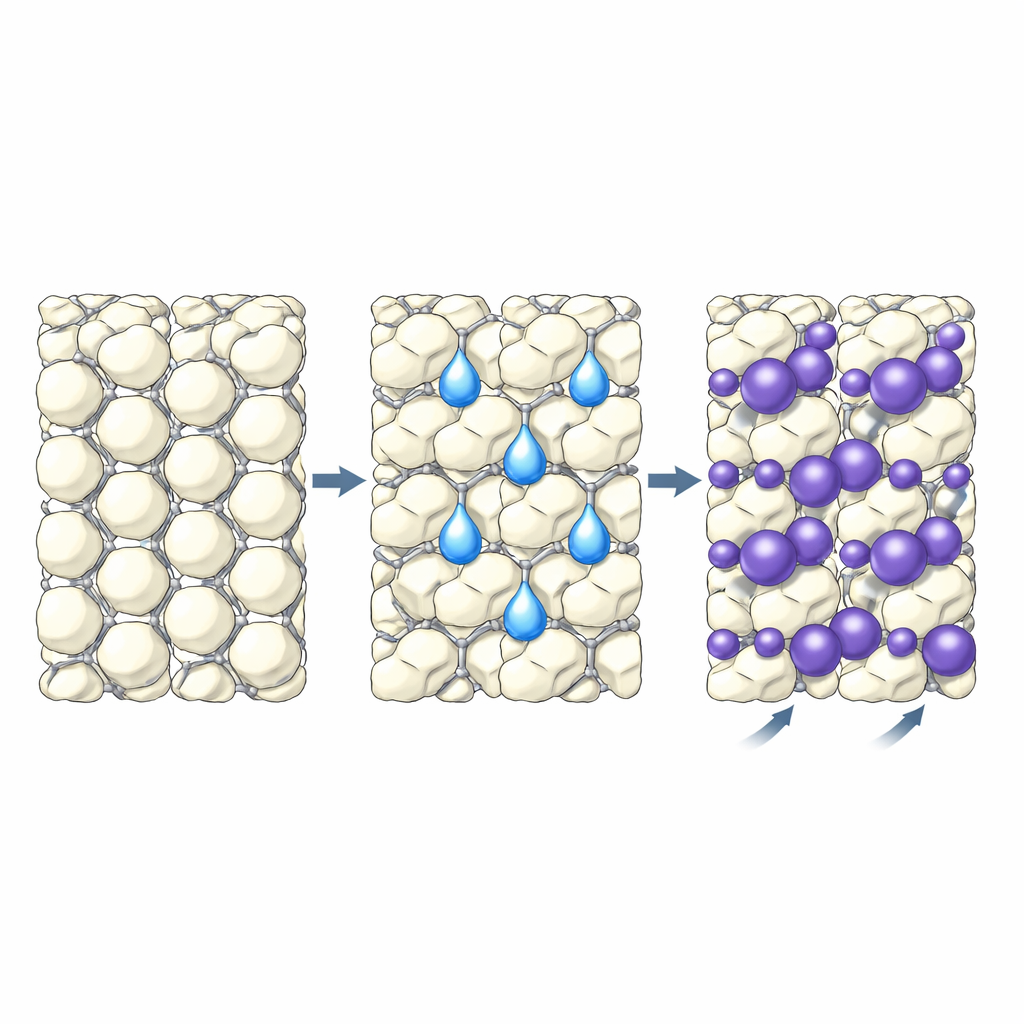
To understand this transformation, the team determined the atomic structures of both crystal types. In the green CryQuad form, each pair of BiPyBz molecules is bridged by a single water molecule, connected through hydrogen bonds. These bridge units then stack to form layers, leaving well‑defined molecular‑scale pockets between groups of eight pyridine units in the crystal. In contrast, the orange CryRod crystals contain no water and pack the molecules more tightly, with stronger stacking interactions that leave almost no free space. Analysis of the weak forces between molecules shows that introducing water strengthens specific hydrogen bonds and drives the system from the dense, less stable packing of CryRod to the more open, stable packing of CryQuad.
Breathing crystals in humid air
The phase change does not only occur in solution. When dry CryRod crystals are simply exposed to humid air, their color gradually shifts from orange to green, starting at the edges and moving toward the center. X‑ray and microscope studies reveal that the rods become rougher as they break up into smaller CryQuad domains. The speed of this change increases with both humidity and temperature, and common organic solvents cannot trigger it, underscoring that water is the key switch. Because the glow color moves in a predictable way as the transformation proceeds, the fluorescence serves as a built‑in optical indicator of how far the process has gone.
Soaking up iodine like a sponge
Both crystal forms can capture iodine vapor, but the water‑gated CryQuad performs dramatically better. At moderate temperatures, one gram of CryQuad can hold up to 3.1 grams of iodine, the highest value reported so far for nonporous adaptive crystals made from small organic molecules. The uptake is fast, reaching most of its capacity within a couple of hours. Microscopy shows that as iodine enters, the green crystals swell, darken and eventually crack, while chemical mapping confirms that iodine penetrates evenly throughout the interior. Further spectroscopic tests reveal that iodine is converted into charged polyiodide species that bind strongly to positively polarized nitrogen sites in BiPyBz, explaining both the high capacity and the excellent long‑term retention.
Toward safer handling of nuclear waste
By building a column packed with CryQuad powder, the team demonstrated that this material can strip iodine from flowing gas streams, cutting concentrations from parts per million to parts per billion with over 99.9% removal efficiency. The crystals also withstand repeated iodine loading and unloading cycles with most of their capacity preserved. For non‑specialists, the key message is that a relatively simple, fluorescent organic crystal can reorganize itself in the presence of ordinary water to open hidden pores, then use these pores and flexible layers to trap radioactive iodine extremely effectively. This guest‑activated “breathing” behavior points to a new class of smart materials that could help secure nuclear waste and reduce environmental risks.
Citation: Zhang, Q., Liu, X., Guo, Y. et al. Guest-induced porous gating of a fluorescent nonporous adaptive crystal for efficient radioactive iodine sorption. Nat Commun 17, 3002 (2026). https://doi.org/10.1038/s41467-026-69608-5
Keywords: radioactive iodine capture, adaptive crystals, porous materials, nuclear waste management, sorption materials