Clear Sky Science · en
Reverberation lags viewed in hard X-rays from an accreting stellar-mass black hole
Echoes from a Cosmic Whirlpool
When matter spirals into a black hole, it releases enormous amounts of X-ray light, but the regions closest to the black hole are far too small to image directly. Instead, astronomers listen for tiny "echoes" in the X-ray flickering to map this extreme environment. This study uses some of the highest-energy X-rays ever examined in such detail to catch these echoes around a stellar-mass black hole, revealing how its hot outer atmosphere, or corona, changes shape and showing that small black holes and giant ones in distant galaxies behave in surprisingly similar ways. 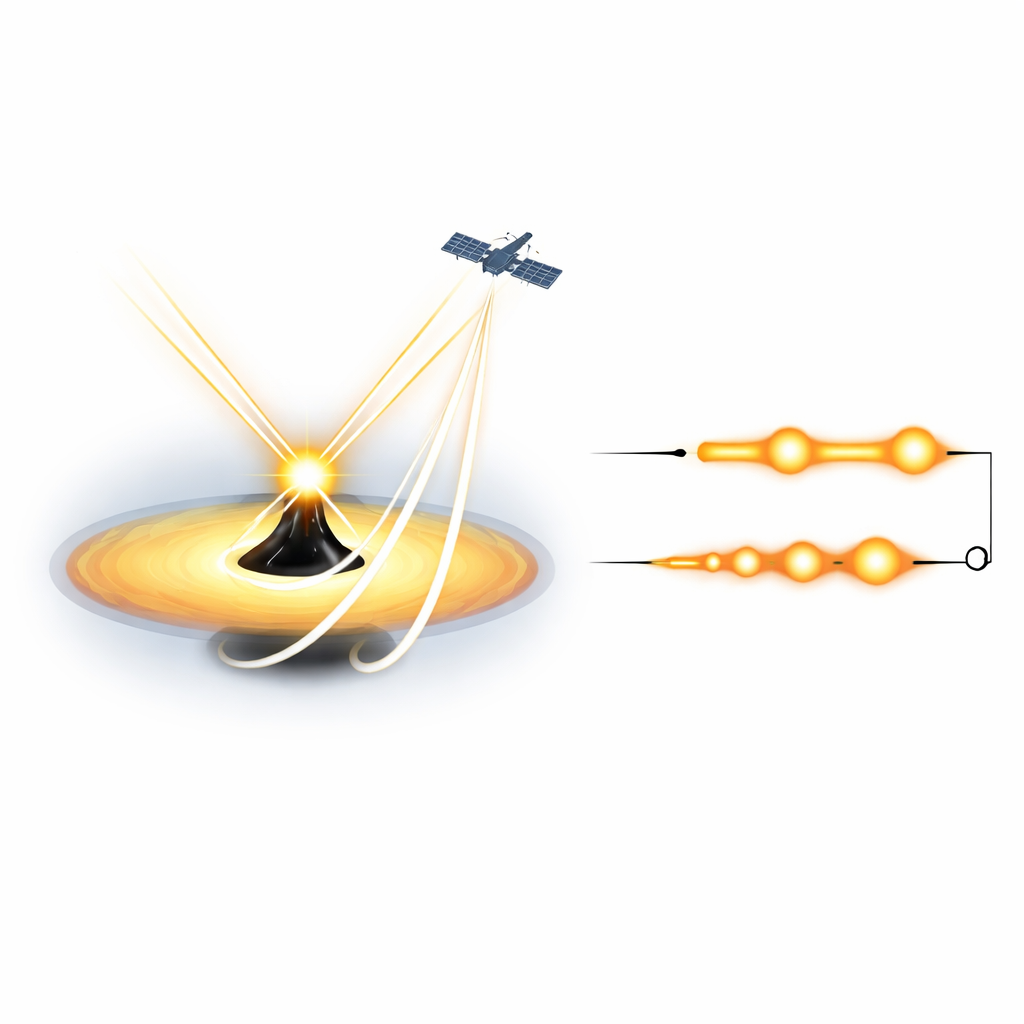
Watching a Small but Mighty Black Hole
The researchers focused on a black hole system in our own Galaxy called MAXI J1820+070, where a black hole about ten times the Sun’s mass pulls gas from a nearby star. As this gas forms a whirling disk and falls inward, its lower-energy light is boosted to higher energies in a compact, superheated region near the black hole known as the corona. Using China’s Insight-HXMT satellite, which can detect X-rays up to 250,000 electron volts, the team followed the system during an outburst when it brightened dramatically. They divided the observations into six time windows spanning the rise and fall of this event, allowing them to track how the timing of X-ray flashes evolved as the system changed.
Tiny Delays that Reveal Cosmic Distances
Because light takes time to travel, X-rays that shoot straight from the corona to our telescopes arrive slightly earlier than those that first hit the disk and bounce off. These reflected X-rays carry distinctive fingerprints: a sharp feature from iron atoms at lower energies and a broad hump at higher energies, produced when very energetic X-rays scatter off electrons in the disk. By comparing how quickly the brightness rises and falls in different energy bands, the team measured time lags as short as thousandths of a second. In the first observing window, they found that high-energy X-rays in the range where the Compton hump appears arrive just after even harder X-rays, matching what is expected if the hump is an echo from the disk. At the same time, they detected the iron feature at lower energies showing a similar delayed response, reinforcing the reverberation picture. 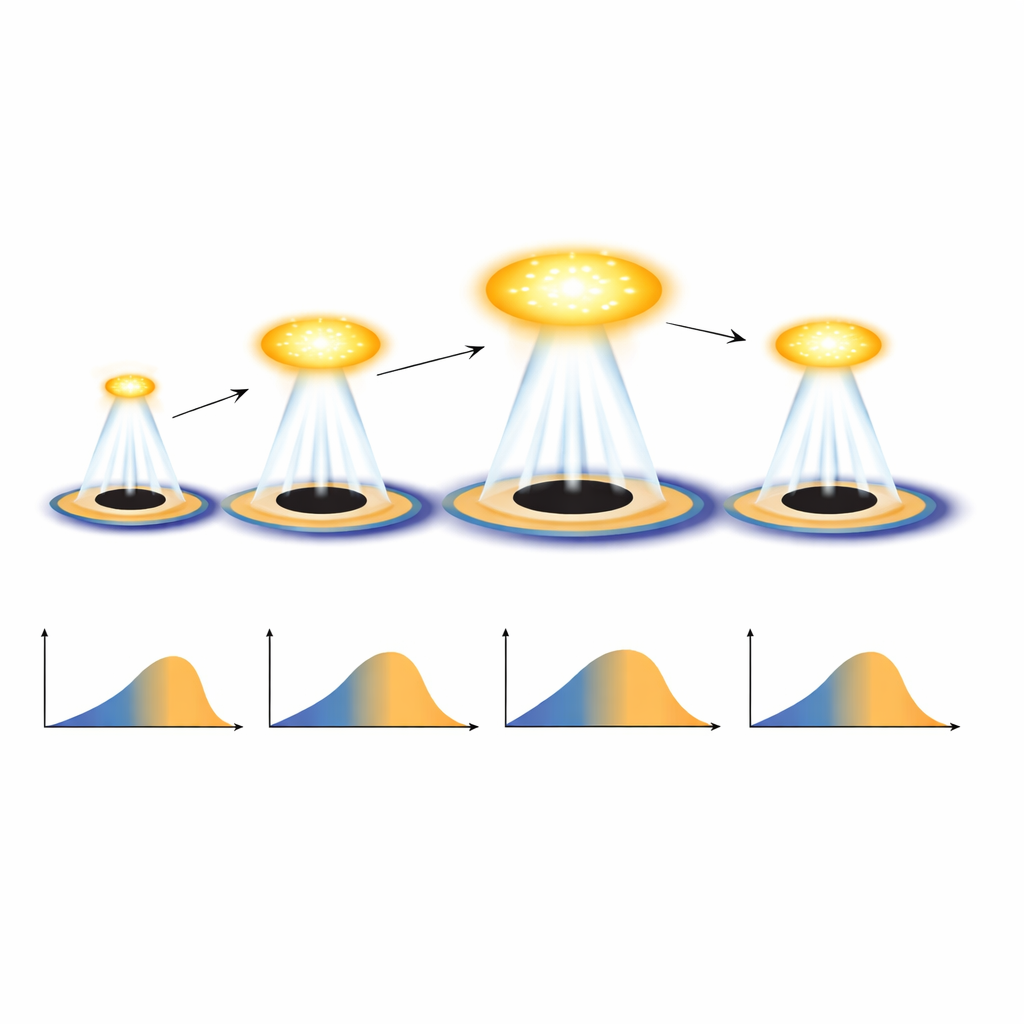
Linking Small Black Holes to the Giants
The authors then compared their lag–versus–energy pattern to similar measurements from three distant active galaxies that harbor black holes about ten million times more massive. Although the details differ, the overall shape — with a delayed iron feature and a delayed high-energy hump — looks strikingly similar once the delays are scaled by black hole mass. In the galactic systems, the echoes appear on timescales of thousands of seconds; in MAXI J1820+070, they are compressed to thousandths of a second, in line with the idea that all characteristic times near a black hole grow in proportion to its mass. This match offers some of the strongest timing-based evidence yet that the way matter falls into small stellar black holes and giant black holes in galactic centers is governed by the same underlying processes.
A Restless Corona in Motion
The echoes did not stay constant over time. After the first observing window, the clear reverberation signal in the high-energy bands faded, replaced by steadily increasing "hard lags" in which the higher-energy X-rays lag behind the softer ones. These longer delays are thought to arise not from light travel, but from slow fluctuations in the rate at which gas flows inward through the hot corona. By modeling these hard lags, the team inferred that the corona expanded from a compact region to a much larger one and then partially shrank, all during the early stages of the outburst. This changing corona likely masked the clean reverberation signal at later times, offering a dynamic view of how the black hole’s immediate surroundings evolve as the system brightens and dims.
What the Echoes Tell Us
Altogether, the work extends X-ray echo mapping up to 150,000 electron volts, catching for the first time the delayed response of the high-energy Compton hump in a stellar-mass black hole. The simultaneous detection of delayed iron and high-energy features confirms that these lags come from light reflecting off the disk, not from some unrelated process. Their sizes and timing match what is seen in much larger black holes when simple mass scaling is applied, strengthening the case for a common engine powering accretion across the cosmos. At the same time, the rapid disappearance of the reverberation signal and the growth of hard lags reveal that the corona itself is a restless, evolving structure. Future wide-field monitors and next-generation X-ray missions should be able to catch such outbursts even earlier and follow these echoes in greater detail, bringing us closer to a time-resolved map of space just outside a black hole’s edge.
Citation: You, B., Yu, W., Ingram, A. et al. Reverberation lags viewed in hard X-rays from an accreting stellar-mass black hole. Nat Commun 17, 2860 (2026). https://doi.org/10.1038/s41467-026-69604-9
Keywords: black hole X-ray binary, X-ray reverberation, accretion disk corona, Compton hump, MAXI J1820+070