Clear Sky Science · en
Biophysical factors and management practices are key to shaping forest resilience
Why the Future of Forests Matters to Everyone
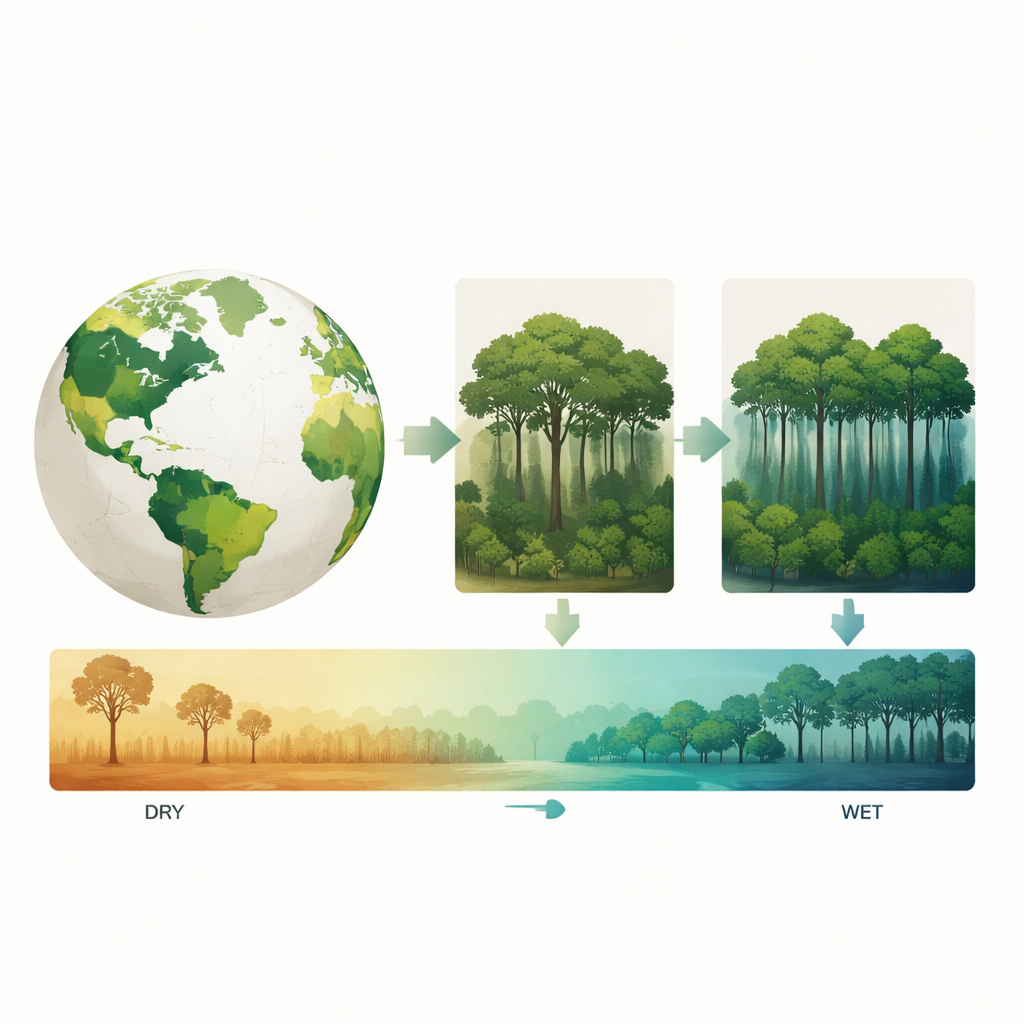
Forests quietly support much of life on Earth: they store carbon, regulate water, protect soils, and shelter countless species. As countries race to plant new trees for climate and conservation goals, a crucial question arises: are these managed and planted forests as robust as untouched woodlands when weather turns harsher and human pressures grow? This study uses satellite data and advanced statistics to examine how different ways of managing forests, together with local climate and soils, shape how well forests can withstand shocks such as drought, heat, and logging.
How the Study Looked at Forest Staying Power
The researchers focused on the idea of “resilience,” meaning a forest’s ability to absorb disturbances and keep functioning without flipping into a degraded state. Instead of tracking only dramatic die‑offs, they used long records of satellite measurements of greenness and growth from 2001 to 2015, including leaf area and productivity. By carefully removing seasonal patterns and long‑term trends, they studied the remaining year‑to‑year wiggles in these signals. According to a theory called Critical Slowing Down, systems that are close to a tipping point start to recover more slowly from small shocks, leaving telltale fingerprints in their variability over time. From these fingerprints, the team derived resilience indicators for forests worldwide at one‑kilometer resolution.
Comparing Forests Under Different Human Touch
To understand the role of people, the authors combined global maps of forest management with satellite tree‑cover data to classify each forest pixel as an untouched natural forest, a natural forest that is managed (for example, selectively logged), or a human‑planted forest. They then compared neighboring patches that share similar age, elevation, and climate but differ in how they are managed. Across the globe, untouched natural forests showed the highest resilience. Natural forests with management interventions were somewhat less stable, and heavily used plantations, such as oil‑palm and agroforestry systems, were the most fragile. Overall, stronger and more frequent human intervention was linked to a weaker capacity of forests to ride out shocks.
When Planted Forests Can Catch Up
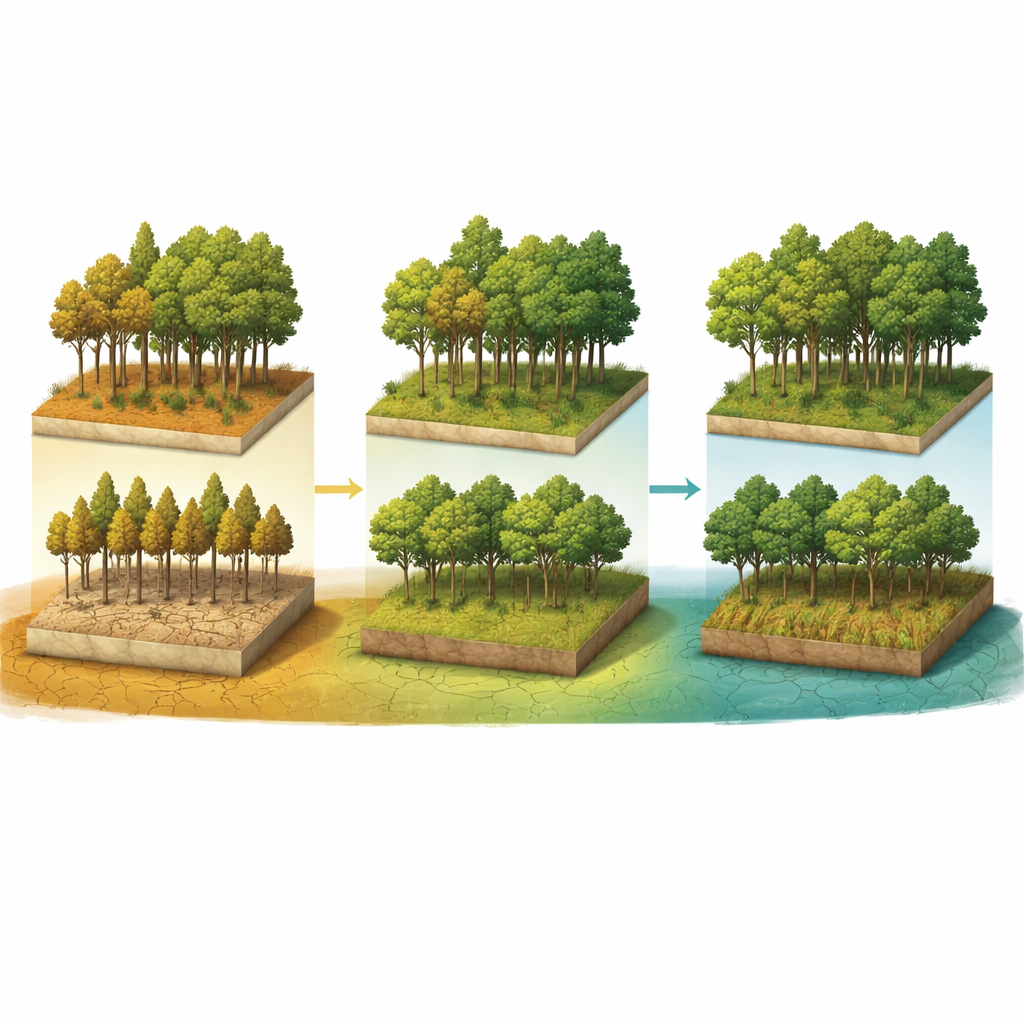
The picture changes in important ways once local climate and soils are taken into account. The study found a key threshold in water balance, expressed as the ratio of rainfall to the atmosphere’s drying power. In regions where water is relatively scarce, natural forests are more resilient than planted ones. But in wetter climates, once this ratio exceeds roughly one and a half, well‑sited planted forests can actually become slightly more stable than nearby natural stands. In such humid, cooler areas with dense vegetation and fertile soils, plentiful water and nutrients can offset some of the stress introduced by human activities. Machine‑learning models confirmed that local climate and soil fertility matter more for resilience differences than fine‑scale contrasts in vegetation traits alone.
Water, Energy, and Forest Sensitivity
To probe why climate matters so much, the researchers examined how strongly forest greenness reacts to swings in water‑related factors such as soil moisture and drought indices, and to energy‑related factors such as air temperature and potential evaporation. In dry regions, planted forests were more sensitive to water shortages than natural forests, likely because they often have denser stands and weaker control over water loss. This heightened sensitivity makes them more vulnerable to drought and thus less resilient. In wet regions, however, water is abundant and energy becomes the main limiting factor. There, planted forests tended to be less sensitive to shifts in temperature and atmospheric demand than natural forests, helping them maintain more stable functioning.
What This Means for Forest Policy and Restoration
Over the study period, many forests around the world showed signs of declining resilience, but the gap between planted and natural forests narrowed in both dry and wet climates. Even so, the results send a clear message: minimizing heavy human pressure is the most reliable way to keep forests stable, and when planting new forests, location and design are crucial. In drylands, protecting existing natural forests is especially urgent because they cope better with water stress. In wetter, cooler, and nutrient‑rich regions, carefully planned planted forests—ideally with diverse species and thoughtful management—can approach the stability of natural forests and help secure carbon storage, water regulation, and other vital ecosystem services for the long term.
Citation: Yan, Y., Feng, X., Liu, Z. et al. Biophysical factors and management practices are key to shaping forest resilience. Nat Commun 17, 2839 (2026). https://doi.org/10.1038/s41467-026-69598-4
Keywords: forest resilience, forest management, planted forests, climate impacts, satellite monitoring