Clear Sky Science · en
Plant diversity’s positive effect on soil respiration diminishes with increasing productivity in global forests
Why this matters for climate and forests
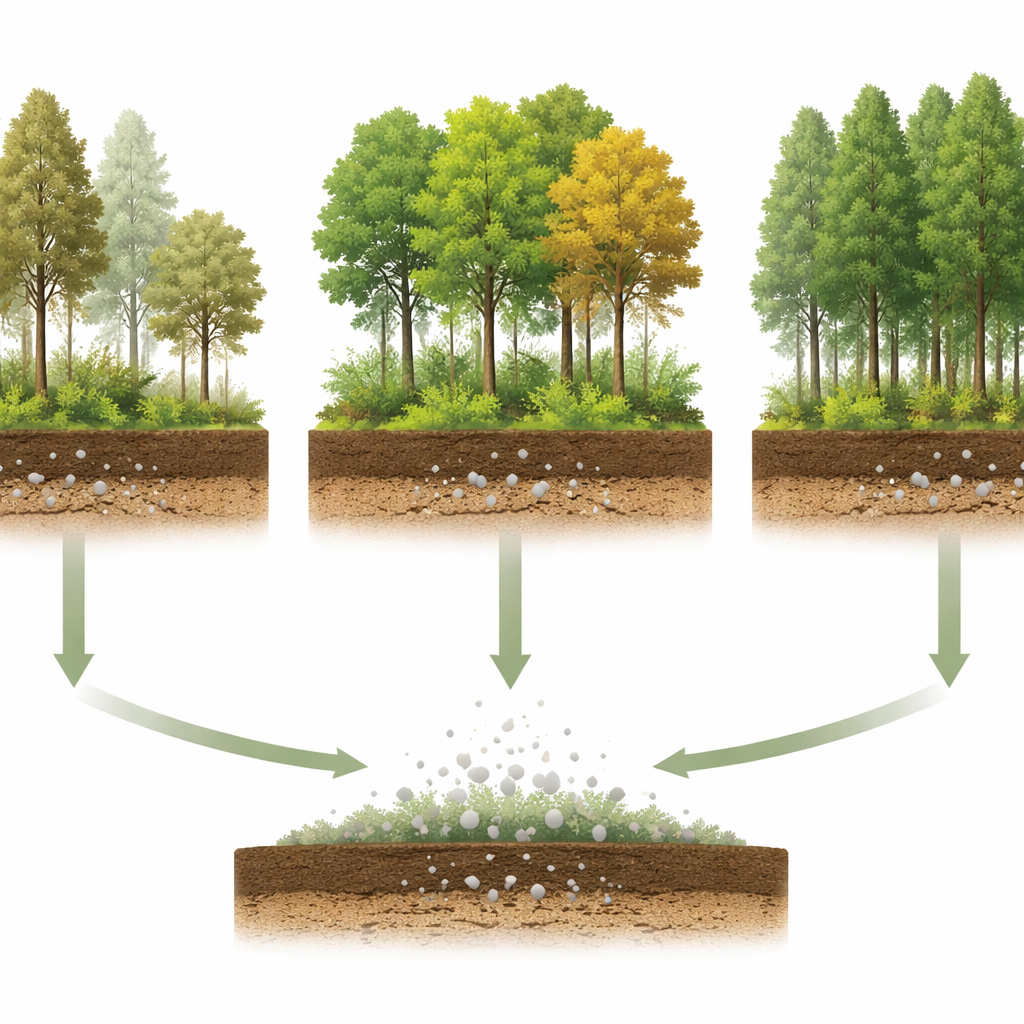
Forests quietly breathe through their soils, releasing carbon dioxide as roots and microbes break down organic matter. This soil “breathing,” called soil respiration, is one of the largest carbon fluxes on Earth and strongly influences climate. At the same time, forests face rapid losses of plant species. This study asks a deceptively simple question with big implications: does having more kinds of plants in a forest make its soils breathe more, and does that answer change between sparse, struggling forests and lush, highly productive ones?
Life in the soil and the forest’s hidden breath
Soil respiration is the continuous release of carbon dioxide from the ground as roots grow and microbes decompose dead leaves and wood. Globally, this flux is second only to plant photosynthesis in size, so even small percentage changes can alter how much carbon stays locked in soils versus returning to the air. Many small-scale experiments have shown that more plant species tend to boost soil life and organic matter, hinting that biodiversity could also increase soil respiration. Yet most of those experiments have been short-term, focused on grasslands, or limited to a handful of species, leaving open the question of how plant diversity shapes soil respiration across the world’s forests and climates.
Building a global picture from scattered measurements
To tackle this, the authors assembled several large datasets and combined them with modern machine learning. They used over 6,000 field measurements of soil respiration collected worldwide and trained a deep learning model to predict monthly soil respiration at fine resolution from climate, soil, and vegetation characteristics. They then overlaid global maps of tree species richness and overall vascular plant richness (including trees, shrubs, and herbs), along with a satellite-based measure of forest productivity known as net primary production. By controlling for temperature, rainfall, soil properties, and vegetation traits, they could tease out how much plant diversity alone contributes to variation in soil respiration.
Diversity helps most where resources are scarce
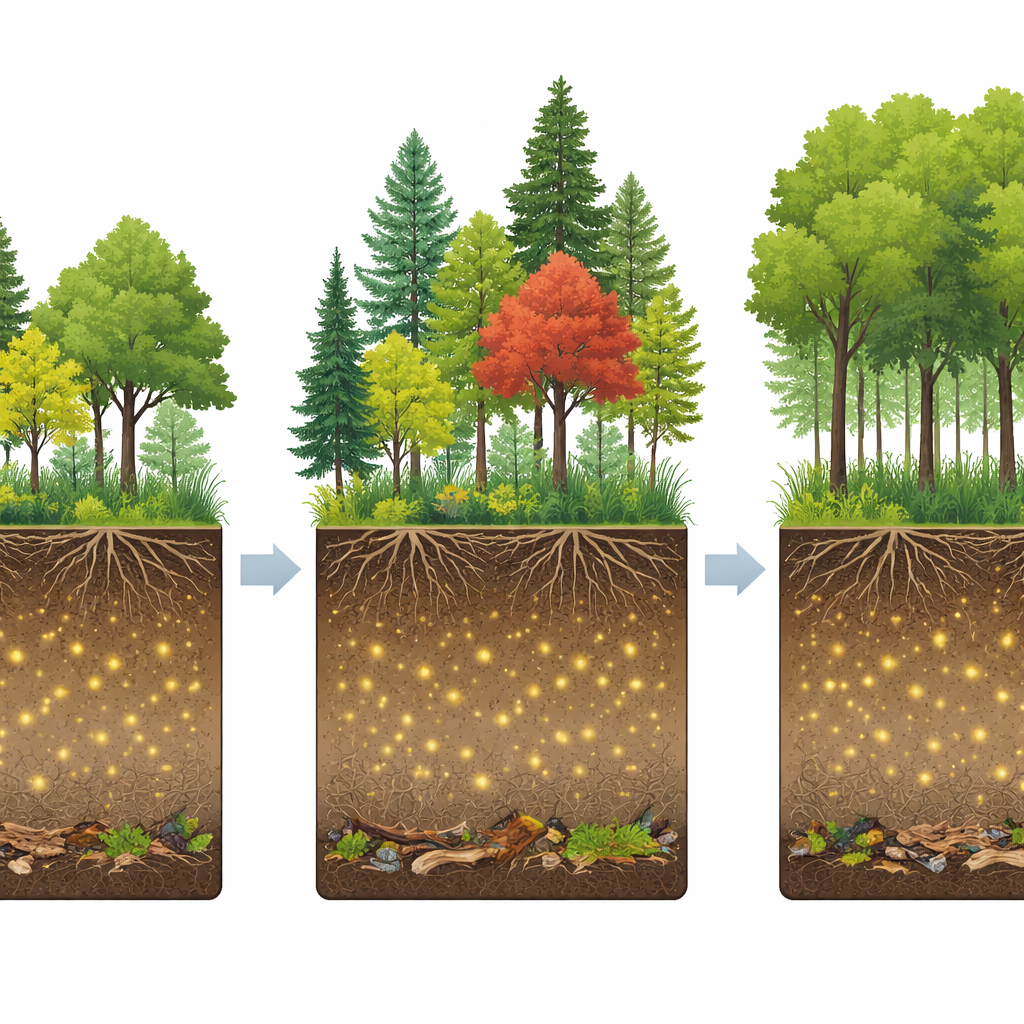
The global analyses reveal a clear yet nuanced pattern. In forests with low to moderate productivity, places where growth is constrained by cold, dryness, or limited nutrients, having more plant species is strongly linked to higher soil respiration. Diverse plant communities there appear to feed the soil system more effectively, through a mix of root depths, root exudates, and litter types that support active microbial communities. But as productivity rises and forests become richer in biomass, the benefit of adding more species shrinks. In very productive forests—such as warm, wet regions with dense canopies—the extra boost from diversity becomes small or can even turn slightly negative once the influence of climate and soils is accounted for.
When more species stop adding much
The study suggests several reasons for this fading diversity effect in highly productive forests. Where conditions are already favorable, a few dominant species can deliver large amounts of organic matter to the soil, setting a high baseline of microbial activity and soil respiration. Additional species may share similar roles, so their presence adds little extra function, a concept known as functional redundancy. Strong competition for light and nutrients can further favor a small set of successful species, reducing the importance of the rest for soil processes. In such settings, temperature, moisture, and other abiotic factors become the main drivers of soil respiration, and biodiversity’s marginal contribution diminishes.
What this means for conserving carbon and diversity
For non-specialists, the key message is that plant diversity does not play the same role everywhere. In low- and mid-productivity forests, each additional plant species can make soils more active, helping to drive nutrient cycling and carbon movement. In the most productive forests, however, simply adding species may not change soil respiration much because the system is already running near capacity. This context-dependent behavior matters for climate policy. Protecting plant diversity in less productive forests is especially critical, because losing species there could weaken soil processes that support long-term carbon storage and ecosystem health. Incorporating realistic biodiversity effects into carbon and climate models will improve our ability to forecast how forests, soils, and the atmosphere will respond to ongoing environmental change.
Citation: Laffitte, B., Yang, Z., Jian, J. et al. Plant diversity’s positive effect on soil respiration diminishes with increasing productivity in global forests. Nat Commun 17, 3023 (2026). https://doi.org/10.1038/s41467-026-69594-8
Keywords: forest biodiversity, soil respiration, carbon cycling, ecosystem productivity, climate feedbacks