Clear Sky Science · en
A synergistic design model for ultrathin broadband microwave absorbers using electromagnetic frequency dispersion coefficients
Why Blocking Unwanted Signals Matters
Modern life runs on invisible radio and microwave signals—from Wi‑Fi and 5G to radar and satellite links. But as electronics shrink and pack closer together, these waves can interfere with one another, causing lost data, noisy measurements, or even safety problems. Engineers fight this by lining surfaces with materials that soak up microwaves instead of reflecting them. This paper presents a new way to design such materials so they can be made extremely thin, work over a wide range of frequencies, and stay reliable even when they heat up.
Thin Shields for Crowded Devices
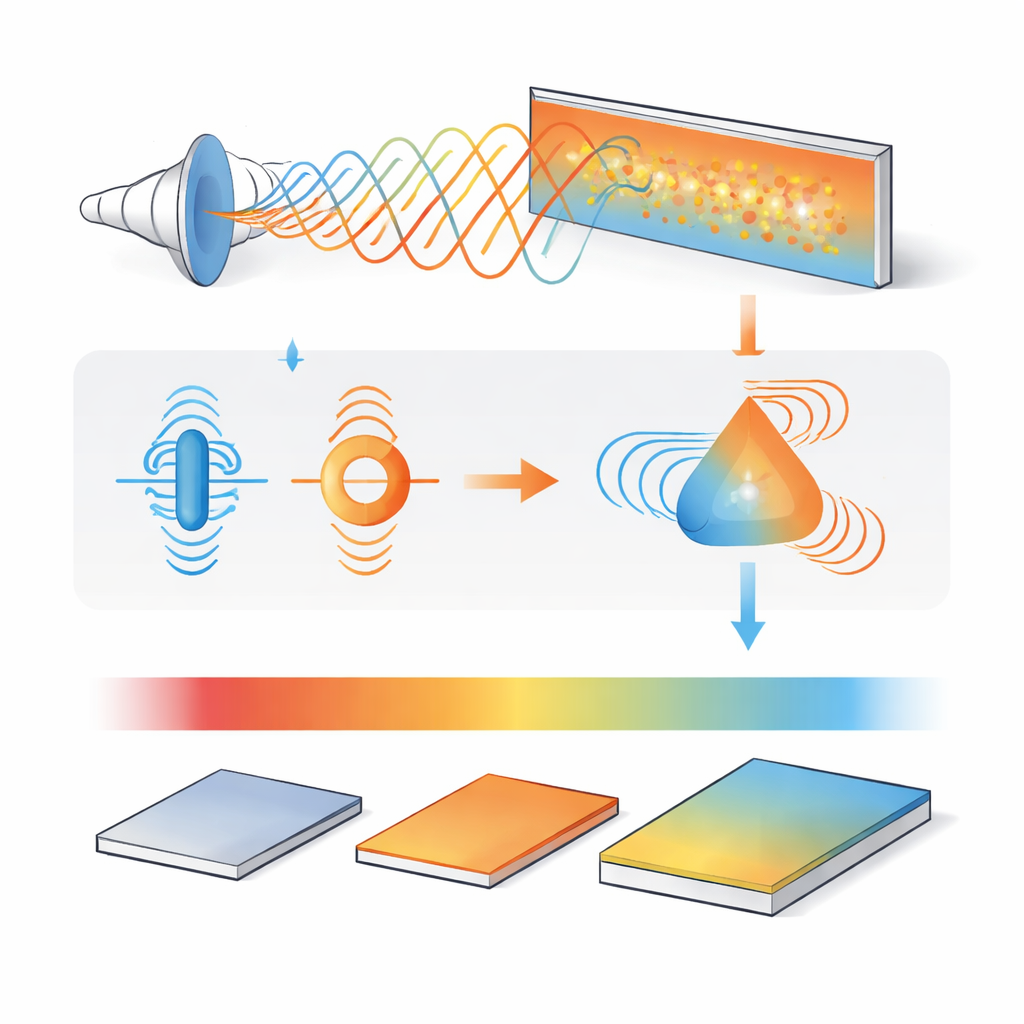
Traditional microwave‑absorbing coatings tend to be thick and heavy, which is a serious drawback in aircraft, cars, phones and portable gadgets where every millimeter and gram counts. Making them thinner usually narrows the range of frequencies they can handle, because of a fundamental trade‑off between thickness and bandwidth. The authors target this problem directly. They focus on ultrathin "microwave absorbing materials" only about one millimeter thick that can still cover several gigahertz of spectrum, enough to span key communication and radar bands. The goal is simple in spirit: guide incoming microwaves into the material and dissipate their energy as heat instead of letting them bounce back.
One Simple Measure for a Complex Dance
Microwaves interact with matter through both electric and magnetic effects. Most past designs tried to tune these two responses separately, juggling many parameters through trial and error. Here, the researchers condense this complexity into a single quantity they call the electromagnetic frequency dispersion coefficient, or EFDC. EFDC captures how strongly a material responds to microwaves as frequency changes, combining the electric and magnetic behavior into one knob. Using basic wave‑propagation theory, they show that for each thickness and frequency there is an optimal EFDC value that leads to nearly perfect absorption, and that this single curve is far more directly tied to performance than the raw electric or magnetic properties alone.
Building a Smart Microwave Sponge
To turn this design rule into a real material, the team built a composite that mixes tiny iron spheres, which provide magnetic loss, with carbon nanotubes, which provide electric loss, all held in an epoxy binder. They then used a simple neural‑network model to search for EFDC patterns that should produce strong absorption across the 8–18 gigahertz range at different thicknesses. Guided by this map, they adjusted the amount of nanotubes until the measured EFDC of the composite closely followed the predicted optimum. The result is a sample only 1 millimeter thick that soaks up more than 90 percent of incoming microwaves over 7.04 gigahertz of bandwidth, and a 1.3‑millimeter version that reaches 9.28 gigahertz—figures that outperform many existing materials of similar or greater thickness.
Stable Performance in the Heat
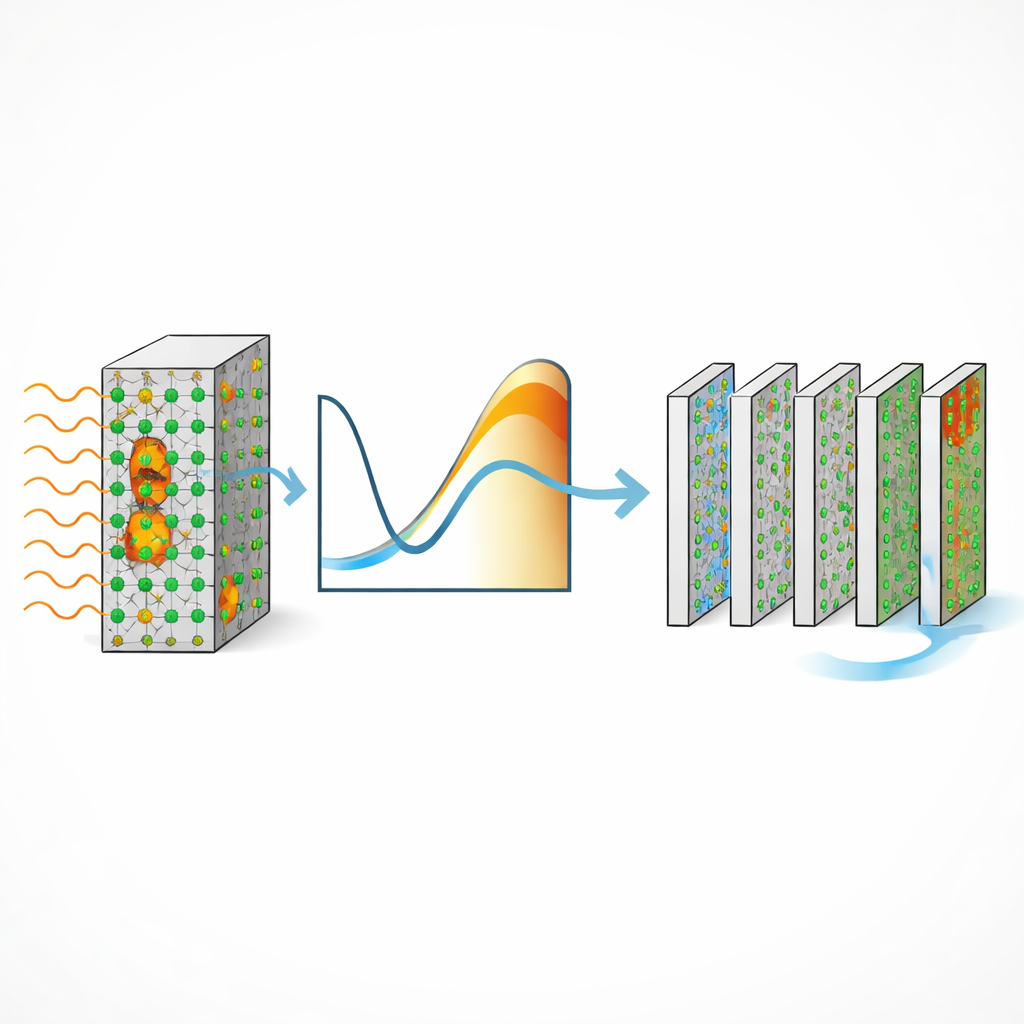
Real‑world devices often run hot, so the team also explored how their absorber behaves from room temperature up to 473 kelvin, hotter than a typical soldering iron. As temperature rises, the electric part of the composite tends to become more conductive and lossy, while the magnetic part weakens, changes that would usually throw off the delicate balance needed for good absorption. Remarkably, when viewed through the lens of EFDC, these opposing trends largely cancel. The combined parameter remains nearly constant across the tested temperatures, and the material maintains a wide absorption band of more than 6 gigahertz even at the highest temperature. Simulations of radar reflections and field patterns confirm that the composite continues to draw energy into its interior rather than scattering it away.
What This Means for Future Devices
In everyday terms, the study shows how to design a very thin microwave "black hole" by focusing on one guiding number instead of many loosely related material properties. By deliberately pairing electric and magnetic ingredients so that their changes with frequency and temperature balance out in EFDC space, the authors demonstrate coatings that are light, broadband, and thermally robust. This strategy could speed up the creation of custom absorbers for everything from stealthier vehicles to cleaner wireless electronics, providing a practical recipe for taming the increasingly crowded microwave environment.
Citation: Si, H., Zhang, Y., Li, M. et al. A synergistic design model for ultrathin broadband microwave absorbers using electromagnetic frequency dispersion coefficients. Nat Commun 17, 2991 (2026). https://doi.org/10.1038/s41467-026-69591-x
Keywords: microwave absorbers, electromagnetic shielding, carbonyl iron composites, carbon nanotubes, thermal stability