Clear Sky Science · en
Universal framework for efficient estimation of stability in multi-principal element alloys
Why many-metal alloys matter
Modern technologies, from jet engines to chemical reactors, increasingly rely on metallic materials that can survive extreme conditions and perform multiple tasks at once. A new family of materials called multi-principal element alloys (often also called high‑entropy alloys) mixes several metals together in nearly equal amounts, opening an enormous design space but making it hard to know which mixtures can actually be made in the lab. This paper introduces a simple, physics‑based way to predict which of these complex alloys should be stable and synthesizable, potentially speeding up the search for robust structural materials and advanced catalysts.
Charting an ocean of metal mixtures
The authors first assembled a huge computational map of possible alloys made from 28 different metals, including both common structural metals and precious “noble” metals. They examined mixtures containing from two up to five metals in equal proportions and considered three common crystal structures. For each composition and structure, they used quantum‑mechanical calculations to estimate the alloy’s energy and its tendency to fall apart into simpler phases. Two key measures guided this analysis: the formation energy, which reflects how favorable it is to build the alloy from pure elements, and the energy above hull, which indicates how strongly the alloy wants to decompose into any other combination of metals or compounds. 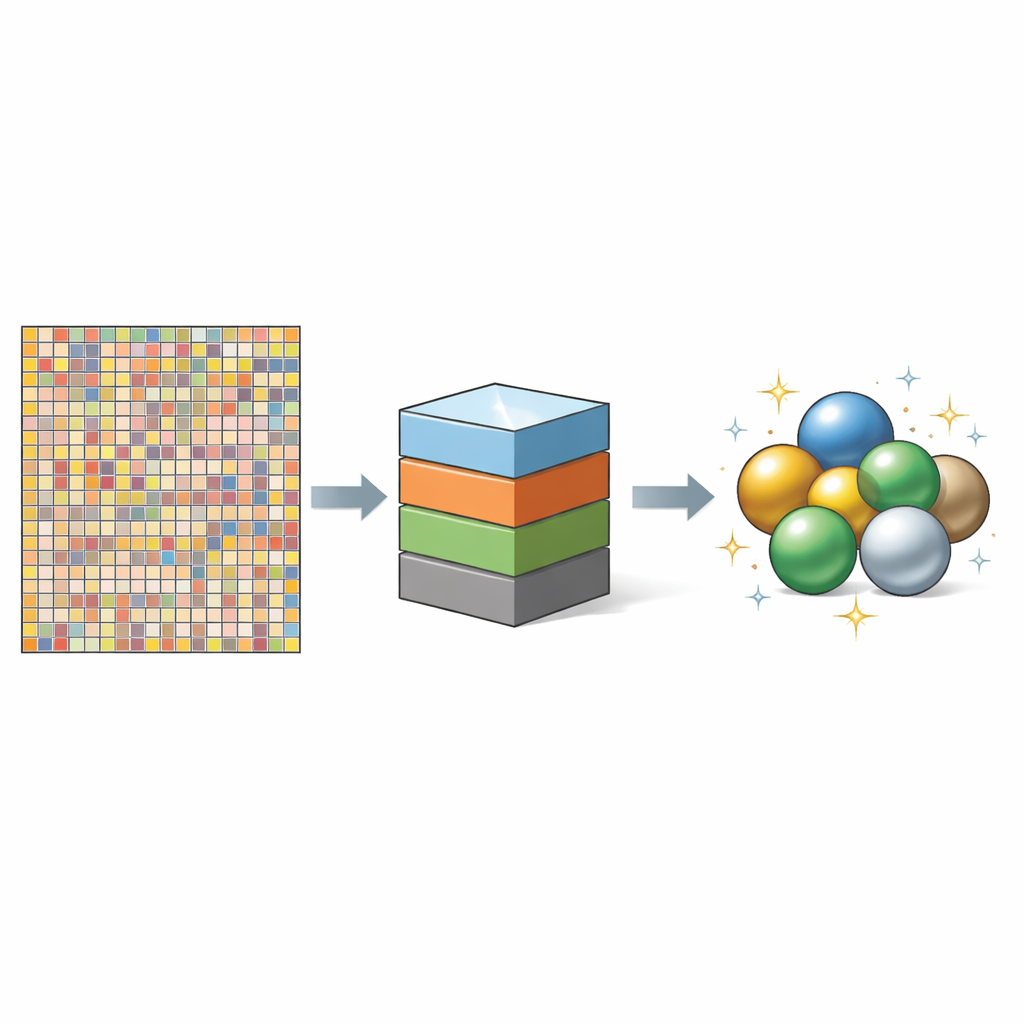
Putting predictions to the experimental test
To ensure their computational rules were meaningful in the real world, the team focused on alloys that contain noble metals such as platinum, palladium, and gold. These compositions are especially interesting for catalysis but have been relatively underexplored. Guided by their stability metric, the researchers picked nine previously unreported four‑ and five‑metal alloys that should remain stable below about 1000 °C. They then used a high‑precision patterning method, which deposits mixtures of metal salts into tiny polymer domes and converts them into single nanoparticles by heating in hydrogen. Microscopy and elemental mapping confirmed that the resulting particles contained the intended combinations of metals, were chemically uniform, and matched the predicted stable phases, validating that the energy‑above‑hull approach can successfully flag synthesizable alloys.
Simple rules hidden in complex mixtures
Looking across their vast dataset, the authors extracted “compatibility rules” that describe which metals tend to form stable multi‑metal alloys together. Some noble metals, such as rhodium and platinum, proved to be especially versatile partners, appearing in many stable combinations, while others like silver and gold were more selective. These patterns align with familiar ideas from the periodic table: metals that sit next to each other or share similar sizes and electronic structures are more likely to mix smoothly. The study also shows that many stable alloys contain at least one noble metal, helping explain the strong interest in noble‑metal‑rich compositions for catalytic applications.
A universal shortcut to alloy stability
The central insight of the work is a surprisingly simple model for estimating the energy of a complicated alloy. Instead of treating a six‑, eight‑, or even ten‑metal mixture as an entirely new problem, the model writes its total energy as a weighted average of the energies of simpler, lower‑dimensional subsystems—such as all the possible three‑ or four‑metal alloys drawn from the same elements. Because these lower‑dimensional building blocks share many of the same local atomic arrangements as the full alloy, their combined energies closely approximate the behavior of the more complex material. 
What this means for future materials
For non‑specialists, the key message is that designing many‑metal alloys no longer needs to be a blind search. By reusing information from simpler mixtures, this framework can rapidly estimate which new combinations of metals are likely to form stable, single‑phase materials and which are destined to fall apart. The work also reveals that, as more different metals are mixed, the energetic incentive for an alloy to decompose becomes smaller, making ultra‑complex alloys easier to stabilize than once thought. Together, these insights provide a practical roadmap for discovering new structural alloys and catalytic materials in a controlled, data‑efficient way.
Citation: Wang, L., Shen, B., He, ZD. et al. Universal framework for efficient estimation of stability in multi-principal element alloys. Nat Commun 17, 3093 (2026). https://doi.org/10.1038/s41467-026-69585-9
Keywords: high entropy alloys, multi-principal element alloys, materials discovery, alloy stability prediction, computational materials science