Clear Sky Science · en
A pulsed optoelectronic microwave source with high power and frequency tunability
Why powerful, flexible microwaves matter
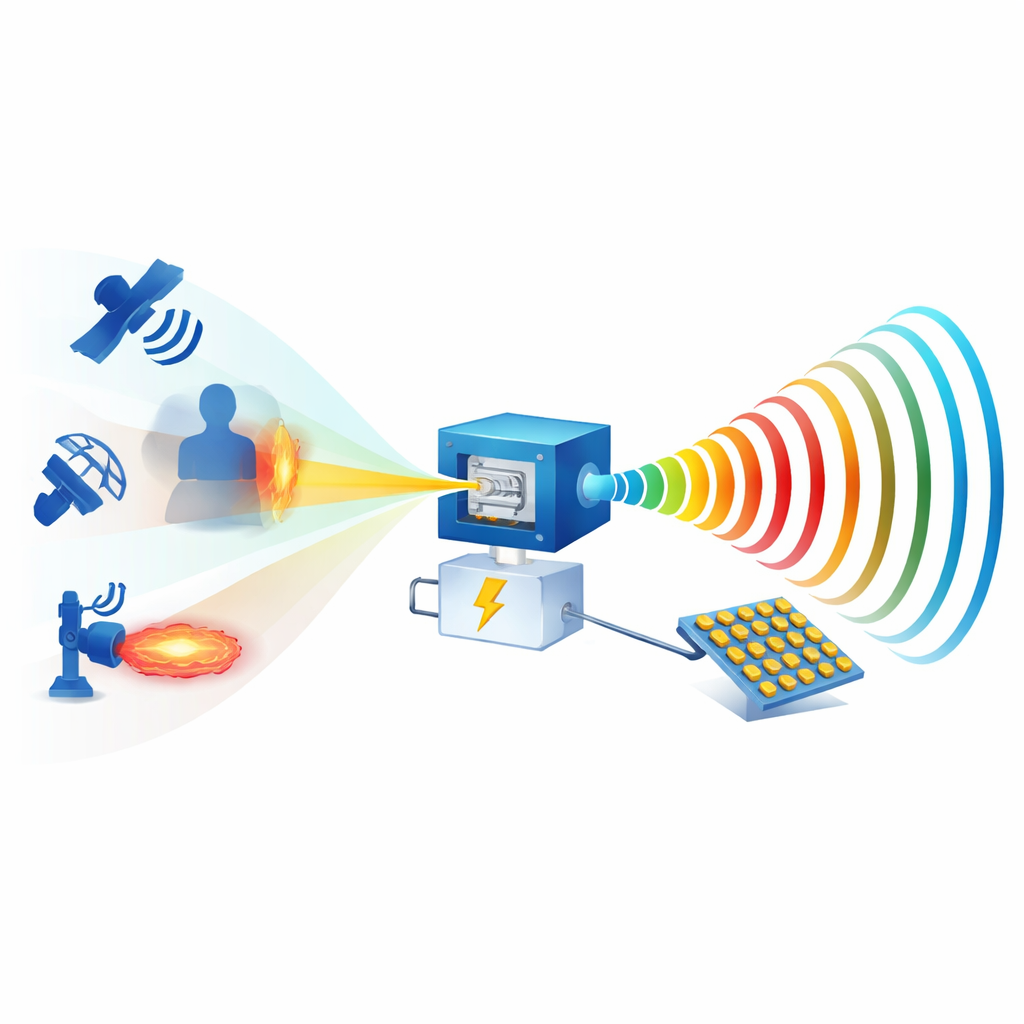
Microwave technology quietly underpins everyday life, from weather radar and satellite navigation to medical treatments and industrial heating. Many of these uses now demand radio waves that are not only extremely powerful but can also change frequency quickly to match different tasks and targets. Traditional electronic microwave generators struggle to deliver both high power and wide tunability at the same time. This paper introduces a new kind of light-driven microwave source that aims to break this trade-off, promising stronger and more adaptable waves for future communication, defense, medical, and industrial systems.
The limits of today’s microwave machines
Conventional microwave sources fall into two main families: bulky vacuum tubes and compact solid-state amplifiers. Vacuum devices can reach enormous peak powers, even up to billions of watts, but they are typically locked to a narrow band of frequencies and are hard to miniaturize. Solid-state amplifiers based on modern transistors are easier to integrate and tune, yet an individual device usually tops out at thousands of watts, and its useful bandwidth is limited. As systems such as radar, wireless links, and advanced heating tools increasingly need multi-band and agile operation, these older approaches face a fundamental dilemma: boosting power tends to reduce flexibility, and widening the tuning range tends to lower power.
Using light to drive stronger radio waves
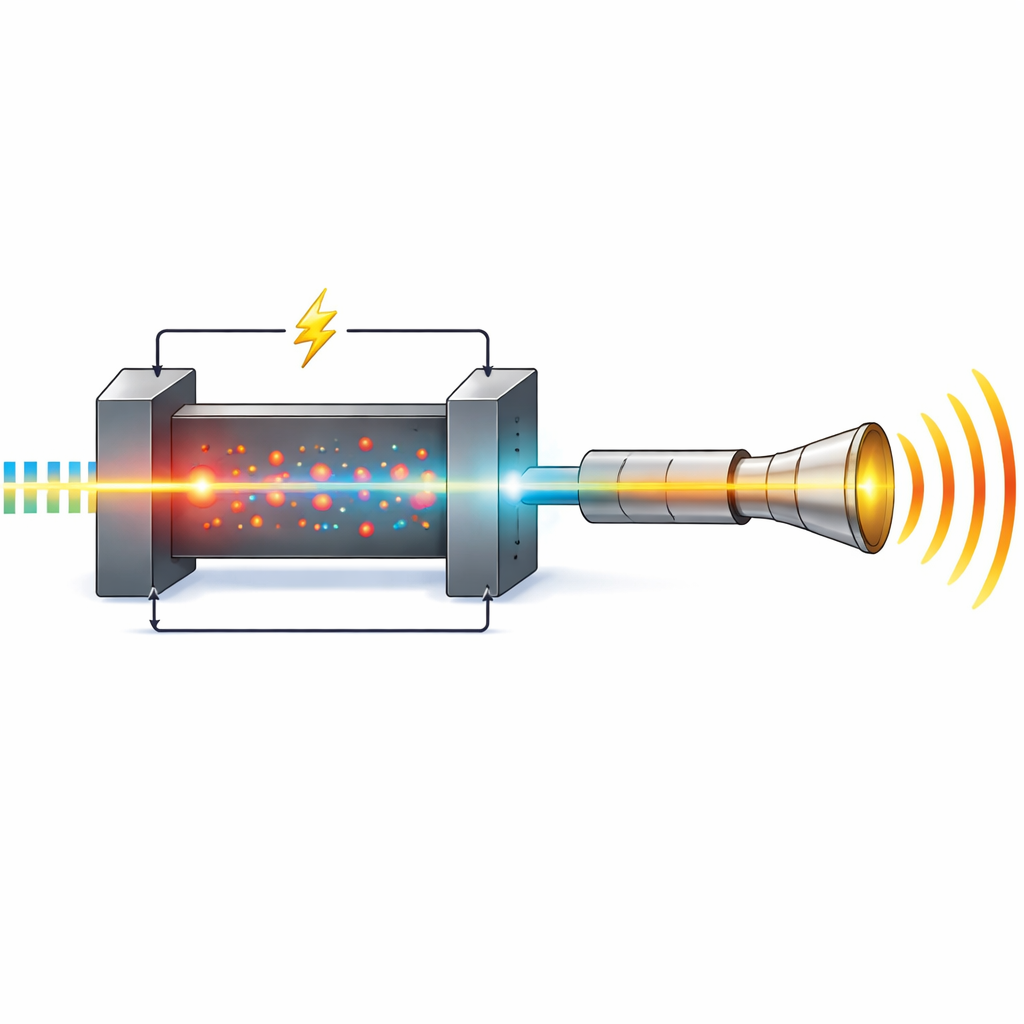
The authors tackle this problem with an optoelectronic microwave source that uses laser light to control a special semiconductor switch. Instead of directly amplifying radio waves with transistors, the system first converts an electrical signal into precisely timed laser pulses. These pulses pass through a chain of optical components that shape their frequency, duration, and repetition rate over a wide range. The shaped light is then delivered by optical fiber to a compact device made from silicon carbide, a tough, wide-bandgap material well suited to high voltages and high temperatures. When the laser pulses hit this device, its electrical resistance changes in step with the light, turning stored electrical energy into powerful microwave bursts.
Designing a fast and rugged semiconductor heart
At the core of the system is a silicon carbide block engineered to respond on a timescale of roughly one hundred trillionths of a second, while still withstanding tens of thousands of volts. The researchers tune the material by adding carefully balanced impurities that trap and release electrons under laser illumination, allowing a rapid rise and fall of electrical conductivity without overheating. They shape the electrodes so that intense electric fields and high currents do not overlap at sharp edges, which helps prevent breakdown. Tests show that a single device can handle peak currents of nearly two thousand amperes and momentary power levels up to about 55 megawatts, placing it among the most capable photoconductive switches reported so far.
From single pulses to coordinated arrays
When integrated with a tailored optical source and a broadband transmission line, the device generates microwave pulses whose frequency can be smoothly tuned across a wide span in the so‑called P–L bands, roughly from a quarter to just over one gigahertz. Over much of this range, the peak microwave power exceeds one megawatt, with pulse durations of about 30 billionths of a second at hundreds of pulses per second. The authors also demonstrate that multiple units can be combined into an antenna array with very little loss of efficiency. Because the timing jitter of the laser-driven pulses is only a few trillionths of a second, the individual beams add up coherently in space, concentrating their energy where it is needed.
What this advance means going forward
In plain terms, this work shows that it is possible to use precisely controlled laser flashes to drive a compact semiconductor device that emits very strong, tunable microwave pulses. By marrying the broad bandwidth and flexibility of optics with the durability of silicon carbide, the authors sidestep long‑standing limits of purely electronic generators. Their prototype already reaches megawatt peak powers over a wide frequency range and combines efficiently in arrays, pointing toward future systems that can steer, shape, and tune microwave energy with great freedom. With further development, similar designs could be adapted to continuous operation and scaled to larger arrays, opening new options for radar, communications, targeted heating, and medical therapies that rely on powerful, highly controllable radio waves.
Citation: Niu, X., Wang, L., Zhang, B. et al. A pulsed optoelectronic microwave source with high power and frequency tunability. Nat Commun 17, 3054 (2026). https://doi.org/10.1038/s41467-026-69582-y
Keywords: high-power microwaves, optoelectronic devices, silicon carbide, photoconductive switches, microwave arrays