Clear Sky Science · en
Transcranial focused ultrasound stimulation enhances semantic memory by modulating brain morphology, neurochemistry and neural dynamics
Remembering Meaning in Everyday Life
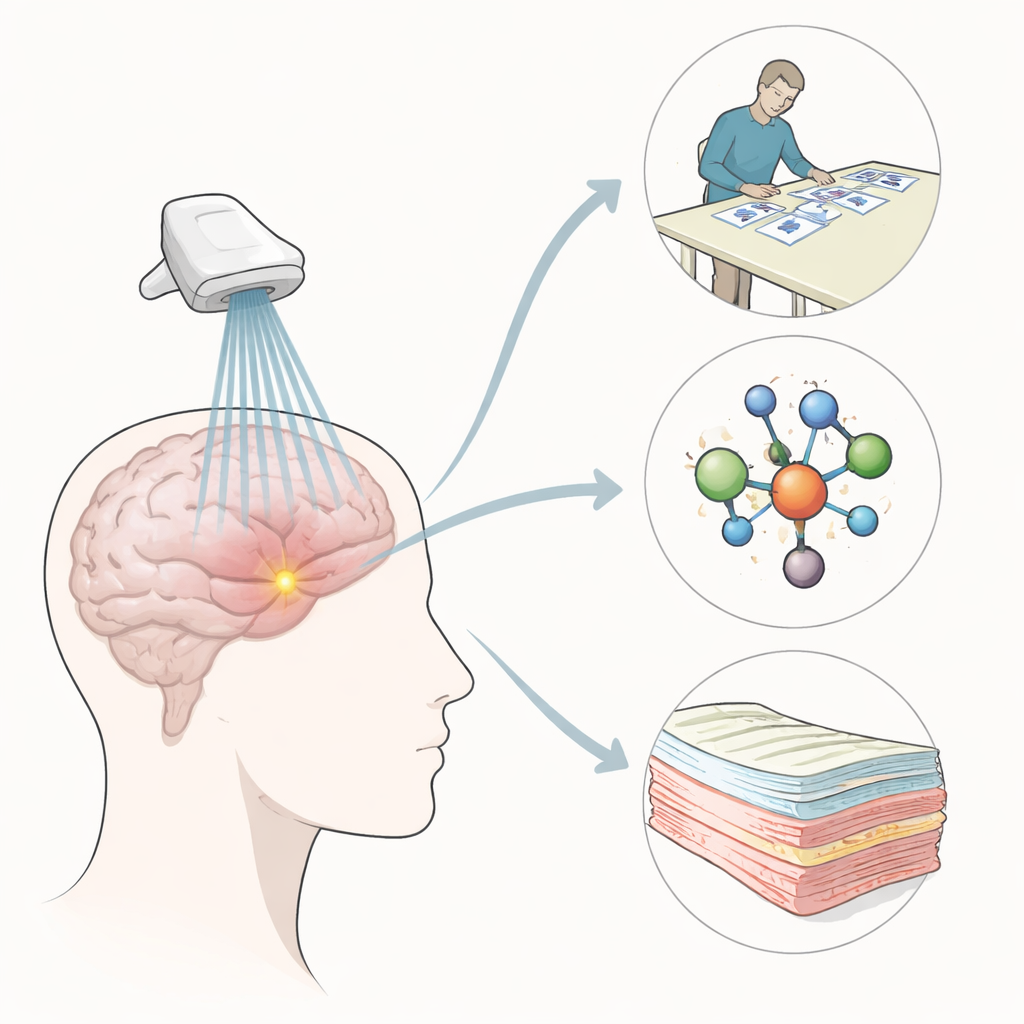
Every time you recognise a friend’s face, understand a joke, or choose milk to go with cereal, you draw on “semantic memory” – your storehouse of general knowledge about the world. When this system breaks down, as it does in some forms of dementia, everyday life becomes confusing and isolating. This study explores a new way to gently nudge a key brain hub for meaning, deep in the temporal lobes, using harmless sound waves, and asks a striking question: can a brief, non-invasive procedure temporarily sharpen our ability to understand meanings and associations?
A Deep Hub for Meaning
Decades of research point to a region called the anterior temporal lobe, tucked near the base of the brain, as a central hub for semantic memory. Damage here, as seen in semantic dementia, erodes knowledge of words, objects and people. Until now, most tools for probing or boosting this area from outside the skull – such as magnetic or electrical stimulation – have struggled to reach its ventromedial portion with precision. The authors turned instead to transcranial focused ultrasound stimulation, which uses finely aimed sound waves to influence brain activity in a very small, deep patch of tissue.
Using Sound Waves to Tune Brain Activity
In the experiment, healthy young adults attended three sessions. After a baseline brain scan, each person received two separate stimulation sessions several days apart: one aimed at the left ventromedial anterior temporal lobe, and one aimed at a control site in a brain ventricle containing fluid rather than thinking tissue. The ultrasound was delivered in a rapid “theta-burst” pattern lasting just 80 seconds. Around the stimulation, participants completed a picture-based semantic association task—choosing which of two images best matched a target picture in meaning—and a pattern-matching control task with scrambled images. At each visit they also underwent a battery of brain scans that measured chemistry, activity and structure.
Changes in Brain Chemicals and Structure
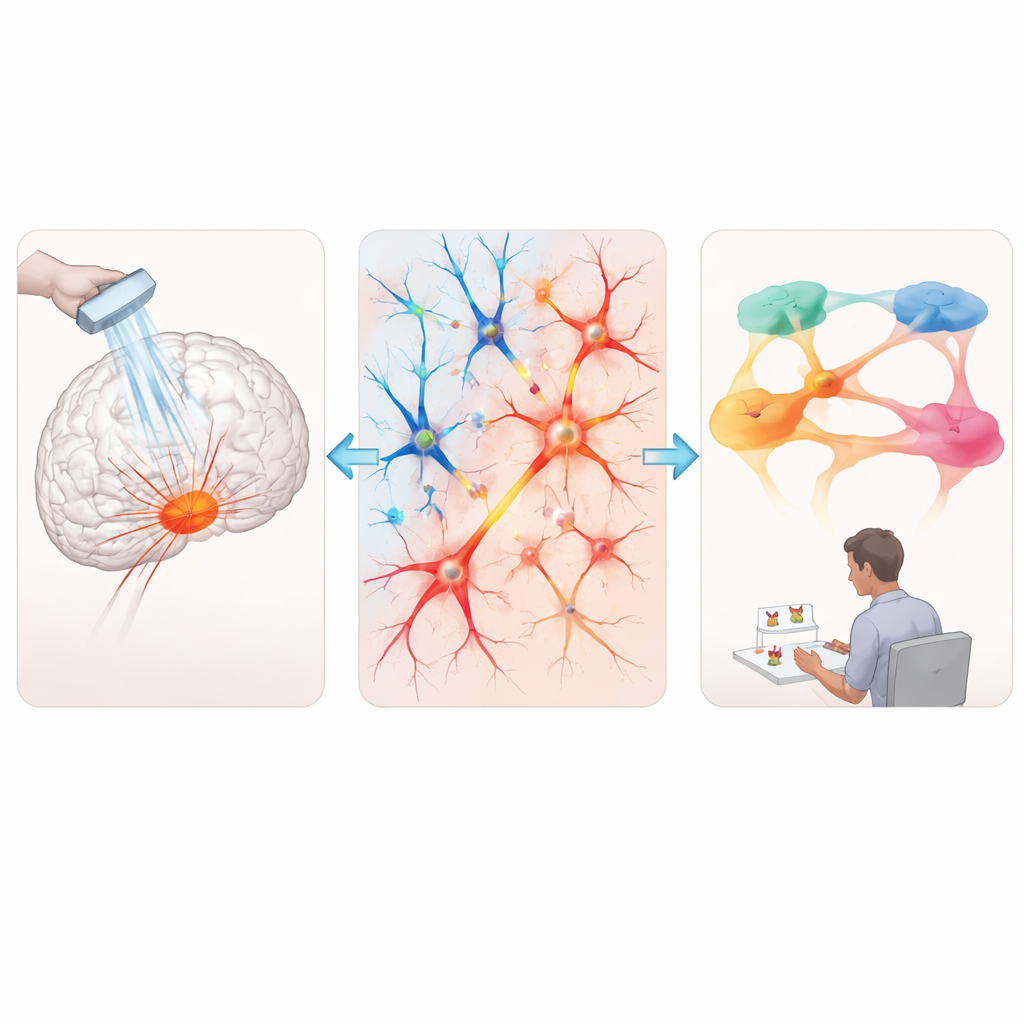
Magnetic resonance spectroscopy allowed the team to measure key brain chemicals in the targeted temporal lobe and in a visual area used as a control. After stimulation of the temporal hub, levels of GABA, an inhibitory messenger, decreased, while combined glutamate and glutamine—linked to excitation—increased. The overall balance shifted toward greater excitability, and this shift was tied to faster performance on the semantic task. Other markers associated with cellular health and energy use, including N-acetylaspartate, creatine and choline, also rose in the stimulated region but not in the control site. Structural scans revealed a small but detectable increase in grey matter volume in the ventromedial anterior temporal lobe after ultrasound, hinting at rapid microstructural adjustments in the local circuitry.
Network Efficiency and Sharper Meaning
Functional MRI showed that, during semantic processing, activity in the anterior temporal lobe and in connected language regions in the frontal and posterior temporal cortex actually decreased after stimulation, even as performance improved. This pattern supports the idea of “neural efficiency”: once the system is tuned, it can do more with less. A more detailed analysis of network interactions confirmed that the temporal hub became more strongly and symmetrically connected with other language regions at rest, and that during semantic tasks it drew stronger input from its partners while sending out slightly leaner signals. Behaviourally, people became more accurate on the semantic association task after temporal-lobe stimulation, whereas the control task and the control stimulation showed no meaningful change, and participants reported no notable discomfort or side effects.
Promise for Helping Failing Memories
Taken together, the results suggest that a brief burst of focused ultrasound to a deep semantic hub can temporarily rebalance local brain chemistry, subtly reshape tissue structure, and streamline communication across a wider language network, resulting in better performance on meaning-based decisions. Although the study was small and tested only short-term effects in healthy volunteers, it offers an early proof of principle that sound waves might one day help support or restore semantic memory in conditions such as dementia, by gently encouraging the brain’s own capacity for rapid plasticity and network reorganisation.
Citation: Jung, J., Atkinson-Clement, C., Kaiser, M. et al. Transcranial focused ultrasound stimulation enhances semantic memory by modulating brain morphology, neurochemistry and neural dynamics. Nat Commun 17, 2833 (2026). https://doi.org/10.1038/s41467-026-69579-7
Keywords: semantic memory, focused ultrasound, anterior temporal lobe, brain plasticity, neuromodulation therapy