Clear Sky Science · en
Do-it-yourself protein arrays as high-throughput immunoassays enabled by confined droplets on patterned plasmonic chips
Why tiny blood samples can tell big health stories
Doctors and scientists often want to track dozens of proteins in the blood to understand infections, cancer, or inflammatory diseases. But today this usually needs bulky lab machines, trained specialists, and more blood than is comfortable to take from small children or experimental animals. This study introduces a simple, pipette-only test that turns tiny droplets of blood or cell culture into rich protein readouts, opening the door to fast, gentle, and widely accessible health monitoring.
A new kind of do-it-yourself test surface
At the heart of the work is a specially patterned glass chip coated with a thin layer of gold nanoislands. These gold structures make nearby fluorescent dyes shine up to hundreds of times brighter. The chip is further treated so that some areas love water (hydrophilic spots) while the surrounding regions repel it (hydrophobic rings). When a user places a small droplet on the chip with an ordinary pipette, the liquid neatly confines itself to the desired spots instead of spreading out. This "droplet corral" lets anyone lay down tiny circles of capture antibodies—the molecules that recognize specific proteins—without using expensive printing machines. 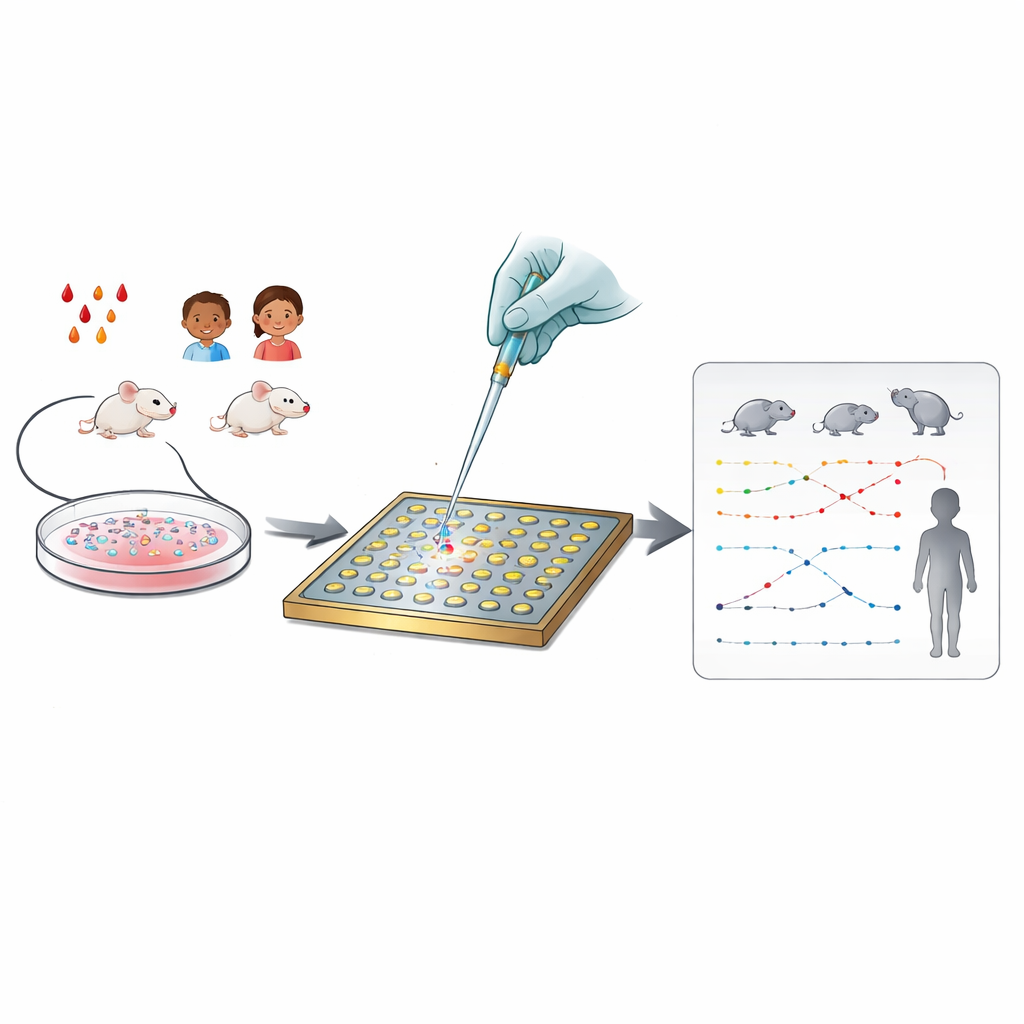
Turning droplets into powerful protein arrays
The team calls their approach a droplet-based do-it-yourself (DBDIY) array. First, microdroplets carrying capture antibodies are pipetted onto the patterned spots and allowed to dry, enriching the antibodies there. Later, slightly larger droplets of blood, serum, or cell-culture fluid are added over groups of spots, letting the target proteins bind. A second antibody tagged with a near-infrared fluorescent dye is then added to complete a “sandwich” around each target molecule. Because the gold nanoislands strongly boost the dye’s glow, even very low protein levels produce bright signals that can be read by a compact scanner. The same chip design can be scaled up or down: one layout measured 24 samples against 12 different proteins at once, while others traded the number of samples for more tested proteins or smaller sample volumes.
Following immune signals over time in animals
To show what this platform can do, the researchers followed ten immune-signaling proteins, or cytokines, in mouse models of infection, intestinal inflammation, and breast cancer. Using only about six microliters of serum or blood per time point—roughly a pinprick—they repeatedly sampled the same animals over days to weeks. In mice given bacterial toxin, the chip revealed sharp rises in proteins such as IL-6, CCL2, and interferon-gamma, marking an escalating inflammatory response. In tumor-bearing mice, cytokine levels climbed gradually as the cancer grew, while chemotherapy produced a burst of immune activity followed by partial normalization. Because each chip carries many tiny spots, the method can capture these changing protein “fingerprints” for individual animals instead of relying only on group averages. 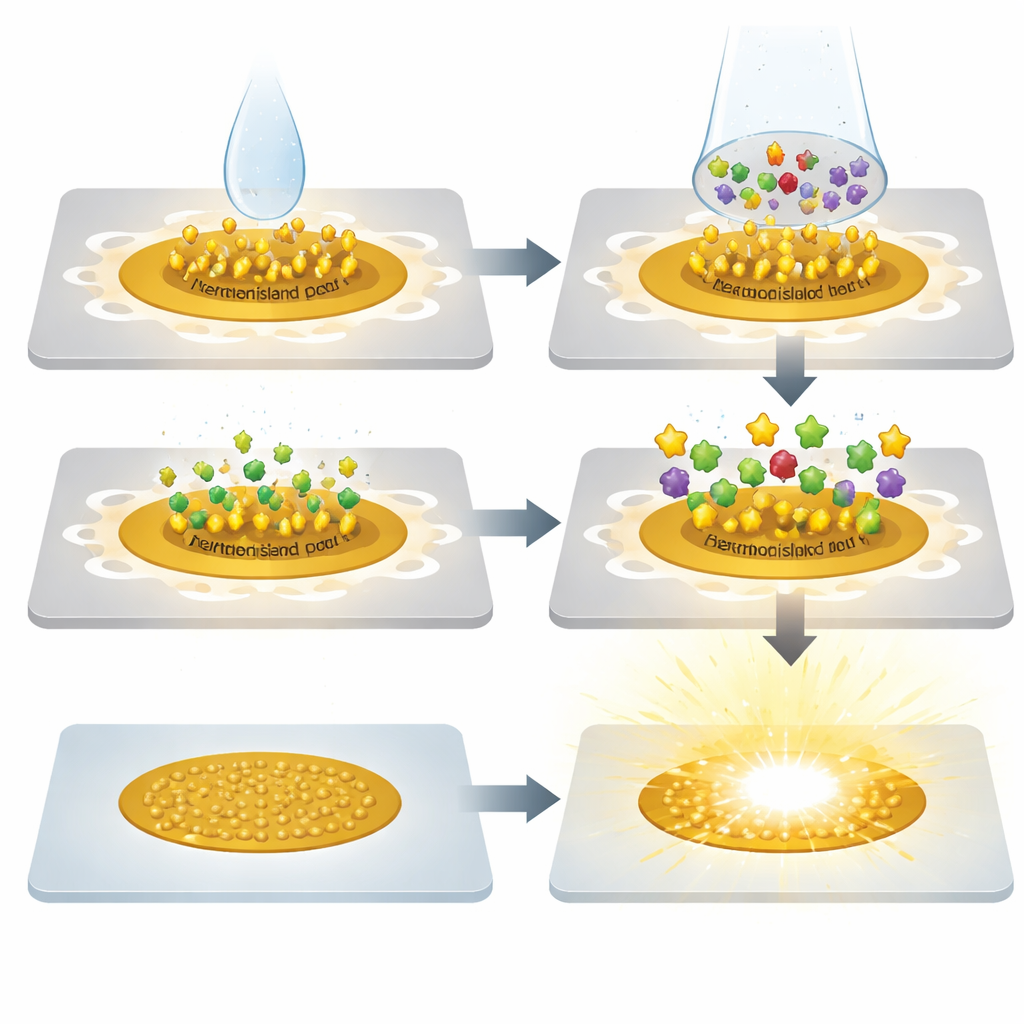
From lab bench to children’s bedside
The platform also proved its worth in real-world clinical tests. The team measured C-reactive protein (CRP)—a widely used marker of infection and inflammation—in peripheral blood from 112 children. Remarkably, just one nanoliter of whole blood was enough for a full measurement completed within an hour. When compared with hospital instruments, the chip achieved 100% sensitivity and 100% specificity for classifying samples as CRP-positive or CRP-negative, and its numeric results closely matched two independent clinical methods across a wide range of concentrations. The same approach accurately measured another heart-related marker, NT-proBNP, and profiled multiple cytokines in samples from infected patients and stimulated human immune cells.
What this means for future testing
In everyday terms, this work turns a sophisticated protein microarray into something that can be built and run with little more than a patterned slide and a pipette. By harnessing droplet confinement and light-boosting gold nanostructures, the DBDIY chip delivers high sensitivity, tests many proteins at once, and uses only trace amounts of sample. That combination could make it easier to monitor disease progression in children, follow treatments in animal models without repeated large blood draws, and eventually bring rich protein testing to clinics and laboratories that lack large instruments or specialized staff.
Citation: Yue, Y., Shi, C., Wang, Y. et al. Do-it-yourself protein arrays as high-throughput immunoassays enabled by confined droplets on patterned plasmonic chips. Nat Commun 17, 2802 (2026). https://doi.org/10.1038/s41467-026-69570-2
Keywords: protein microarray, cytokine monitoring, plasmonic biosensor, point-of-care diagnostics, CRP detection