Clear Sky Science · en
Impact of authigenic clay formation on marine trace element cycling
Hidden clay and the chemistry of the seas
Far below the ocean’s waves, in thin layers of mud only centimeters thick, tiny green clay grains quietly help regulate the chemistry of seawater. This study reveals that these “authigenic” clays—minerals that grow directly on the seafloor—do far more than lock up common elements like iron and magnesium. They also act as subtle gatekeepers for many trace elements that influence marine life, climate, and the way scientists read Earth’s past from the rock record.
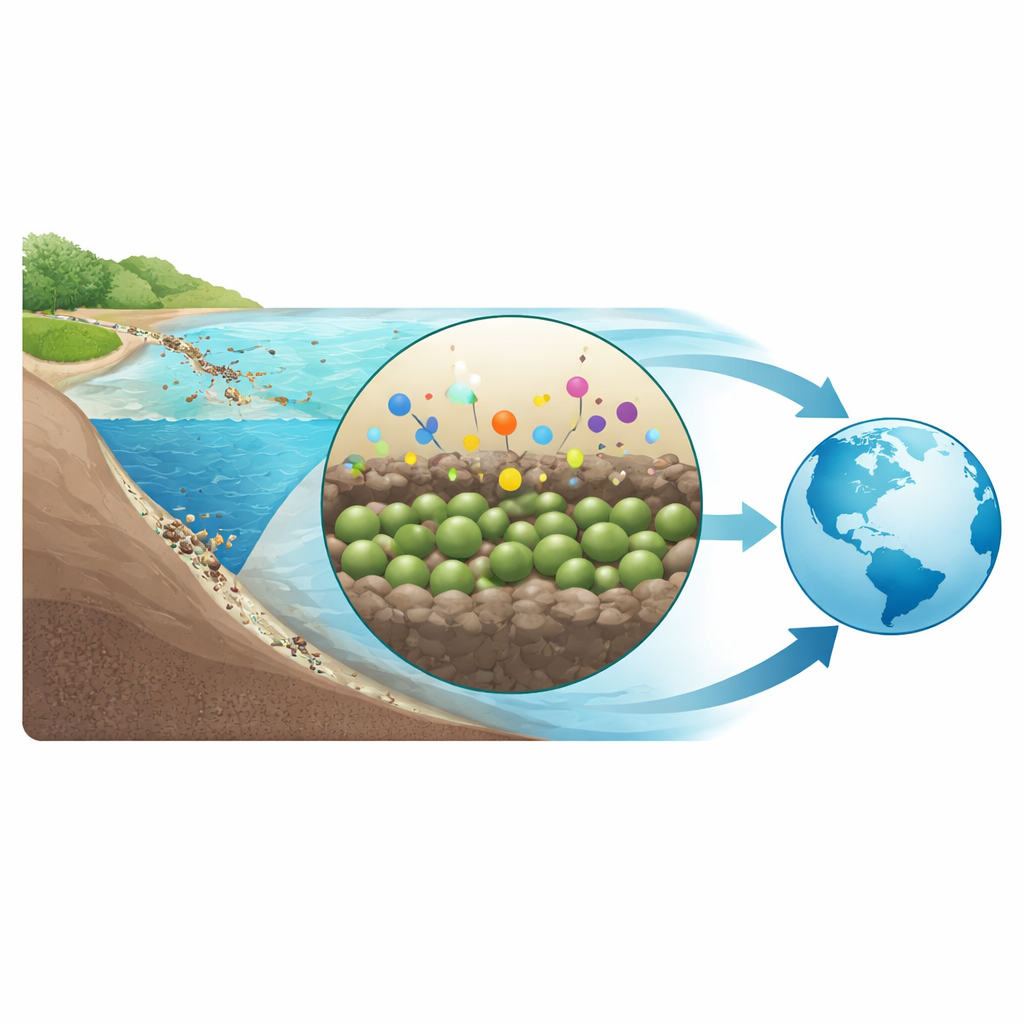
Green grains growing in the sea floor
The research focuses on a family of green clays that form in marine sediments—iron-rich smectites that gradually mature into the mineral glauconite. Unlike the fine, dusty clays carried in by rivers, these green grains grow in place inside seafloor mud and in tiny fecal pellets produced by seafloor animals. Because the pellets are relatively large and magnetic, the team could separate them from surrounding sediment and analyze their chemistry in unusual detail. They sampled sites off West Africa, the eastern tropical Atlantic, and the Oregon coast in the North Pacific, capturing a range of water depths, sediment types, and oxygen conditions.
Taking and giving back chemical ingredients
By comparing the green pellets with the original detrital material around them, the scientists identified which elements the clays tend to absorb and which they reject as they form. After correcting for simple dilution effects, they found that elements such as boron, iron, magnesium, potassium, rubidium, zinc, chromium, cobalt, vanadium, and several others are consistently enriched in the authigenic clays. This means the clays act as a sink, pulling these substances out of the surrounding porewater and, ultimately, sequestering them in buried sediments. In contrast, elements like copper, barium, titanium, many rare earth elements, and aluminum are depleted in the green clays relative to their starting material. Those elements are preferentially left behind in the porewater, creating a small but persistent upward “leak” of these species from sediments back into the ocean.
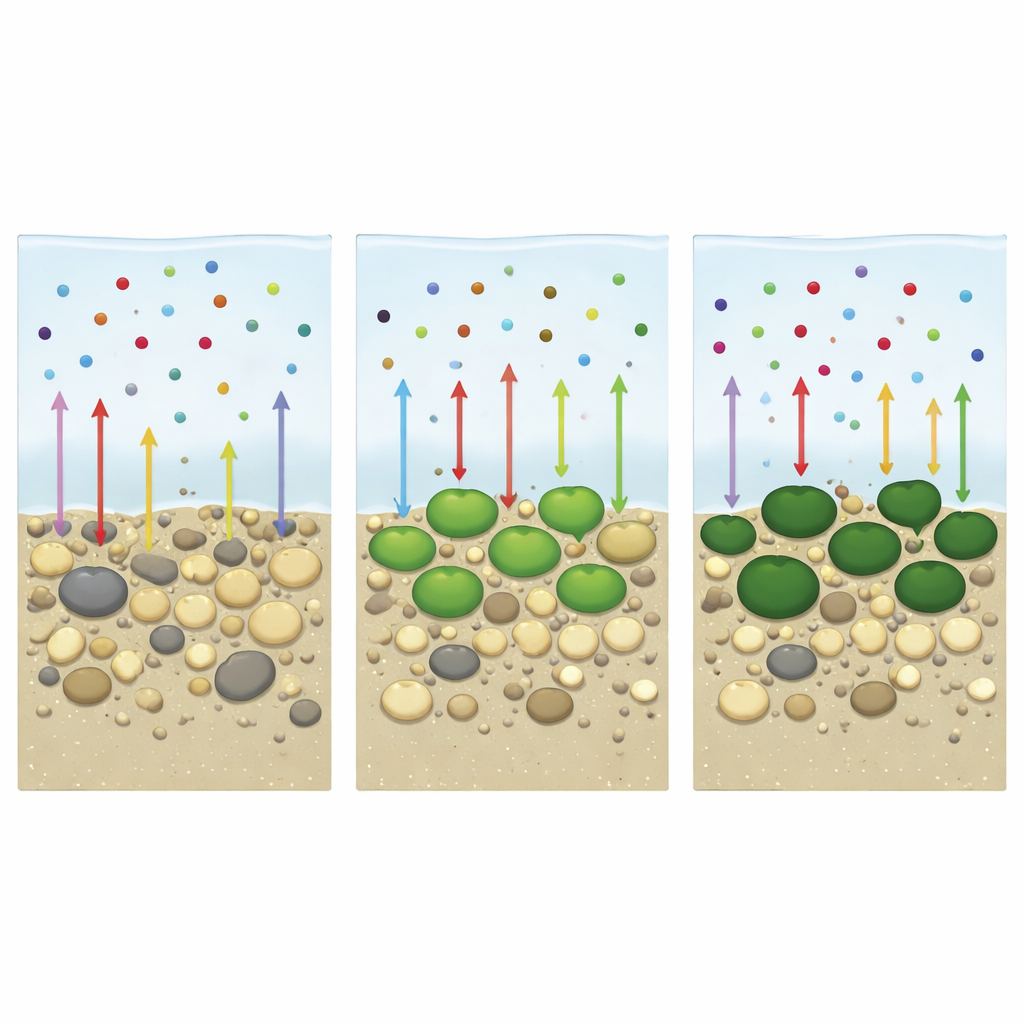
How maturing clays reshape ocean budgets
The team also examined pellets of different ages and stages of maturity, especially at one Atlantic site where the grains have been growing and transforming for up to 2.5 million years. As the clays evolve from iron-rich smectite toward more ordered, potassium-rich glauconite, their tendency to hoard certain elements grows stronger: many metals and alkali elements continue to accumulate in the pellets over time. A few elements, like strontium, niobium, and barium, become increasingly excluded as the clays mature. Using these patterns together with previous estimates of how much clay forms globally, the authors built a series of first-order budgets for dozens of elements. They show that clay formation can account for a substantial fraction of the “missing” sinks or sources in existing global cycles for elements such as zinc, rubidium, gallium, boron, beryllium, cobalt, chromium, and vanadium.
Rethinking ocean tracers from the mud up
Rare earth elements and neodymium isotopes are widely used as tracers of ancient ocean circulation, so the team paid special attention to how green clays handle them. They found that the rare earth patterns and neodymium isotope signatures in the authigenic grains closely match those of the detrital sediments from which they grew, not those of seawater. Because the clays systematically exclude rare earth elements rather than incorporating them, they help generate the elevated rare earth concentrations measured in porewaters and contribute to a benthic flux back into the ocean. At the same time, this means these clays cannot straightforwardly record past seawater properties, and that diagenetic processes in sediments must be carefully considered when interpreting other archives, like carbonate shells or phosphate grains, that do incorporate these elements.
Why these quiet clays matter
Overall, the study shows that green authigenic clays act as chemical control knobs at the seafloor, selectively locking away some trace elements while liberating others. When scaled up to the entire ocean, these tiny grains help close important gaps in our understanding of how elements move into and out of seawater, with implications for nutrient availability, climate-linked chemical cycles, and the reliability of geochemical “fossils” used to reconstruct Earth’s history. In simple terms, what happens in a thin layer of seafloor mud can quietly shape the chemistry of the whole ocean.
Citation: Löhr, S.C., Abbott, A.N., Baldermann, A. et al. Impact of authigenic clay formation on marine trace element cycling. Nat Commun 17, 2974 (2026). https://doi.org/10.1038/s41467-026-69566-y
Keywords: marine authigenic clays, trace element cycles, ocean chemistry, glauconite, seafloor sediments