Clear Sky Science · en
An LCA-assisted hierarchical design of radiative cooling coating for full life-cycle CO2 reduction
Cooler Buildings, Cleaner Air
Keeping homes and offices comfortable in a warming world usually means more air conditioning and higher electricity use, which in turn drives up carbon dioxide (CO2) emissions. This paper explores a new kind of ultra-white, heat-shedding coating that can keep buildings cool under the sun while actually removing more CO2 over its lifetime than it produces. By looking at the coating from raw materials to disposal, the researchers show how smart design can turn a simple layer of paint into a quiet tool for fighting climate change.
Why Cooling Paint Matters
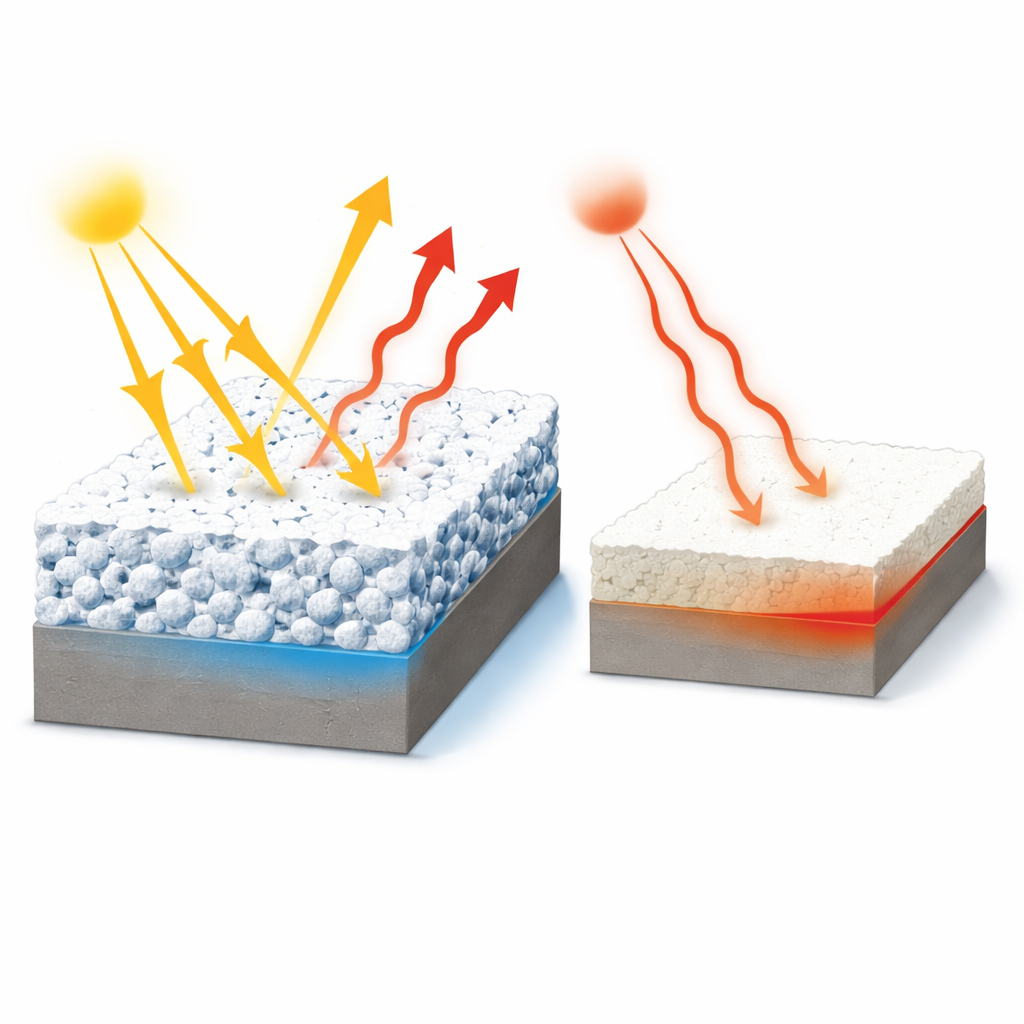
Air conditioners already consume nearly a tenth of global electricity and produce around a tenth of greenhouse gas emissions. One promising alternative is passive daytime radiative cooling: surfaces that strongly reflect sunlight and efficiently radiate heat into the cold of outer space. Many experimental materials can do this during use, but most ignore the emissions created when mining ingredients, making the product, and dealing with waste. The authors apply a full life-cycle assessment, a method that tracks CO2 from “cradle to grave,” and find that for typical commercial white building paint, almost 90% of emissions come from the raw materials, especially mineral fillers like titanium dioxide. This means that even highly reflective paints may still have a heavy hidden carbon cost if their ingredients are produced in a carbon-intensive way.
Turning Industrial Waste into a Climate Asset
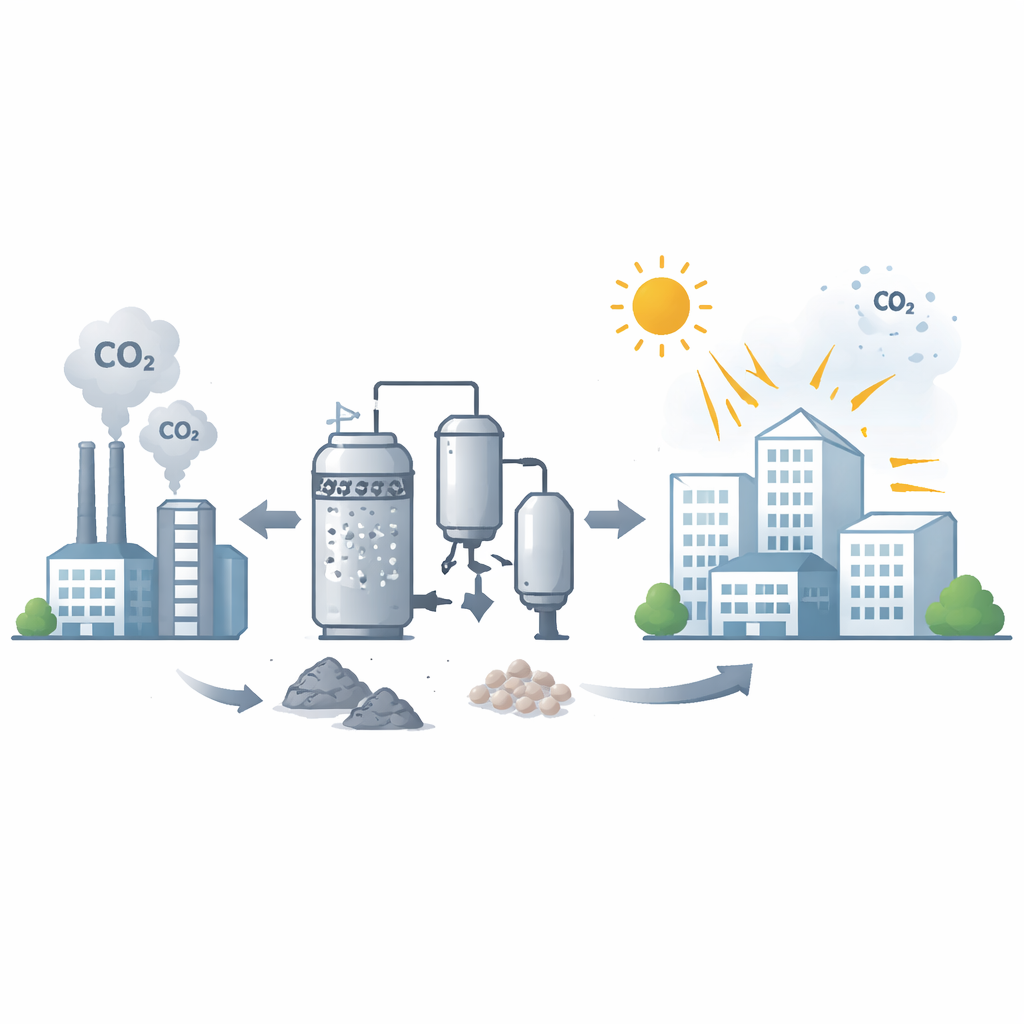
The team tackles this problem by redesigning the filler itself. They use waste magnesium salt from salt-lake lithium extraction and react it with CO2 taken from industrial flue gas to form a mineral called hydromagnesite. With the help of a common surfactant, sodium dodecyl sulfate, they tune this mineral into tiny, porous, flower-like and nest-like spheres. Making these particles not only locks away CO2 as solid carbonate but also co-produces ammonium chloride, a valuable chemical, which offsets further emissions. When all inputs and outputs are counted at industrial scale, the filler comes out “carbon negative”: every ton produced removes more CO2 than it emits. Embedding these spheres in a polymer binder therefore starts the coating’s life with a built-in climate advantage before it ever reaches a wall or roof.
A Bright Shield Against the Sun
To turn the filler into a practical coating, the researchers disperse it in a durable fluoropolymer (PVDF) that forms a tough, weather-resistant film. The result is a matte, ultra-white layer that reflects over 96% of incoming sunlight and strongly emits heat in the infrared range that passes through the atmosphere into space. Outdoor tests in two Chinese cities show that under strong midday sun, surfaces coated with this material stay as much as about 9 degrees Celsius cooler than the surrounding air and noticeably cooler than a leading commercial reflective product. Across all 19 standard global climate zones, simulations indicate that the coating can provide more than 100 watts per square meter of cooling power, reducing the need for mechanical air conditioning in many settings.
Built to Last in the Real World
For a cooling coating to deliver long-term climate benefits, it must resist dirt, water, and sunlight damage. The PVDF-based system shows strong adhesion to metals, ceramics, glass, wood, and plastics, and even on curved surfaces it forms a uniform, crack-free layer. Its superhydrophobic surface causes water droplets to roll off, carrying away dust that would otherwise darken the coating. Harsh tests in hot salt water barely affect its appearance or strength, while accelerated aging equivalent to five years of outdoor sun leads to only a small drop in reflectivity and almost no visible color change. In contrast, a typical commercial reflective coating loses more brightness and becomes less water-repellent over the same test, suggesting that frequent repainting would be required and would add extra emissions.
Counting Carbon from Start to Finish
By combining experimental data with building-energy simulations, the authors compare their coating to a widely used commercial reflective product of equal practical performance. For every ton of coating produced and applied, the new system cuts emissions in the raw-materials stage by more than two tons of CO2, thanks mainly to the carbon-negative filler. During use, the higher reflectivity and strong heat emission lower air-conditioning demand in most of the world’s climate zones, though in very cold regions the extra cooling can slightly increase heating needs. After disposal by landfill, the new coating still generates less waste mass. Taken together, depending on climate, each ton of this coating prevents between about 0.6 and 13.7 tons of CO2-equivalent emissions over its life, comparable to planting dozens to hundreds of trees per year, while remaining cost-competitive with ordinary exterior paints.
A Simple Layer with a Big Climate Role
For non-specialists, the key message is that coatings can be designed not just to save energy when in use but to be climate-friendly from the moment their ingredients are sourced to the time they are thrown away. By turning industrial waste and smokestack CO2 into a bright, long-lasting cooling layer, this work shows a pathway to building materials that act as net carbon sinks rather than sources. If adopted widely on roofs and walls, such coatings could help keep cities cooler, ease pressure on power grids, and contribute meaningfully to global efforts to cut CO2 emissions.
Citation: Cao, N., Chi, H., Chen, Y. et al. An LCA-assisted hierarchical design of radiative cooling coating for full life-cycle CO2 reduction. Nat Commun 17, 2819 (2026). https://doi.org/10.1038/s41467-026-69560-4
Keywords: radiative cooling, cool roofs, carbon-negative materials, building energy efficiency, life cycle assessment