Clear Sky Science · en
Scalable semitransparent organic solar cells with robust film thickness tolerance for building-integrated photovoltaics
Windows That Make Their Own Power
Imagine if the glass in office towers or home windows could act like quiet, invisible power plants—letting in daylight while also generating electricity and even helping keep rooms cooler. This study shows how to build such "power windows" using organic solar cells that are both see‑through and efficient, and that can be manufactured at sizes and thicknesses practical for real buildings.

Why See-Through Solar Cells Are Hard
Conventional solar panels are opaque because they absorb as much light as possible to maximize power. Semitransparent organic solar cells must strike a delicate balance: they need to let enough visible light through to remain window-like, yet still capture enough light to produce useful electricity. Until now, this has forced researchers to use extremely thin active layers—less than 80 nanometers thick—made with toxic halogenated solvents under tightly controlled lab conditions. Those fragile, ultra-thin films work on tiny test cells, but they are very difficult to reproduce over large areas. When scaled up to window-sized modules, their performance typically collapses, with only a little more than half of the cell-level efficiency surviving in the final panel.
A New Recipe for Thick, Transparent Power Windows
The team behind this work tackled the problem from two directions at once. First, they used a "donor-dilution" strategy in the light-absorbing layer, reducing the fraction of the donor material that absorbs most visible light and increasing the fraction of the acceptor material, which is more transparent in that range but still active in the near-infrared. Second, instead of spin-coating tiny devices, they used slot-die coating—a printing-like method that can cover large areas—together with a benign, non-halogen solvent in normal air. Using a particular donor–acceptor pair known as PM6:Qx-p-4Cl, they tuned the mixture to a donor-to-acceptor ratio of 1:3 and showed that even relatively thick films, around 120–300 nanometers, could remain semitransparent while still delivering strong electrical performance. In devices of 1 square centimeter, they achieved light utilization efficiencies above 4% for thinner films and about 3% for films more than three times thicker than the usual designs, all while keeping average visible transparency between roughly one-third and one-half.
How the Microscopic Structure Makes It Work
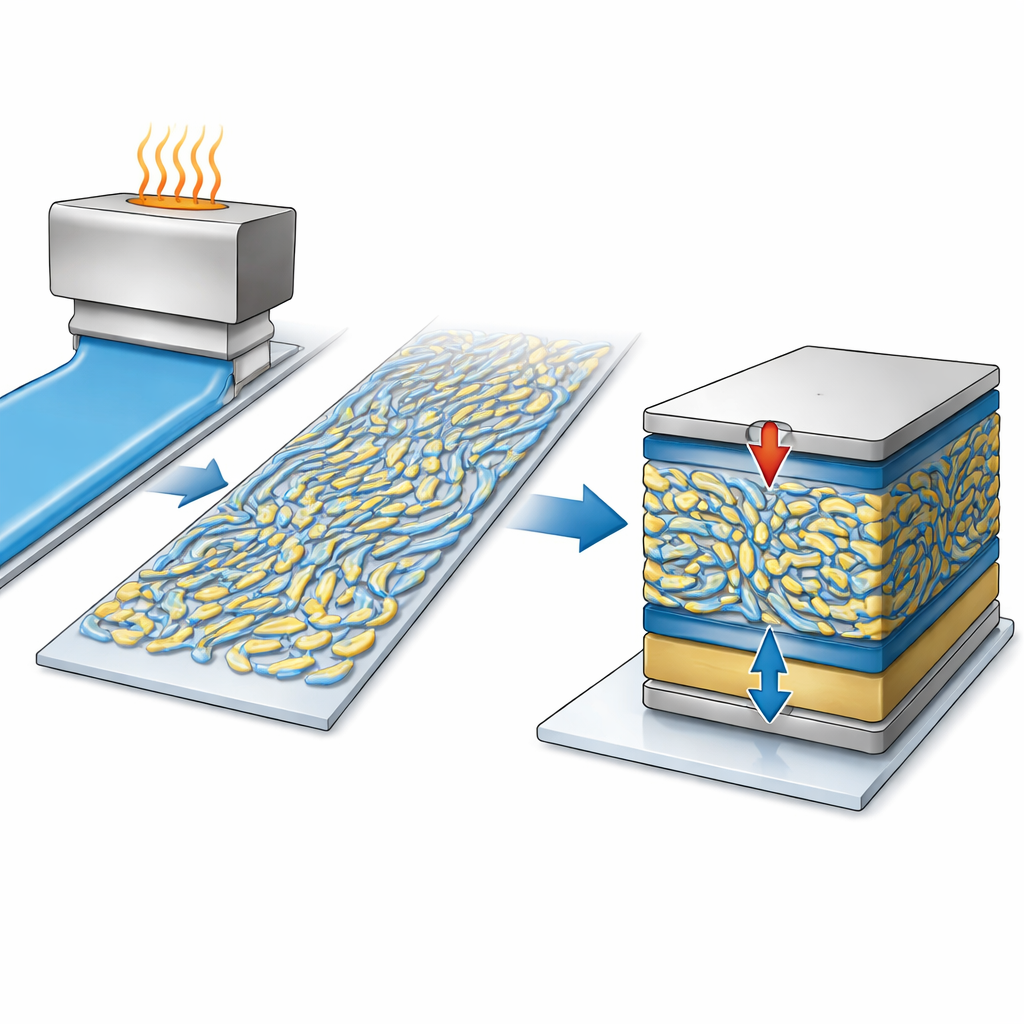
To understand why these thicker, diluted films work so well, the researchers probed their internal structure and how they form during drying. With traditional spin coating at high acceptor content, the acceptor molecules clump into large, rigid regions, leaving poor contact with the donor material and creating bottlenecks for charge motion. By contrast, when the same mixture is applied by slot-die coating onto a warm surface, the molecules organize while still in the liquid state. This produces a finely interwoven network of narrow, fiber-like domains that stay similar in size even when the donor is heavily diluted. Measurements of how excited states move and separate into charges show that this network preserves fast charge generation and transport almost independent of the blend ratio. Crucially, the typical distance an excitation can travel is slightly longer than the width of these fibers, so most absorbed energy can reach an interface and be turned into usable charge.
From Lab Devices to Realistic Window Modules
Because the structure of the active layer remains robust even when thick, the performance of small test cells carries over unusually well to large modules. The team built a 100-square-centimeter semitransparent module made of 23 connected sub-cells and achieved more than 10% power conversion efficiency while keeping about one-third of visible light transmission. The efficiency of this full-size module retained roughly 85% of the efficiency measured in single devices, a level previously seen only in opaque organic modules. They then integrated six such modules into a 600-square-centimeter "window" in a scale model house, where the window simultaneously powered a small display, charged a lithium-ion battery, and blocked most near-infrared heat, significantly slowing the indoor temperature rise under simulated sunlight.
What This Means for Everyday Buildings
For non-specialists, the main message is that it is now possible to design see-through organic solar coatings that are thick, forgiving to manufacture, and scalable to window-sized modules without losing much performance. By carefully adjusting the material mix and the way the films are printed and dried, the authors created a stable, fibrous internal network that works well even when the layer is no longer ultrathin. As a result, large semitransparent panels can both look and behave like real windows, while generating meaningful power and helping manage heat. This advances the prospect of future buildings whose glass façades routinely supply electricity, store energy, and improve comfort—all without sacrificing views or daylight.
Citation: Wang, T., Fang, J., Zhang, H. et al. Scalable semitransparent organic solar cells with robust film thickness tolerance for building-integrated photovoltaics. Nat Commun 17, 2916 (2026). https://doi.org/10.1038/s41467-026-69537-3
Keywords: semitransparent solar cells, building-integrated photovoltaics, organic photovoltaics, solar windows, slot-die coating