Clear Sky Science · en
Natural hyperbolicity of hexagonal boron nitride in the deep ultraviolet
Why this matters for future light-based technology
Modern technologies from chipmaking to medical imaging increasingly rely on controlling light at very small scales and very short wavelengths, including the deep‑ultraviolet (DUV) used in advanced lithography. Engineers often need complex artificial structures, called metamaterials, to bend and squeeze light in unusual ways. This study reports that a naturally occurring crystal—hexagonal boron nitride (hBN)—can itself behave like an advanced “hyperbolic” optical material in the DUV, potentially simplifying and improving next‑generation nano‑optical devices.
A special crystal that treats light differently in different directions
hBN is a layered material: its atoms are strongly bonded within flat sheets but only weakly connected between sheets. This built‑in directional difference means hBN interacts with light very differently along and across the layers. The authors use an advanced optical technique, imaging spectroscopic ellipsometry, to measure how hBN reflects polarized light over many wavelengths and angles. From these measurements they reconstruct how the material’s refractive index behaves in‑plane (within the sheets) and out‑of‑plane (between sheets) down to 190 nanometers, well into the DUV. They find a striking contrast: within the sheets, hBN shows an intense, sharp absorption feature around 6.1 electron volts, while across the sheets the response is much weaker.
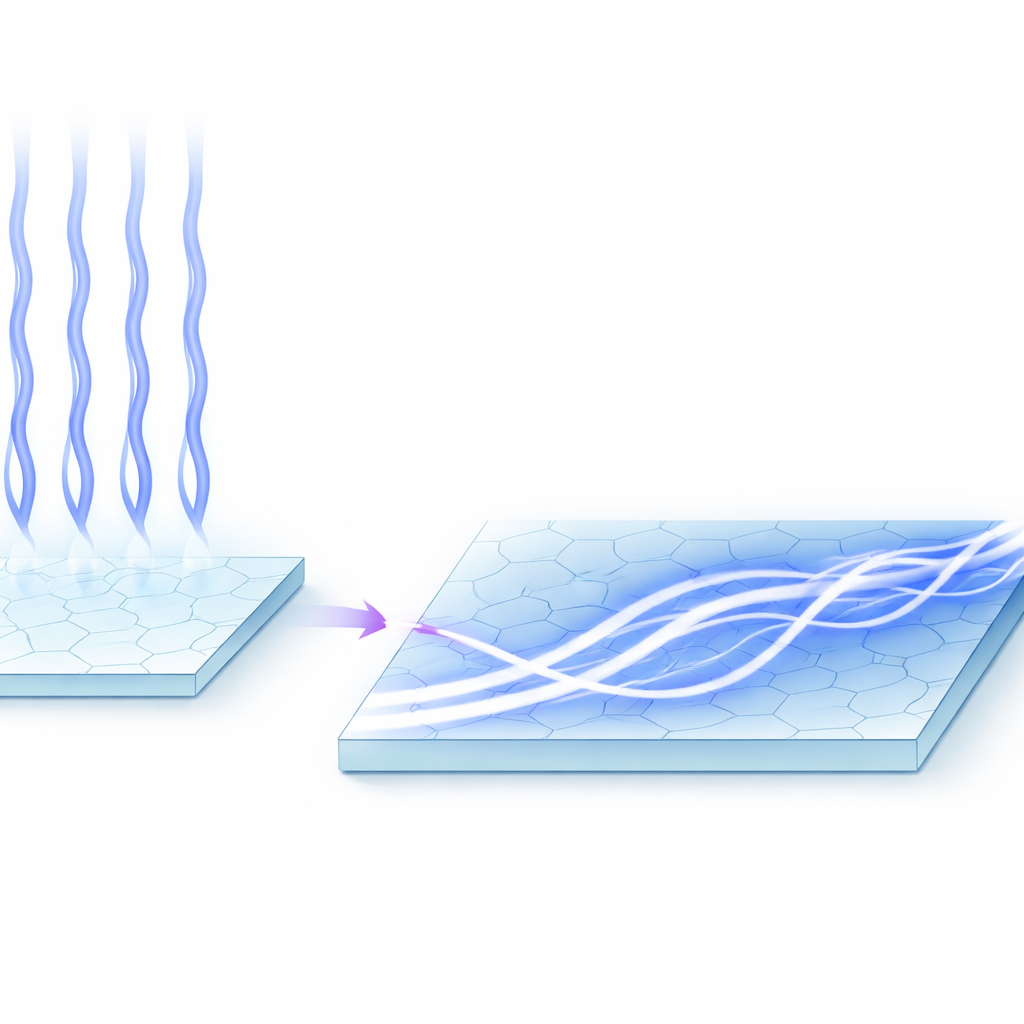
Tightly bound electron–light hybrids in the deep ultraviolet
The strong in‑plane response arises from “excitons,” bound pairs of electrons and holes created when light is absorbed. In hBN these excitons are unusually tightly bound and concentrated, giving the material an exceptionally large ability to soak up DUV light in very thin layers—much stronger than in other well‑known excitonic semiconductors and even compared with wide‑bandgap materials like aluminum nitride. Because these excitons live almost entirely within the sheets, they create a large mismatch between absorption and refraction along different directions. This combination of strong, direction‑dependent excitons and the layered crystal structure sets the stage for unusual ways of guiding and confining light.
When a natural crystal mimics an advanced metamaterial
Under certain DUV energies, the team finds that hBN enters a “type‑II hyperbolic” regime: its effective optical response looks metallic within the sheets but remains insulating across them. In simple terms, light traveling parallel to the layers feels a very different medium than light trying to cross them. This produces open, hyperbola‑shaped paths in the space of allowed light waves, which favor very large, highly confined wave patterns. Experiments on hBN flakes tens of nanometers thick reveal a broad, highly reflective plateau in this energy range, while calculations show that ordinary light cannot simply pass through—only evanescent, high‑momentum waves can exist. The authors also identify an energy where the in‑plane response nearly vanishes, an “epsilon‑near‑zero” point that can further enhance nonlinear and quantum optical effects.
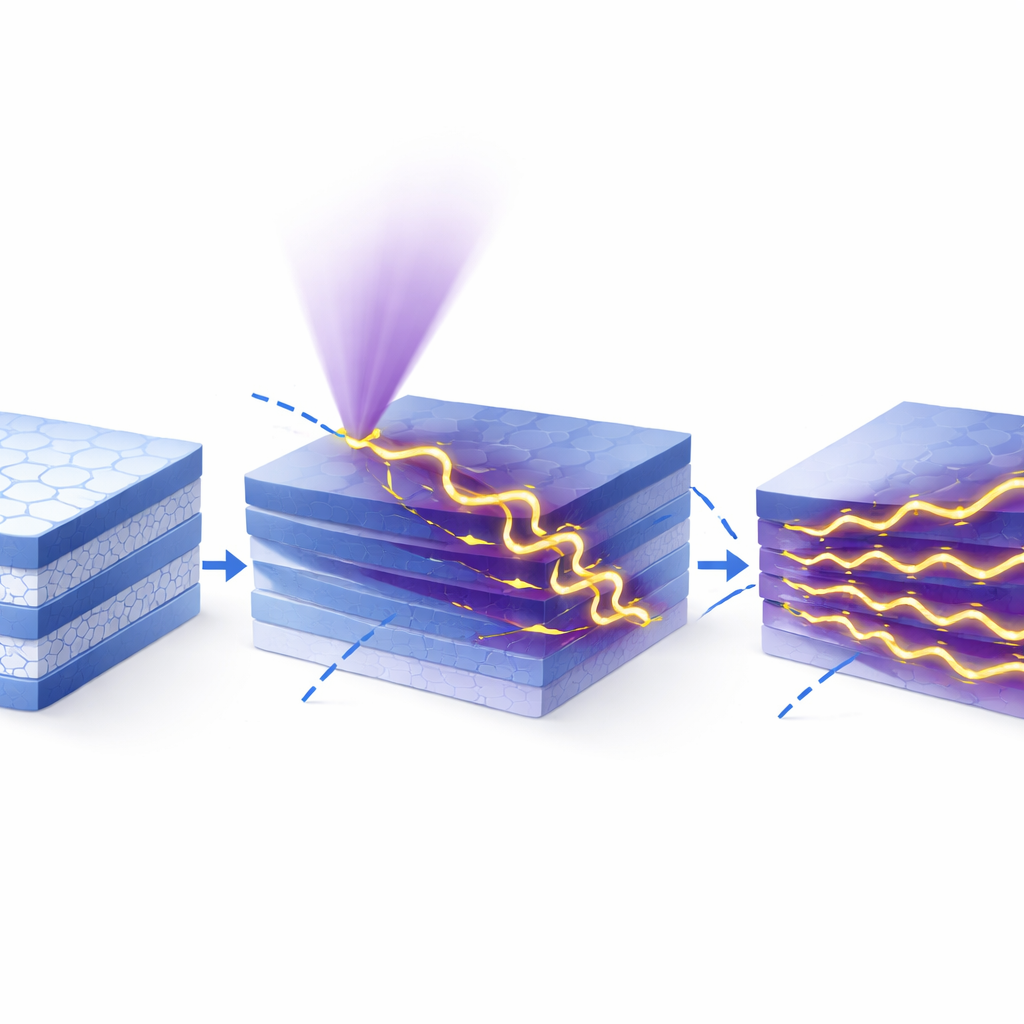
Guided ripples of light with extreme confinement
Building on these measurements, the researchers model “hyperbolic exciton polaritons”—hybrid waves where light couples strongly to excitons and is forced to travel at specific angles within the hBN slab. Simulations show that, in the hyperbolic energy window, a tiny dipole source placed near the surface launches sharply directional beams that skim within the crystal, in contrast to the more evenly spreading waves outside that window. Analytical calculations reveal that these modes carry several times more momentum than light in free space, leading to wavelengths inside the material up to ten times smaller than the free‑space wavelength. Higher‑order modes are even more confined yet still able to travel tens of nanometers before fading, with very slow group velocities that increase the time light interacts with the material.
What this means for real‑world devices
Altogether, the work shows that hBN, without any nanoscale structuring, naturally supports deep‑ultraviolet hyperbolic behavior driven by its strong, anisotropic excitons. This means it can funnel DUV light into ultra‑tight, highly directional channels and greatly boost the density of optical states available for emission and absorption. For non‑specialists, the key takeaway is that a single, crystalline material can act as a powerful “light compressor” for DUV wavelengths. Such properties could enable sharper‑than‑diffraction imaging, more precise DUV lithography for chip manufacturing, and new quantum‑optical platforms, all built on a robust and relatively simple natural crystal rather than elaborate artificial metamaterials.
Citation: Choi, B., Lynch, J., Chen, W. et al. Natural hyperbolicity of hexagonal boron nitride in the deep ultraviolet. Nat Commun 17, 2869 (2026). https://doi.org/10.1038/s41467-026-69536-4
Keywords: hexagonal boron nitride, deep ultraviolet optics, hyperbolic materials, exciton polaritons, nanophotonics