Clear Sky Science · en
Intrinsically stretchable all-polymer neuromorphic visual adaptive transistors based on multidimensional-phase-separation-induced micromesh
Why Stretchable Smart Vision Matters
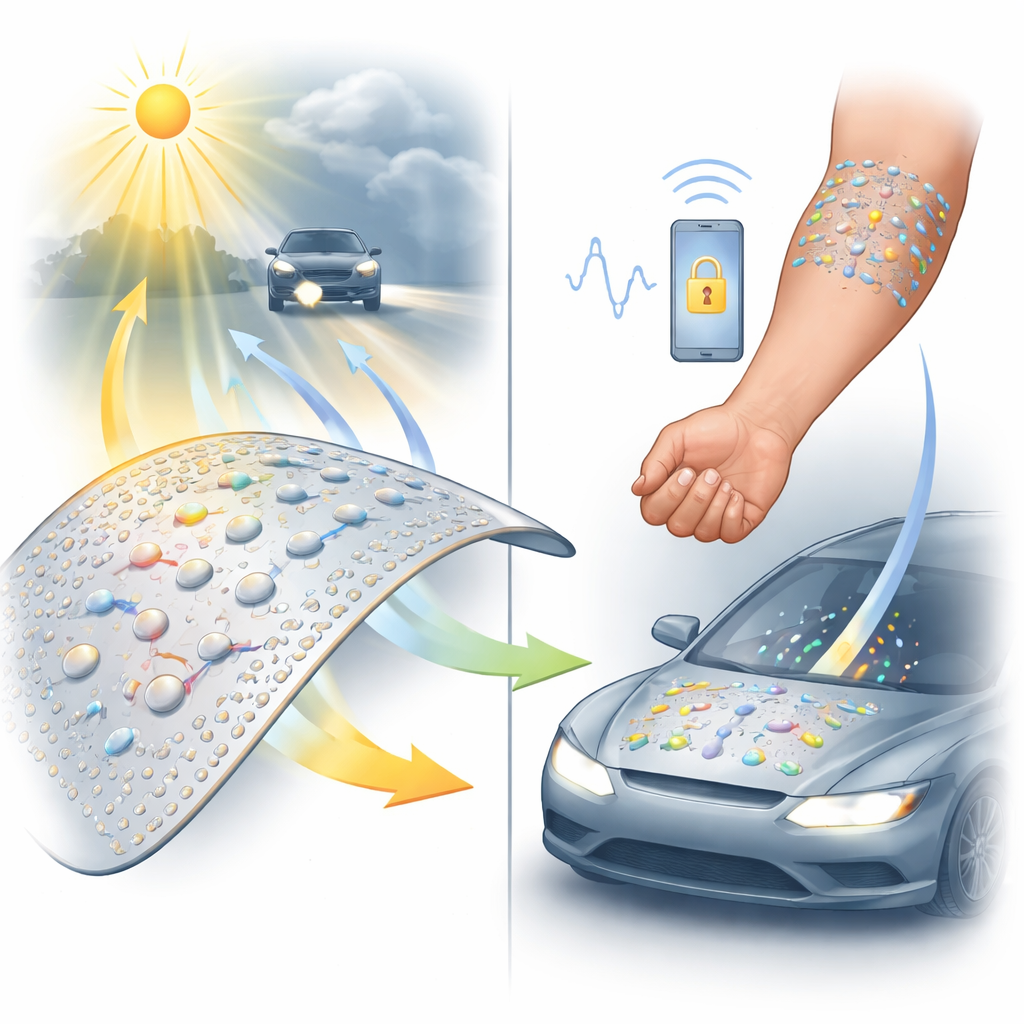
Imagine a soft, skin-like patch on your arm that lets you "see" in the dark, adapts to blinding headlights faster than your eyes, and secretly sends messages using invisible light. This study describes a new kind of flexible electronic device that can do just that. By mimicking how our eyes adapt to changing light, and by building that ability into a rubbery, stretchable material, the researchers point toward future wearable cameras, artificial retinas, and driver-assistance systems that are both smarter and safer.
A Soft Material That Acts Like an Eye
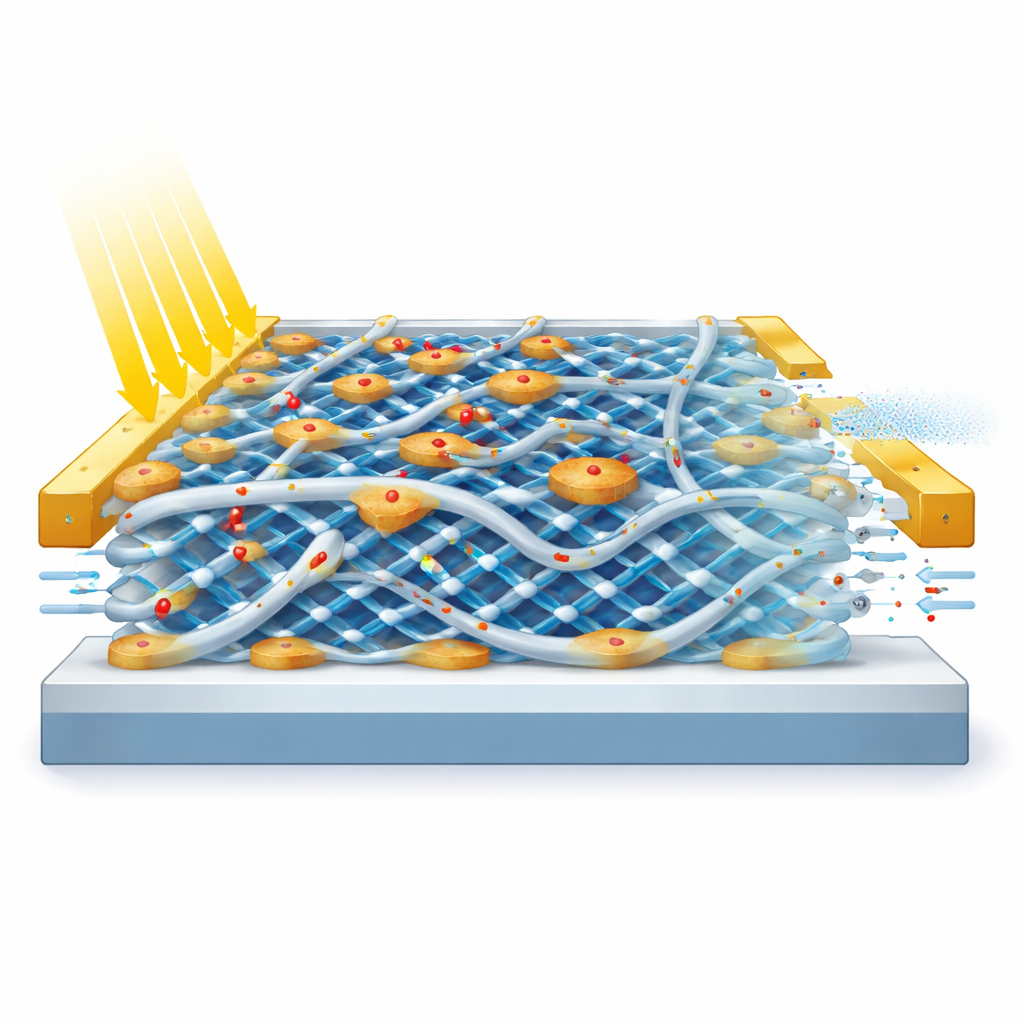
The heart of the work is a new soft semiconductor film that reacts to light and can be stretched to double its size without losing function. The team combines two light-sensitive polymers—one that donates electrical charges and one that accepts them—with a springy plastic called an elastomer. Because these ingredients do not mix evenly, they naturally separate into a fine three-dimensional micromesh: islands rich in rubber are surrounded by networks of intertwined light-sensitive fibers. This special structure lets the film bend, twist, and stretch like skin while still efficiently turning light into electrical signals across a wide range of colors, from visible light to near-infrared.
Hidden Traps That Enable Adaptation
In natural vision, our eyes avoid overload by adapting: after a sudden flash, the response quickly rises, then falls back to a comfortable level. The micromesh film is engineered to show a similar behavior. The boundaries between the rubbery islands and the polymer fibers act as controlled "traps" for electric charges. When light first hits the device, many charges flow, producing a strong signal. As illumination continues, more of these charges become caught in the traps, and the current automatically drops to a lower, steady value. By tuning how large and how numerous the holes in the micromesh are, the researchers can adjust how quickly and how strongly the device adapts to light, much like dialing in a biological reflex.
Transistors That Stretch, See, and Think
Building on this film, the team constructs all-organic "neuromorphic" transistors—devices that not only detect light but also imitate certain features of nerve cells and brain connections. These transistors reach a very high contrast between light and dark response, work for many colors of light, and crucially keep performing even when stretched up to 100 percent in two directions. Their adaptive response is exceptionally fast: they settle to a new level in about 0.4 seconds, faster than reported similar devices and far quicker than human dark adaptation, while saving nearly 90 percent of the energy that a non-adaptive detector would use under the same conditions. The same charge traps that cause adaptation also allow the devices to mimic inhibitory synapses—connections in the brain that dampen signals—showing one of the lowest measured values for a standard index of this behavior.
From Secret Messages to Safer Driving
Because the adaptive response changes over time, each light pulse carries more than just an on–off signal; it also carries timing and strength information. The authors exploit this richness to design an optical "codebook" similar to Morse code, where patterns in the peak current and decay time represent letters. By slightly changing the reading conditions, the same incoming signal can be decoded into a completely different word, enabling intentionally misleading messages for secure communication using near-infrared light that is hard to notice with the naked eye. The researchers also assemble arrays of these devices into pixels that imitate how the eye adapts in harsh lighting. In tests resembling advanced driver-assistance scenarios with fog, glare, or mechanical strain, adaptive pixels briefly flash a strong warning signal and then quickly dim, allowing the system to keep sensing the surroundings instead of being blinded.
What This Means for Everyday Technology
To a non-specialist, the key takeaway is that the team has created a soft, stretchable light-sensing material that behaves less like a rigid camera chip and more like living tissue. It can be pulled, bent, and illuminated intensely while still responding quickly and efficiently, and it can internally adjust its own sensitivity without extra circuitry. This opens the door to comfortable, skin-mounted vision aids, smarter robots that "see" through their soft exteriors, and cars whose sensors can make rapid, low-power decisions directly in hardware. In short, the work demonstrates a practical path toward electronic eyes that are not only flexible in shape, but flexible in how they think about light.
Citation: Wang, C., Qin, M., Sun, J. et al. Intrinsically stretchable all-polymer neuromorphic visual adaptive transistors based on multidimensional-phase-separation-induced micromesh. Nat Commun 17, 2806 (2026). https://doi.org/10.1038/s41467-026-69534-6
Keywords: stretchable electronics, neuromorphic vision, adaptive phototransistor, wearable sensors, optical cryptography