Clear Sky Science · en
Climate extremes intensify global lake eutrophication by increasing the stress resistance of harmful bloom-forming algae
Why lake algae matter to all of us
From drinking water and fisheries to swimming and boating, many parts of daily life depend on healthy lakes. Yet around the world, more lakes are turning pea-soup green with thick mats of algae that can smell bad, kill fish, and even threaten human health. This study asks a pressing question: why are these harmful blooms getting worse in many places even when pollution controls have reduced nutrient runoff? The authors show that short, intense bursts of extreme weather—heatwaves and heavy downpours—are quietly rewiring how bloom-forming algae survive, grow, and keep lakes in a chronically degraded state.
Big weather swings, bigger algal surges
Using nearly twenty years of satellite data from more than 600 large shallow lakes worldwide, the researchers tracked how often surface algal blooms appeared. They found that bloom frequency has risen over time, but not in a smooth, steady way. Instead, it jumps up and down in sync with climate extremes: years with unusually hot conditions and powerful rainstorms show the sharpest increases in algal coverage. Statistical models revealed that these short-lived anomalies and extremes explain more of the year-to-year variation in lake greenness than slow, gradual warming or average rainfall alone. Nutrient pollution and growing human populations still set the overall background risk, but heatwaves and intense storms act like triggers that unlock that stored potential and rapidly convert it into large blooms.

How heatwaves toughen dangerous algae
The team then turned to laboratory and field experiments with several notorious bloom-forming cyanobacteria, including Microcystis and Aphanizomenon. When exposed to heatwave-like temperatures around 40 °C, these algae experienced a burst of internal oxidative stress—essentially chemical damage from reactive oxygen molecules. In response, the cells quickly ramped up protective systems, including antioxidant enzymes and heat shock proteins, and dramatically increased their stores of a simple, chain-like compound called polyphosphate. This substance is packed into dense microscopic bodies known as stabilisomes. Acting as both energy-rich fertilizer and physical ballast, stabilisomes allow algae to tolerate heat, repair themselves, and keep growing once conditions cool. Rather than killing the cells, non-lethal heatwaves effectively train them, leaving a kind of thermal memory that improves their odds of surviving the next hot spell.
Sinking for shelter and tapping hidden food
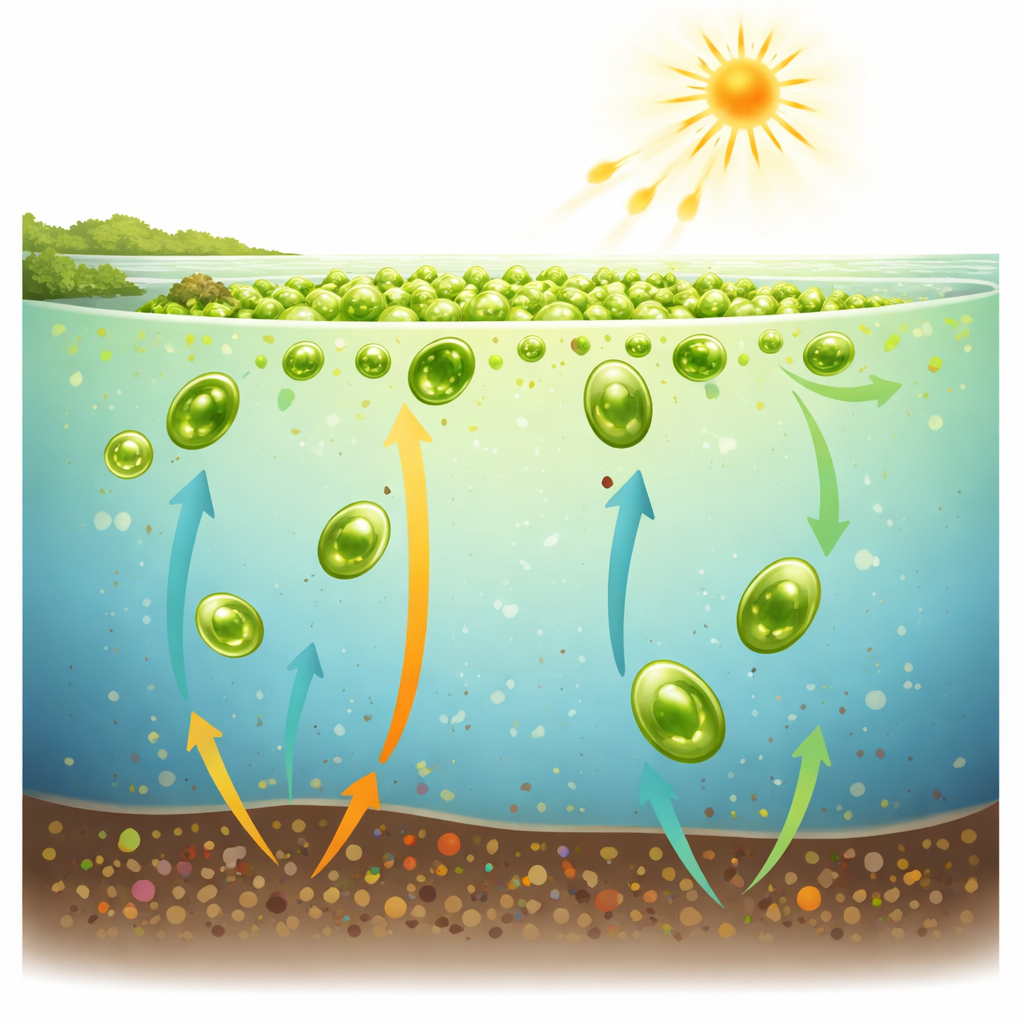
These stabilisomes also change where algae live within the water column. Because they are heavy, their buildup increases cell density and encourages algae to sink away from the sun-baked surface into deeper, cooler water, where heat and light stress are lower. In carefully controlled tank experiments, heat-treated cells accumulated much more strongly at mid and bottom depths than controls. Down in these dimmer layers, near or within resuspended sediments, the algae can tap into phosphorus released from lake mud, especially when warmer temperatures speed up that release. As blooms grow, their photosynthesis strips carbon dioxide from the water and pushes pH to highly alkaline levels. Surprisingly, this high-pH environment further stimulates phosphorus uptake and polyphosphate storage, reinforcing a self-feeding “thermo-alkaline” loop: heat and alkalinity trigger more internal ballast and nutrient hoarding, which in turn support bigger, longer-lasting blooms.
Flash floods that linger in algal memory
Heavy rainstorms add another twist to this story. Intense downpours wash sediment and phosphorus-rich particles off the land and stir up the lake bottom, delivering short, powerful pulses of nutrients. Experiments with real lake sediments and suspended particles showed that warming greatly increases the release of dissolved phosphorus into the water. The tested algae grabbed this phosphorus within hours, taking up far more than they needed for immediate growth and locking the surplus into polyphosphate reserves. These internal stockpiles persist long after the storm water has cleared and external nutrient levels drop. When a later heatwave arrives, the algae are already “pre-loaded” with fuel, ready to respond by forming more stabilisomes, diving for shelter, and then rebounding into fresh surface blooms. This means even relatively clear, nutrient-poor lakes can suffer severe blooms when heavy rain and heatwaves arrive in close succession.
Rethinking how we protect lakes
Together, the satellite records and experiments support a new framework for understanding modern lake problems. Instead of seeing harmful blooms as a simple outcome of too many nutrients or a gradually warming climate, the study shows that bursts of extreme heat and rain can convert brief shocks into long-lasting advantages for bloom-forming algae. By storing phosphorus in stabilisomes, altering their buoyancy, and building resistance to combined heat and high-pH stress, these organisms turn each extreme event into a stepping stone toward more persistent eutrophication. For managers and communities, this means that cutting nutrient inputs remains crucial but is no longer enough. Protecting lake health in a world of intensifying climate extremes will require strategies that also anticipate heatwaves and storm-driven nutrient pulses, and consider how the timing of these events can prime harmful blooms to thrive.
Citation: Wang, C., Wang, M., Xie, M. et al. Climate extremes intensify global lake eutrophication by increasing the stress resistance of harmful bloom-forming algae. Nat Commun 17, 2859 (2026). https://doi.org/10.1038/s41467-026-69529-3
Keywords: harmful algal blooms, lake eutrophication, climate extremes, heatwaves and storms, freshwater management