Clear Sky Science · en
Cell-cell communication as underlying principle governing color pattern formation in teleost fishes
Why fish color patterns matter
From the white bars of clownfish to the stripes of zebrafish, many fishes wear vivid patterns that help them hide from predators, recognize partners, and communicate. Yet behind these striking designs lies a basic question: how do individual skin cells coordinate to paint such precise shapes, and how can small genetic changes turn neat bars into irregular patches? This study uses clownfish and zebrafish to uncover how direct electrical and chemical conversations between pigment cells help draw sharp color boundaries—and how disrupting those chats produces a “Snowflake” clownfish with jagged, expanded white bars.
A closer look at a snowflake clownfish
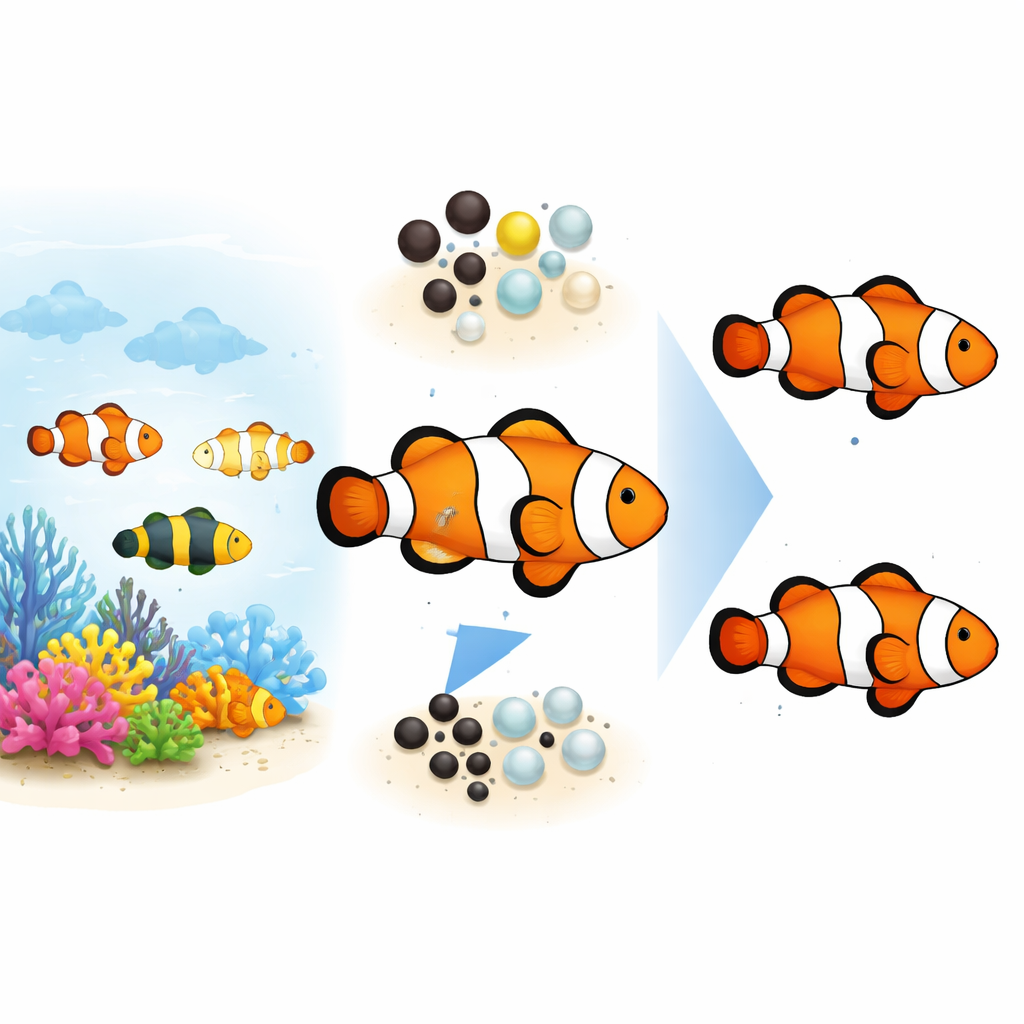
The researchers focused on a popular aquarium variety of the clownfish Amphiprion ocellaris known as “Snowflake.” Wild clownfish have three smooth, vertical white bars bordered by black on an orange body. Snowflake fish keep the basic layout, but their white areas are broader, and the dark borders become thicker and highly irregular, forming unique, wavy outlines on each fish. By tracking young fish as they develop their adult pattern, the team showed that these differences arise early, during the formation of the bars themselves, rather than from later reshaping. The mutant bars become broader and more jagged over time, even though left and right sides of the same fish remain remarkably symmetrical.
Finding the gene behind the broken borders
To pinpoint the cause of the Snowflake pattern, the authors compared the genomes of many Snowflake and normal siblings. They found a single-letter change in the DNA of a gene called gja5b, which encodes a gap junction protein (Connexin 41.8) that forms tiny channels between neighboring cells. These channels allow ions and small molecules to pass directly from cell to cell. Using CRISPR genome editing to introduce the same change into otherwise normal clownfish recreated Snowflake-like patterns, confirming that this mutation is responsible. When the team exposed normal larvae to chemicals known to block gap junctions, the young fish developed irregular white bars similar to Snowflake, further supporting the idea that impaired cell-cell communication distorts color boundaries.
Who talks to whom in the fish skin
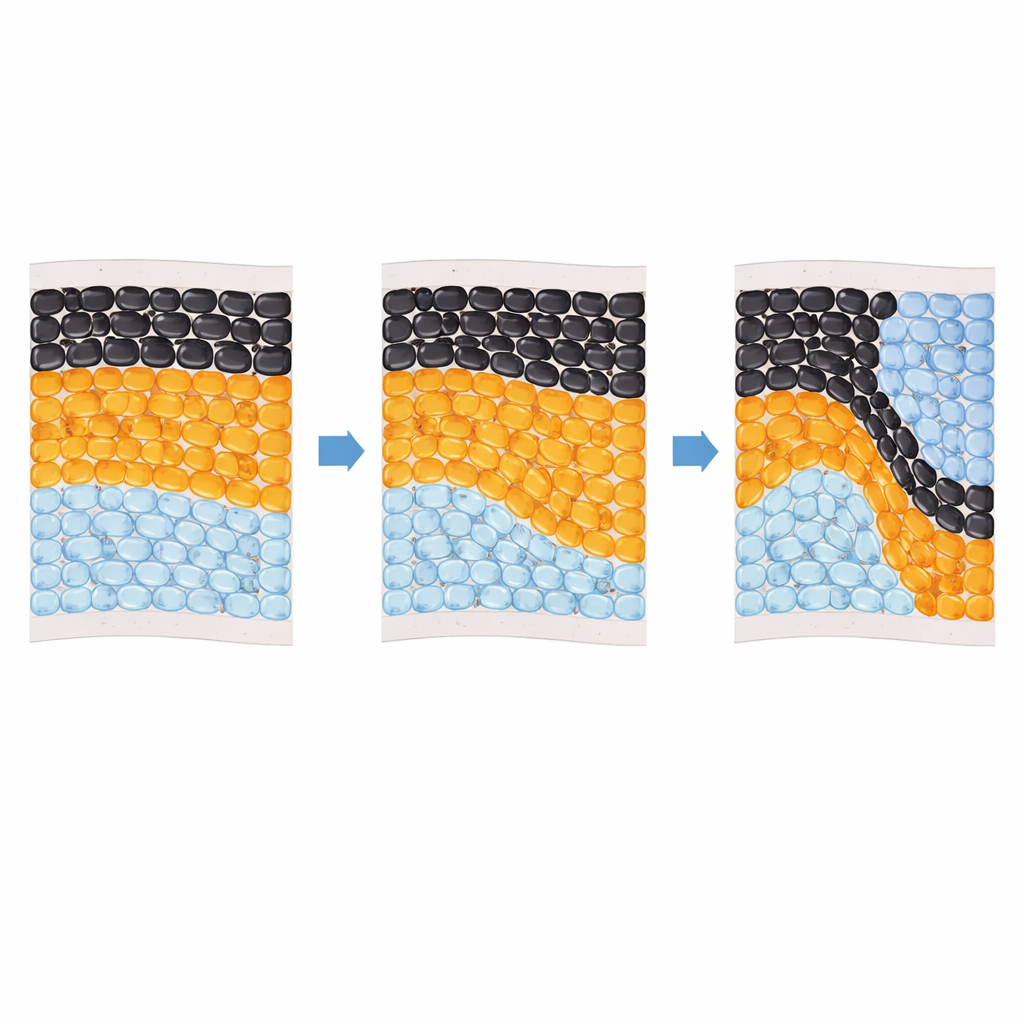
Fish skin color comes from three main pigment cell types: dark melanophores, yellow-orange xanthophores, and reflective iridophores that appear white or iridescent. By sequencing RNA from differently colored scales, the researchers discovered that, in clownfish, gja5b is expressed mainly in iridophores within the white bars. This contrasts with zebrafish, where the same gene is active mostly in melanophores and xanthophores that build dark and yellow stripes. Functional tests in frog eggs revealed that the Snowflake version of the protein behaves as a dominant negative: it blocks gap junction currents even when mixed with normal protein, effectively silencing communication. Additional experiments showed that clownfish Connexin 41.8 can pair with other gap junction proteins likely present in neighboring pigment cells, suggesting that iridophores act as communication hubs influencing how black and orange cells position themselves at bar edges.
Shared rules across very different fish
The team then turned to zebrafish, a classic model for studying stripe formation. By chance, an existing zebrafish mutant carried the exact same amino acid change in the equivalent gene. These fish showed disorganized stripes that broke into spots and scattered melanophores, again indicating that the mutation severely weakens gap junction communication. When the authors forced either normal or mutant versions of the protein to be produced specifically in zebrafish iridophores, they changed how dark cells respected stripe boundaries: boosting healthy communication let melanophores invade normally pale zones, while the mutant protein caused wandering, jagged stripe edges and widened light regions. These results reveal that all three pigment cell types can respond to changes in gap junction signaling, and that similar molecular tools can generate different patterns depending on which cell types are wired together.
From smooth bars to jagged edges
To link cell-level communication to the visible outlines of bars, the authors applied a physical model that treats the border between white and orange regions like a flexible line shaped by two opposing influences: random fluctuations and a smoothing “tension” arising from coordinated cell behaviors. Using boundary outlines traced from many fish, they found that Snowflake clownfish have boundaries that are much rougher than normal. The model explains this as stronger local noise and lower effective tension, consistent with pigment cells that no longer coordinate tightly because their gap junctions are impaired. Thus, a single mutation that weakens cell-cell communication can turn crisp, stable bars into highly individualized, jagged patches.
What this means for pattern diversity
Altogether, the study shows that direct communication through gap junctions is a central, flexible principle shaping color patterns in teleost fishes. The same connexin gene, used in different pigment cell types and arrangements in clownfish and zebrafish, helps establish where stripes and bars start and stop, and how sharp their edges are. For a layperson, the key message is that animal patterns are not just painted by isolated cells; they emerge from a coordinated conversation. Tweaking how strongly cells are connected—without changing the types of cells present—can generate new, stable color designs. This offers a powerful way for evolution, and potentially breeders, to produce the rich variety of stripes, spots, and bars seen in fishes around the world.
Citation: Klann, M., Miura, S., Lee, SH. et al. Cell-cell communication as underlying principle governing color pattern formation in teleost fishes. Nat Commun 17, 2899 (2026). https://doi.org/10.1038/s41467-026-69524-8
Keywords: fish color patterns, cell communication, gap junctions, clownfish snowflake mutation, pigment cells