Clear Sky Science · en
Observation of a backward sliding motion for rollers on surfaces in viscoelastic fluid
Why wheels that roll can sometimes slide backward
We are used to the idea that wheels and rollers move forward when they spin, from Stone Age logs under heavy rocks to modern cars and tiny medical robots. This study reveals a surprising twist: when very small rollers move along a surface inside certain stretchy, gel-like liquids, they can slide backward even while rotating in the “forward” direction. Understanding this counterintuitive effect could help engineers design new kinds of microscopic machines that travel through mucus, blood, and other complex fluids in the body.
Strange motion in stretchy liquids
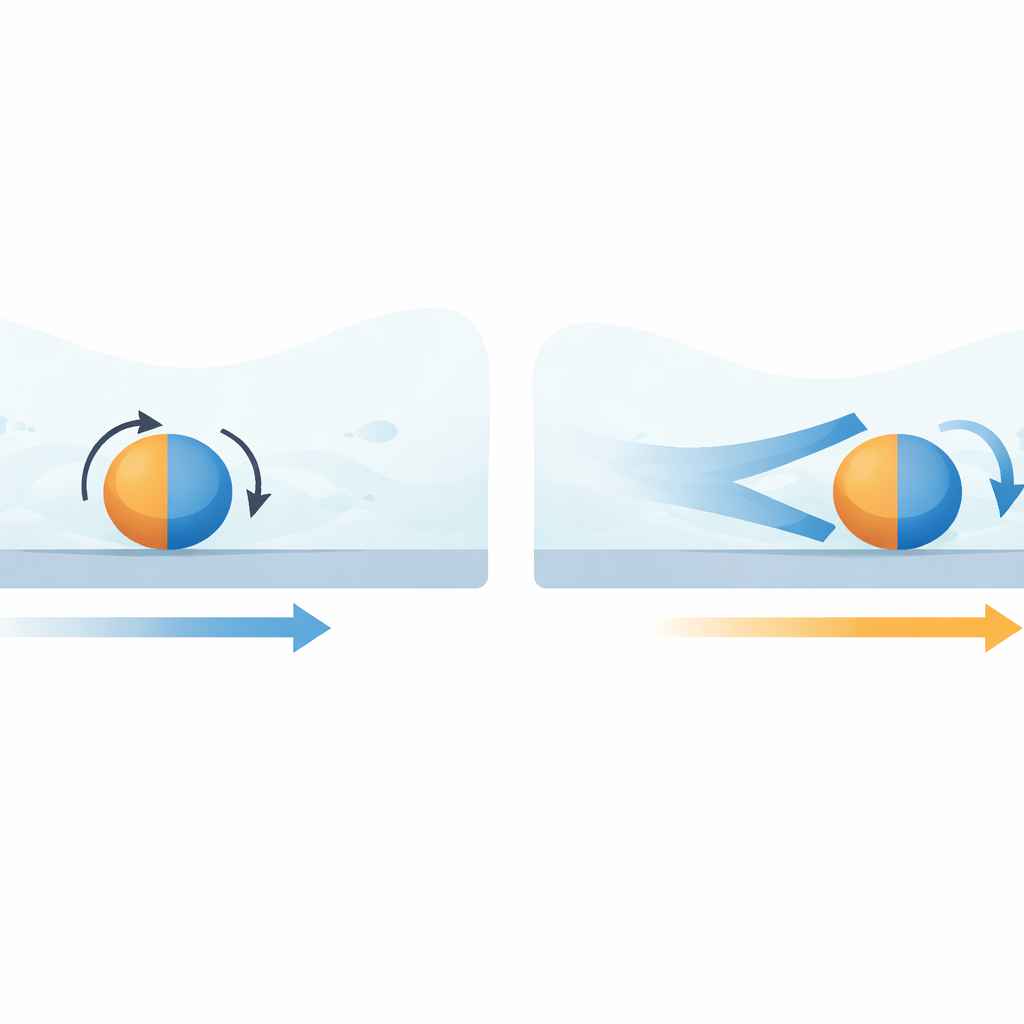
The researchers studied magnetic spheres ranging in size from a few micrometers (smaller than a red blood cell) up to a few millimeters. These spheres sat near a solid surface and were set spinning by a rotating magnetic field, mimicking how many artificial microswimmers are driven in the lab. In plain water, the spheres behaved as expected: they rolled forward along the surface. But in several viscoelastic liquids—including solutions of long-chain polymers, a special soap mixture, and even egg white—the same spinning caused the spheres to drift backward instead. This backward sliding appeared for many sphere sizes, shapes, and surface conditions, showing that it is a robust and general phenomenon.
How the surrounding fluid pulls from behind
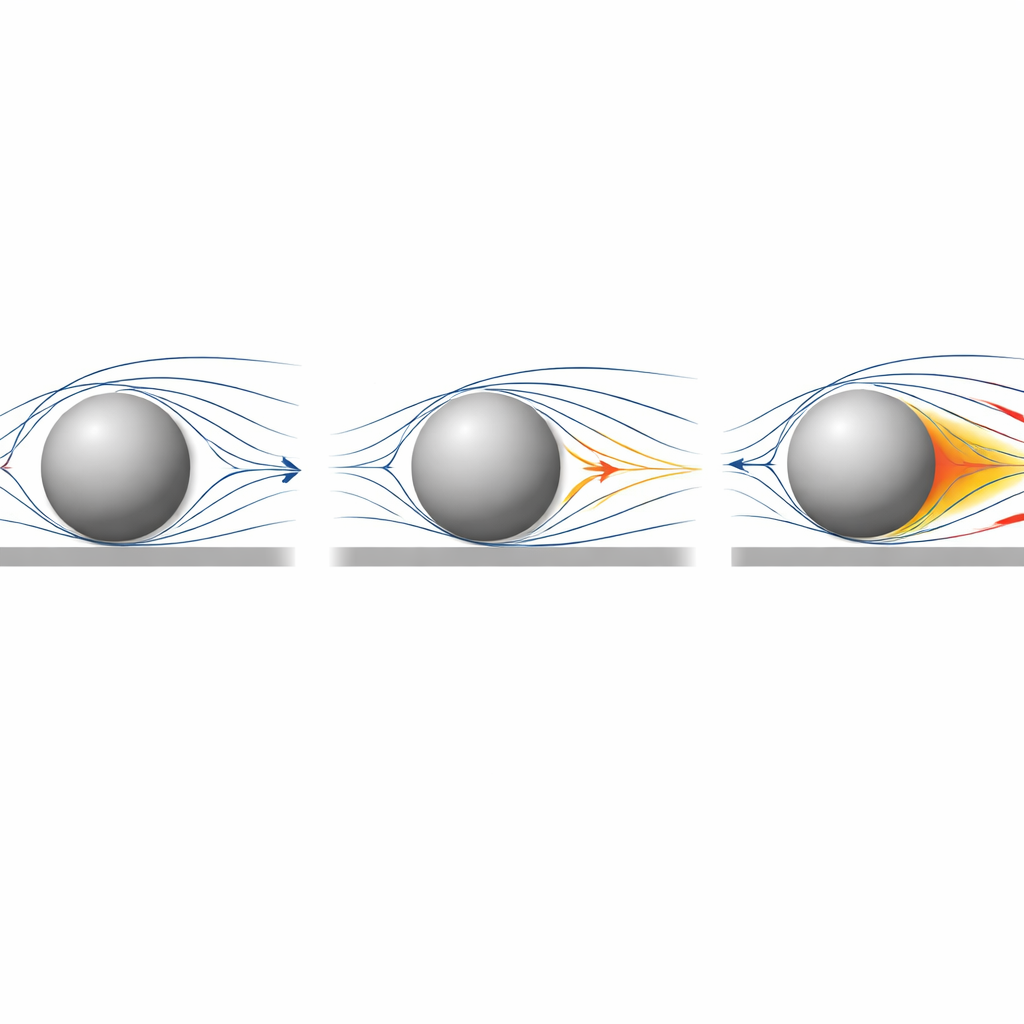
To understand what causes this reversal, the authors combined experiments with computer simulations of the flowing liquid. Viscoelastic fluids behave partly like liquids and partly like stretched rubber bands, because they contain long molecules that can be pulled out of shape by motion. When a sphere spins close to a wall in such a fluid, the flow around it is not symmetric from front to back. The simulations showed more tightly packed flow lines and more strongly stretched polymers on the side of the sphere facing the oncoming flow than on the leeward side. These stretched regions act like many tiny rubber bands tugging on the sphere from behind. If this backward elastic pull becomes stronger than the usual forward friction from rolling contact, the net result is motion in the reverse direction.
From smooth reversals to speed-dependent effects
For microscopic rollers in dilute polymer solutions, the researchers found a simple, nearly linear link between the spinning rate and the backward sliding speed. Increasing polymer concentration gradually reduced the usual forward rolling, brought the motion to a standstill at a critical concentration, and then produced steadily stronger backward sliding. Larger spheres needed higher polymer concentrations before the reversal appeared, because their greater contact with the surface increases ordinary friction. For millimeter-scale rollers in more concentrated, strongly non-Newtonian solutions, the behavior became richer: the direction and strength of motion depended not just on concentration but also on how fast the spheres rotated. When the data were analyzed using a dimensionless measure called the Weissenberg number—which compares elastic to viscous effects—the results for many conditions collapsed onto a single curve, showing that backward motion emerges once elastic forces dominate over viscous drag and contact friction.
Hidden attraction and tiny magnetic gears
The same asymmetric flow that pulls the spheres backward also presses them toward nearby surfaces. Experiments showed that micrometer-sized rollers could cling to and travel along ceilings and vertical walls inside the fluid, held in place by this viscoelastic “suction.” The team then exploited this effect to build a simple micro-scale gearing system. A small magnetic sphere was spun near a larger non-magnetic sphere. The flow made the two spheres stick together, and friction between them transferred the rotation, causing the larger sphere to circle around. By changing the rotation speed and path of the magnetic sphere, the researchers could steer the larger one along controlled, spiral and zigzag trajectories, hinting at ways to move tiny cargo without directly gripping it.
What this means for tiny robots in real fluids
In everyday terms, this work shows that in complex, stretchy liquids, pushing harder in one direction can sometimes make you drift the other way, because the medium itself stores and redirects mechanical energy. For future medical microrobots designed to travel through viscoelastic bodily fluids, designers will need to account for this backward sliding and may even harness it for new forms of motion and cargo transport. More broadly, the study highlights how adding elasticity to a fluid can flip our intuitive expectations about how simple objects move, opening avenues for smart control of microscopic machines in realistic environments.
Citation: He, C., Qiao, Y., Cao, Y. et al. Observation of a backward sliding motion for rollers on surfaces in viscoelastic fluid. Nat Commun 17, 2781 (2026). https://doi.org/10.1038/s41467-026-69523-9
Keywords: viscoelastic fluids, microswimmers, backward sliding, polymer solutions, active matter