Clear Sky Science · en
Physical limits of sea-level rise adaptation in global river deltas
Why rising seas matter for river deltas
Hundreds of millions of people live on river deltas—fertile, low-lying landscapes where great rivers meet the sea. These regions power national economies with farms, cities, ports and industry. But as oceans rise, deltas face growing threats from coastal flooding, land loss and saltwater intrusion. This study asks a simple but urgent question: given the physics of water, sediment and space, how far can deltas realistically adapt to rising seas with the tools we already have, and where will we run into hard physical limits?
Five main ways to live with higher water
The authors group flood-risk responses in deltas into five easy-to-grasp strategies. “Protect-open” uses levees and storm-surge barriers while keeping rivers connected to the sea. “Protect-closed” seals the coastline and relies on pumps and inland storage basins to move river water out. “Advance” pushes the shoreline seaward by building new land and defences offshore. “Accommodate” means learning to live with more water—for example by elevating buildings or letting certain areas flood. “Retreat” involves planned relocation of people and assets to safer ground. For nearly 800 deltas worldwide, the team calculates how much land, material and engineering capacity each strategy would require by the year 2100 under mid-range sea-level projections. 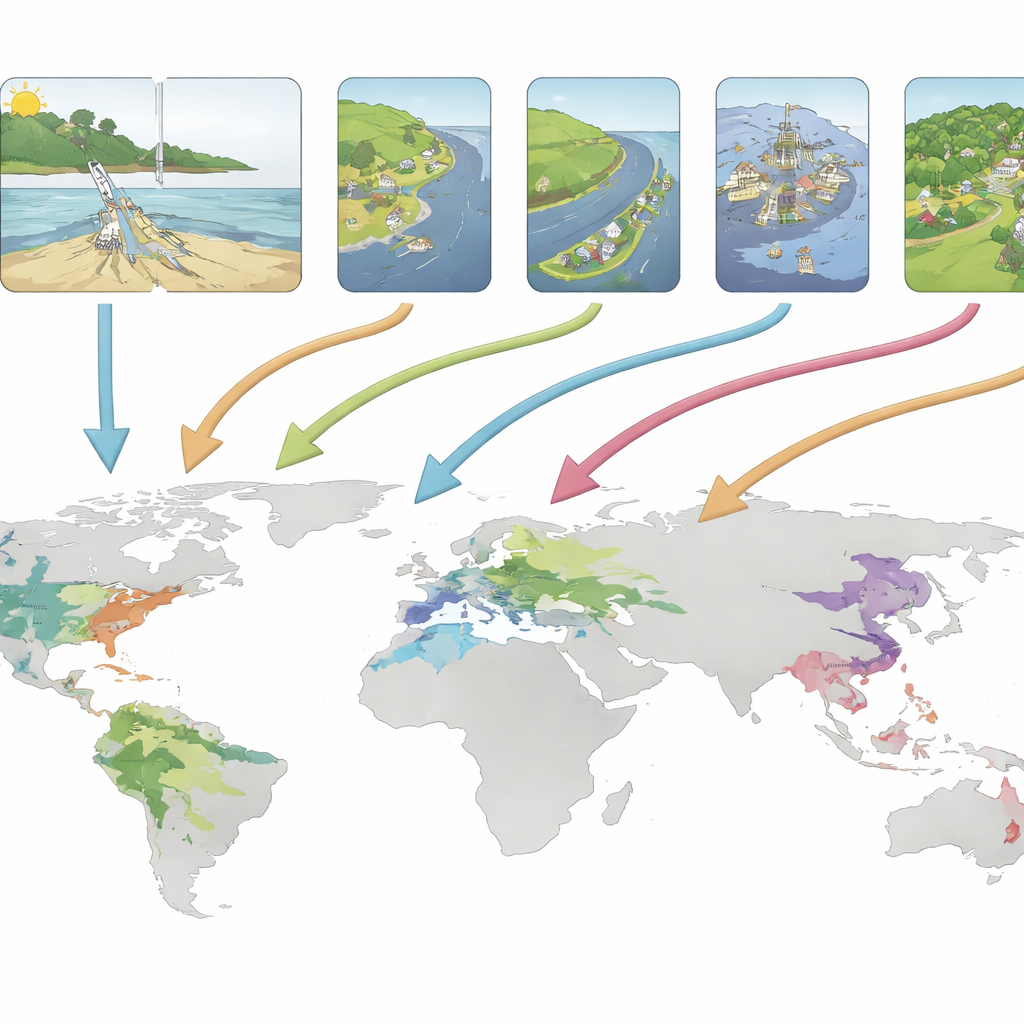
How the study measures what is physically possible
To compare options fairly, the researchers convert each strategy into a set of measurable requirements. These include how wide a river mouth can be to realistically build a storm-surge barrier, how powerful pumps must be to lift river water into a higher sea, how much storage is needed in basins and wetlands during extreme floods, how deep floodwaters would be over cities that might need raising, and how much nearby land is available for people to move to. For each indicator they define three levels: a low-resource version using modest, widely used measures; a “current practice” level based on the largest projects built so far; and an ambitious “innovative” level that assumes future engineering breakthroughs or large-scale cooperation. A strategy is judged physically feasible for a delta if none of these requirements exceed the chosen threshold.
What the global picture reveals
The surprising headline is that for every delta studied, at least one delta-wide strategy is physically possible by 2100 with today’s types of technology, space and materials. Under an intermediate warming scenario, almost all deltas can in principle be protected with open river mouths, can accommodate some degree of flooding, or can retreat in a planned way without running into absolute physical barriers. However, strategies that depend heavily on pumps and sand, such as sealing off the coast (“protect-closed”) or extending it seaward (“advance”), are much more constrained. Many large deltas simply carry too much river water to be pumped out during extreme floods, or lack enough accessible sand and mud offshore to build new land, even with optimistic assumptions about future tools.
Why size, flooding and land use change the options
The study shows that delta characteristics strongly shape their “solution space” of options. Small deltas that are only partly flooded under future seas often have many choices, including low-cost measures, because their river mouths are narrow, their flood depths are modest and they have nearby unflooded land for retreat. In contrast, vast deltas like the Mississippi, Niger and Ganges–Brahmaputra–Meghna have powerful rivers, wide mouths and large flood-prone areas. For these systems, sealing the coast or advancing it seaward may be physically impossible without major innovation, leaving accommodation, retreat or selective protection as more realistic paths. Highly urbanized deltas face extra hurdles: raising dense city districts by more than a meter or two is technically demanding, which nudges them toward protective works where river widths and materials allow. 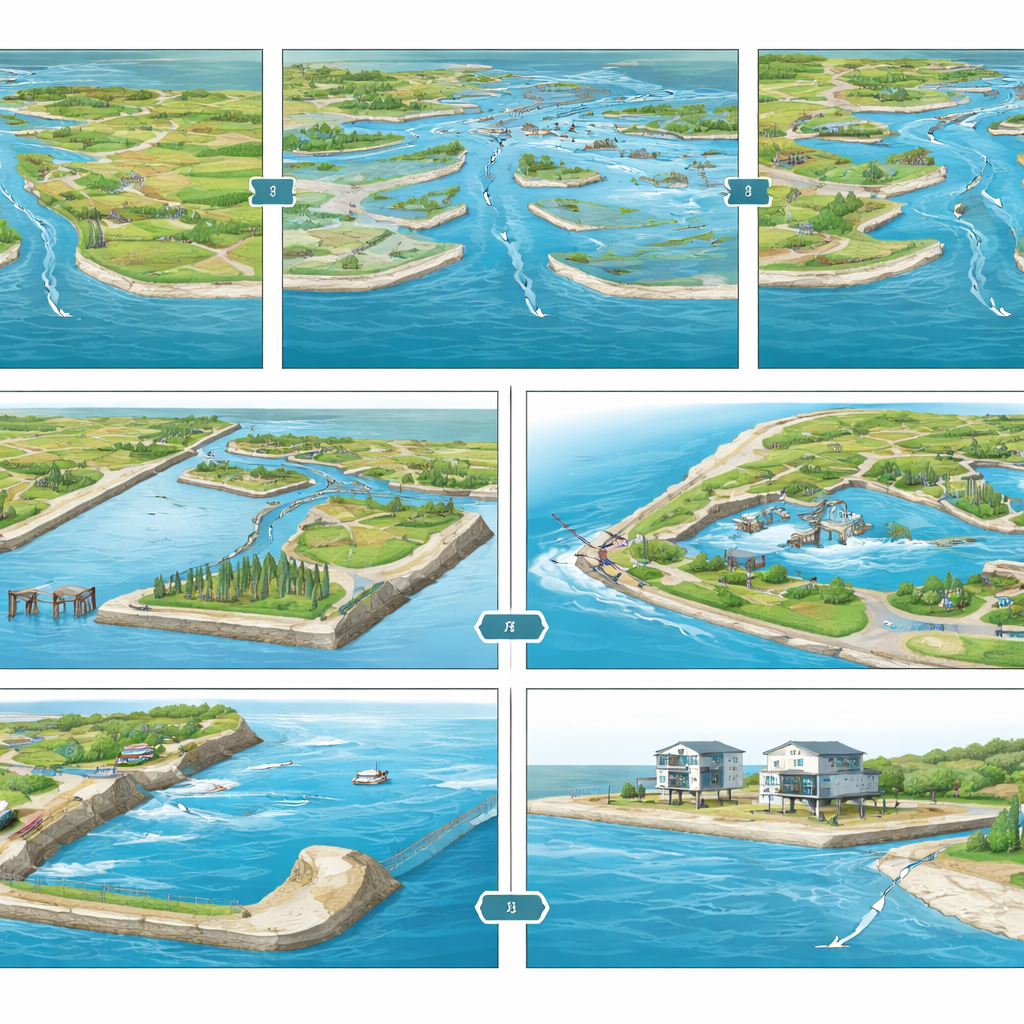
Hidden pressure on sand and other shared resources
Looking beyond individual deltas, the authors estimate how much material would be needed if many places chose the advance strategy. Extending every delta’s coastline by just a few kilometers would require far more sand than all the world’s rivers can deliver this century and vastly more than is currently dredged for land reclamation. Even where local rivers or offshore areas hold enough sediment, it usually arrives in large floods, exactly when pumping demands would already be extreme. This mismatch means that in many deltas, land-building options are limited long before social, legal or financial constraints come into play, raising the risk of competition for shared resources and the need for international cooperation.
What this means for people living on deltas
For lay readers, the key message is both reassuring and sobering. There is no single global “point of no return” after which deltas must surrender to the sea: physics suggests that every delta still has at least one viable way to reduce flood risk by 2100, especially if actions start early and can be scaled up. Yet the menu of options is much narrower for large, crowded and already flood-prone deltas, particularly where pumps and sand are limiting. Planning that focuses only on what is technically imaginable, without checking whether enough space, water-handling capacity or construction material actually exist, risks overpromising. By mapping these physical boundaries, the study offers a starting map for where innovation, coordination and careful long-term planning are most urgently needed to keep delta communities safe.
Citation: Lasch, K.G., Nienhuis, J.H., Winter, G. et al. Physical limits of sea-level rise adaptation in global river deltas. Nat Commun 17, 2760 (2026). https://doi.org/10.1038/s41467-026-69517-7
Keywords: river deltas, sea-level rise, climate adaptation, flood risk, coastal planning