Clear Sky Science · en
Ketone displacement and migration enabled by trifunctionalization of vinyl triflates
Moving Parts in Drug Molecules
Chemists are always looking for faster ways to tweak complex drug molecules—swapping one chemical piece for another or nudging it to a new position on a ring can turn a weak medicine into a potent one. This article describes a new laboratory method that lets researchers slide an important chemical unit called a ketone from one carbon atom to a neighbor while installing two other useful pieces at the same time. The process is gentle, flexible, and works on molecules related to real medicines, opening a shortcut to explore new drug candidates.
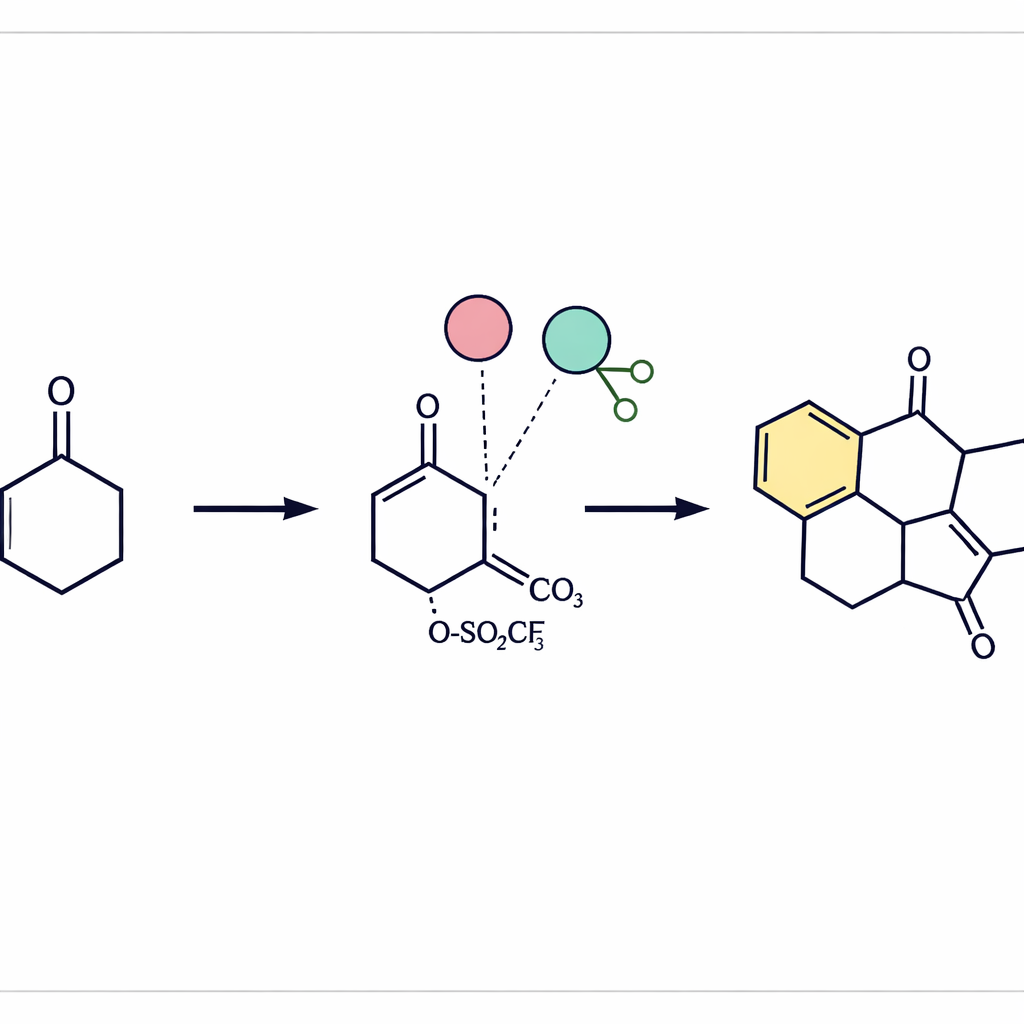
Why Shifting a Single Piece Matters
Small changes in a molecule’s shape can produce huge differences in biological activity. The authors highlight examples where moving or replacing a single group on a ring boosted the effect of drug candidates hundreds of times, or even switched them from hitting one enzyme to another. Ketones are among the most common building blocks in pharmaceuticals, so a method that can deliberately move a ketone around a ring—while also adding new fragments—would give medicinal chemists a powerful way to redesign existing molecules late in the discovery process.
Turning Simple Building Blocks into Crowded Rings
The team focused on “vinyl triflates,” easily prepared from ordinary ketones. These act like specially primed handles that metals can grab. Using a nickel catalyst, a boron reagent, and an aryl bromide (a common source of ring-shaped fragments), they developed a reaction that joins all three partners in one step. The result is a densely substituted six-membered ring that now carries a boron group and an aryl group and has effectively lost its original oxygen atom. This “trifunctionalization” creates complex ring systems with quaternary carbon centers—crowded positions that are usually hard to build directly.
How the Hidden Steps Unfold
By monitoring the reaction over time, the researchers saw that a boron‑containing intermediate builds up and then slowly disappears as the final product appears. When they made this intermediate separately and fed it back into the reaction, it cleanly converted to the same product, confirming its central role. Combining these observations with prior nickel chemistry, they propose that nickel first picks up boron, then attaches it to the vinyl triflate to form a boronate, and finally joins this intermediate with the aryl fragment. Throughout, the metal moves and inserts into different bonds, orchestrating the sequence that strips away oxygen and installs the new groups in a controlled fashion.
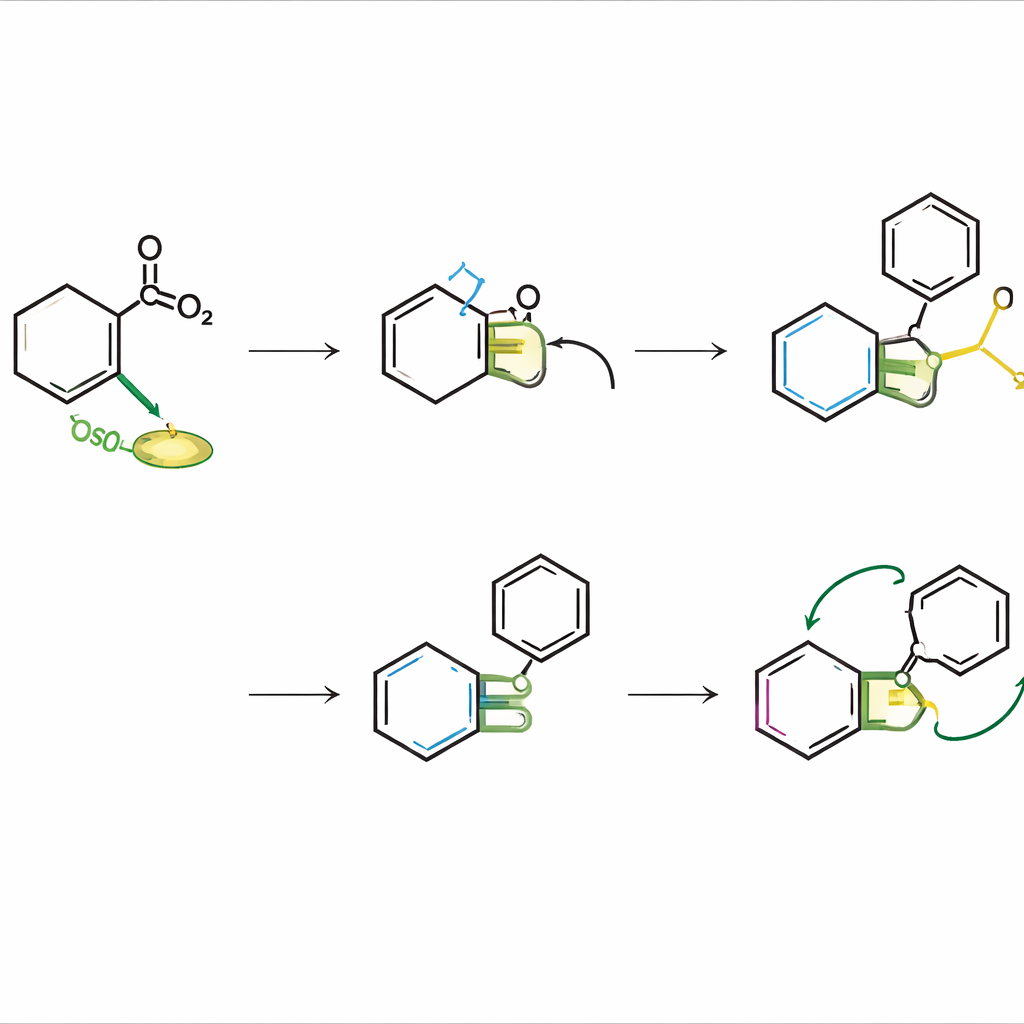
From Simple Rings to Drug-Like Frameworks
One of the strengths of the method is how many different starting pieces it tolerates. A wide variety of aryl bromides bearing sensitive groups like amines, alcohols, and nitrogen‑rich rings work well, as do complex vinyl triflates derived from fused rings and even natural products. The products can be made on gram scale and then transformed further: oxidizing the boron units and treating them with a Lewis acid rearranges the skeleton, sliding the ketone from one carbon to the next with high control over which side of the ring each new group ends up on. Using this sequence, the team edited the cores of steroid‑like molecules and built highly substituted cyclohexanones that would be very difficult to obtain by classic routes.
A New Lever for Molecular Makeovers
In everyday terms, this work gives chemists a new way to remodel molecules from the inside out. Starting from a relatively simple ketone, they can temporarily convert it into a vinyl triflate, run the nickel‑catalyzed reaction to bolt on boron and aryl fragments, and then trigger a rearrangement that moves the ketone to a neighboring site. Repeating the sequence allows stepwise installation and migration of multiple aryl groups around a ring. For non‑specialists, the key takeaway is that the authors have created a versatile “skeletal editing” tool: a controlled way to shuffle key pieces of a molecule’s framework, greatly expanding the range of shapes that drug designers can explore without rebuilding everything from scratch.
Citation: Wang, S., Yao, T., Liu, Y. et al. Ketone displacement and migration enabled by trifunctionalization of vinyl triflates. Nat Commun 17, 3294 (2026). https://doi.org/10.1038/s41467-026-69513-x
Keywords: ketone migration, nickel catalysis, vinyl triflates, skeletal editing, medicinal chemistry