Clear Sky Science · en
Sensory coding of borneol repellency in culicine mosquitoes via the Or49 pathway
A New Way Plants Help Protect Us from Mosquitoes
For thousands of years, people have burned leaves, rubbed oils on their skin, or hung branches in their homes to keep biting insects away. Many of these traditional remedies come from plants that contain fragrant ingredients like camphor and borneol. This study uncovers how some of the world’s most troublesome mosquitoes actually smell one of these plant compounds, borneol, and then choose to avoid us—revealing a natural repellent pathway that could inform safer, more targeted mosquito control tools.
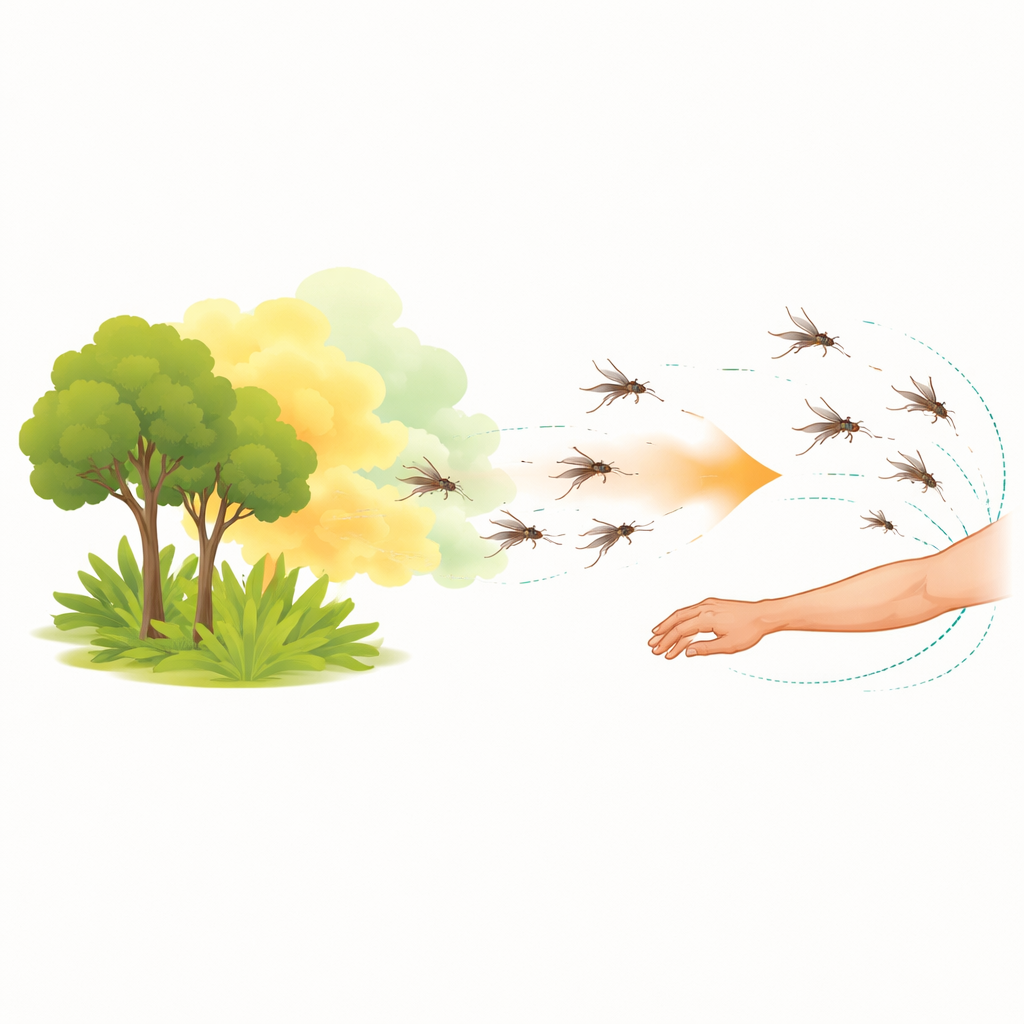
How Mosquitoes Smell the World
Mosquitoes rely heavily on smell to find hosts. On a small mouthpart called the maxillary palp, they have tiny sensory hairs that each house three smell-sensing nerve cells. Two of these cells detect signals that draw mosquitoes toward animals: one senses carbon dioxide from our breath, and another responds to a skin-related odor called 1‑octen‑3‑ol. These attraction cues are wired into specific regions of the mosquito brain, helping females track down blood meals with remarkable accuracy. The third nerve cell in this sensory hair, however, had an unknown role in many disease-spreading mosquito species.
Finding a Nose for Plant Repellents
The researchers focused on a gene called Or49, which is active in that mysterious third nerve cell in culicine mosquitoes such as Aedes aegypti and Culex pipiens. By inserting the Or49 receptor into frog egg cells and exposing them to dozens of different odor molecules, they discovered that Or49 responds strongly and selectively to a family of plant chemicals called bicyclic monoterpenoids. Among them, borneol—a classic component of traditional plant-based repellents—was by far the most potent trigger. Related mosquito species from different parts of the world all carried versions of Or49 that reacted robustly to borneol, indicating that this “borneol detector” has been conserved over millions of years of evolution.
From Scent Molecule to Mosquito Brain
To see how this signal travels inside the mosquito, the team recorded electrical activity directly from the tiny sensory hairs on the maxillary palp. In species that carry Or49, borneol reliably activated the smallest of the three nerve cells. In contrast, a malaria mosquito species that uses a different receptor in that position showed no response. Using advanced brain imaging, the scientists then watched how odor information is handled in the mosquito’s primary smell center, the antennal lobe. Borneol activated one specific structure there, called the MD3 glomerulus, while the familiar attractants carbon dioxide and 1‑octen‑3‑ol lit up neighboring regions. This precise “labeled line” from borneol in the environment to a dedicated brain node suggests that the mosquito treats this plant scent as a special warning signal.
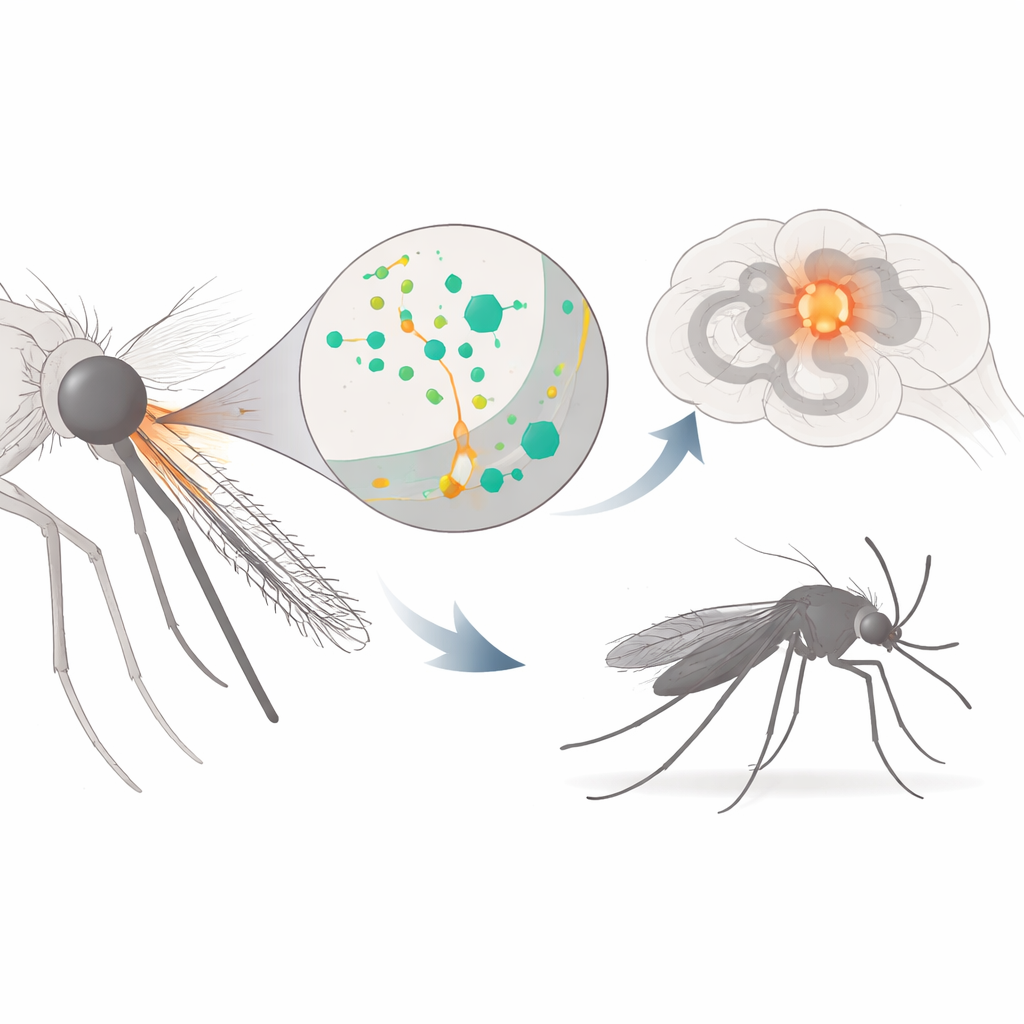
Switching Off a Single Gene Changes Behavior
To test whether this circuit truly makes mosquitoes avoid us, the researchers used gene-editing tools to knock out Or49 in Aedes aegypti. In these mutants, the third palp neuron no longer responded to borneol. The team then ran a simple but telling experiment: a volunteer placed a protected hand near a cage of hungry female mosquitoes, with or without borneol vapor present. Normal mosquitoes sharply reduced their visits toward the hand when borneol was in the air, especially in the first few minutes. Mutant mosquitoes lacking Or49, however, showed a much weaker drop in visits and continued to explore the hand region. This shows that Or49 is a major driver of borneol-based repellency during human host-seeking, even though other, weaker detection routes may still exist.
What This Means for Future Mosquito Control
This work reveals that some disease-carrying mosquitoes possess a dedicated sensory channel tuned to a plant compound that tells them to stay away. By tracing the path from a single plant molecule, through a specific receptor and nerve cell, to a defined brain region and an observable avoidance behavior, the study provides a clear blueprint of natural repellency. For non-specialists, the takeaway is simple: certain plants do not just smell strong to us; they tap directly into built-in mosquito wiring that tells them our vicinity is a bad place to be. Understanding this pathway opens the door to designing new repellents that are more precise, potentially longer lasting, and inspired by how nature has been fending off mosquitoes all along.
Citation: Vainer, Y., Sar-Shalom, E., Wang, Y. et al. Sensory coding of borneol repellency in culicine mosquitoes via the Or49 pathway. Nat Commun 17, 2981 (2026). https://doi.org/10.1038/s41467-026-69511-z
Keywords: mosquito olfaction, natural repellents, borneol, odorant receptors, vector control