Clear Sky Science · en
Ocean dynamics shape marine heatwaves and their predictability
Why hot oceans matter
Around the world, stretches of unusually warm ocean water—known as marine heatwaves—are becoming longer and more intense. These events bleach coral reefs, disrupt fisheries, and threaten coastal economies. This study asks a deceptively simple question with big implications: how much of these marine heatwaves is driven not just by a warming atmosphere, but by the ocean’s own internal movements and circulation patterns, and how far in advance might we be able to anticipate them?
Two different oceans in the same model
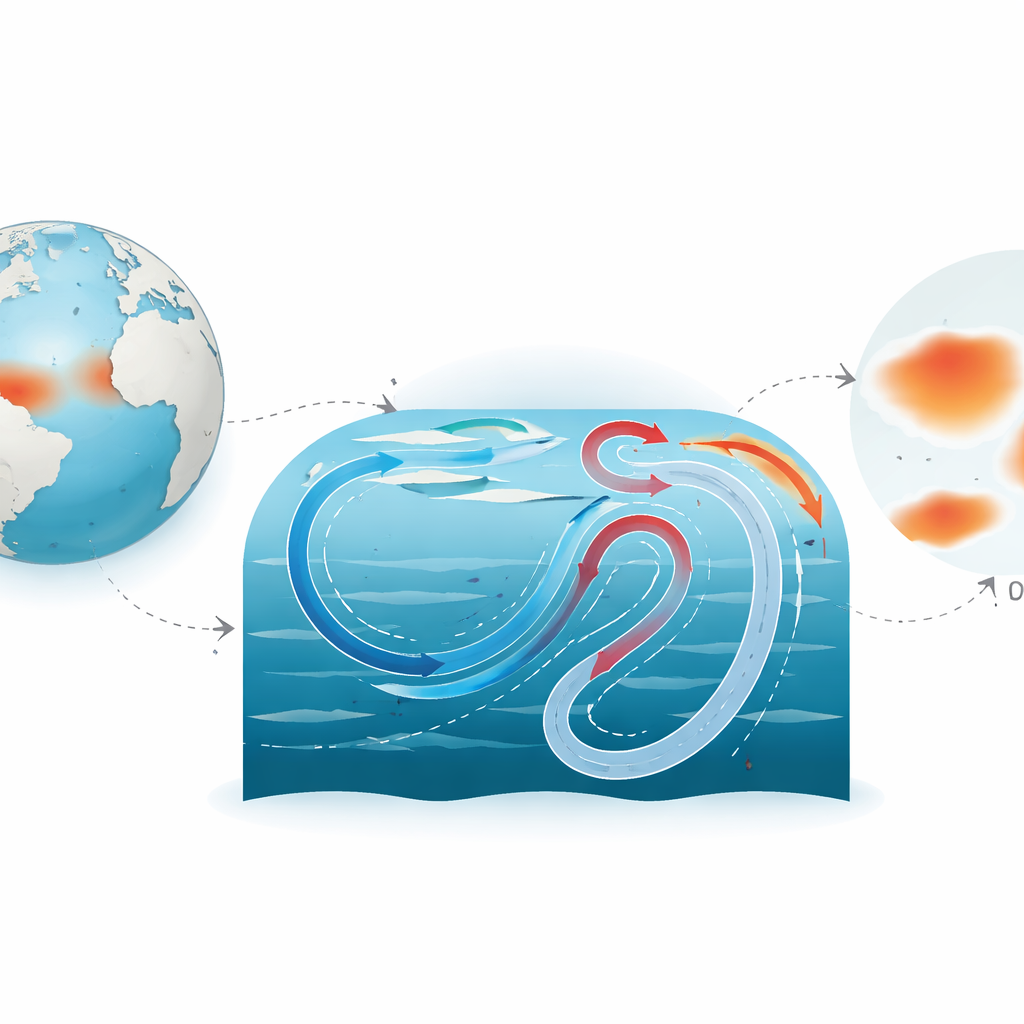
To tease apart the ocean’s role, the authors ran the same climate model in two distinct modes. In one, the ocean was fully dynamic, with currents, upwelling, and mixing all allowed to evolve naturally. In the other, the ocean was treated more like a motionless “slab” that can warm and cool but lacks active circulation. By comparing hundreds of simulated years from these two setups, they measured how often marine heatwaves occur, how strong they become, and how long they last in each part of the global ocean. This side-by-side experiment reveals where ocean motion amplifies heat extremes and where it instead tends to smooth them out.
Hot spots in the tropics and cooler extremes elsewhere
The clearest contrast appears in the eastern tropical Pacific, home to El Niño events. In the dynamic-ocean world, marine heatwaves in this region are about half again as long and intense as in the slab version. The model shows that when the ocean and atmosphere can fully interact, El Niño-like swings grow stronger and more persistent. Currents and vertical motions pump warm water into the surface layer and help sustain high temperatures, while feedbacks between warm seas and stormy weather reinforce the pattern. In the simpler slab ocean, temperatures depend mostly on local heating and cooling from the air above, so the warm spells never build to the same extremes.
When motion keeps heatwaves in check
Outside the tropics, ocean dynamics play a more nuanced role. In the Mediterranean, the Gulf of Alaska, and along the Gulf Stream, the slab ocean produces stronger surface hot spells than the dynamic ocean does. A closer look at the heat budget—the accounting of how heat enters, leaves, and moves within the upper ocean—shows why. In the slab case, short bursts of strong heating at the surface rapidly spike temperatures. In the dynamic case, mixing and currents spread that warmth downward and sideways, acting like a buffer that blunts the peak at the surface. In the Gulf Stream region, intense heat loss from the ocean to the atmosphere further prevents prolonged build-up of extreme surface warmth, even when currents bring in extra heat.
Hidden memory in the Atlantic conveyor
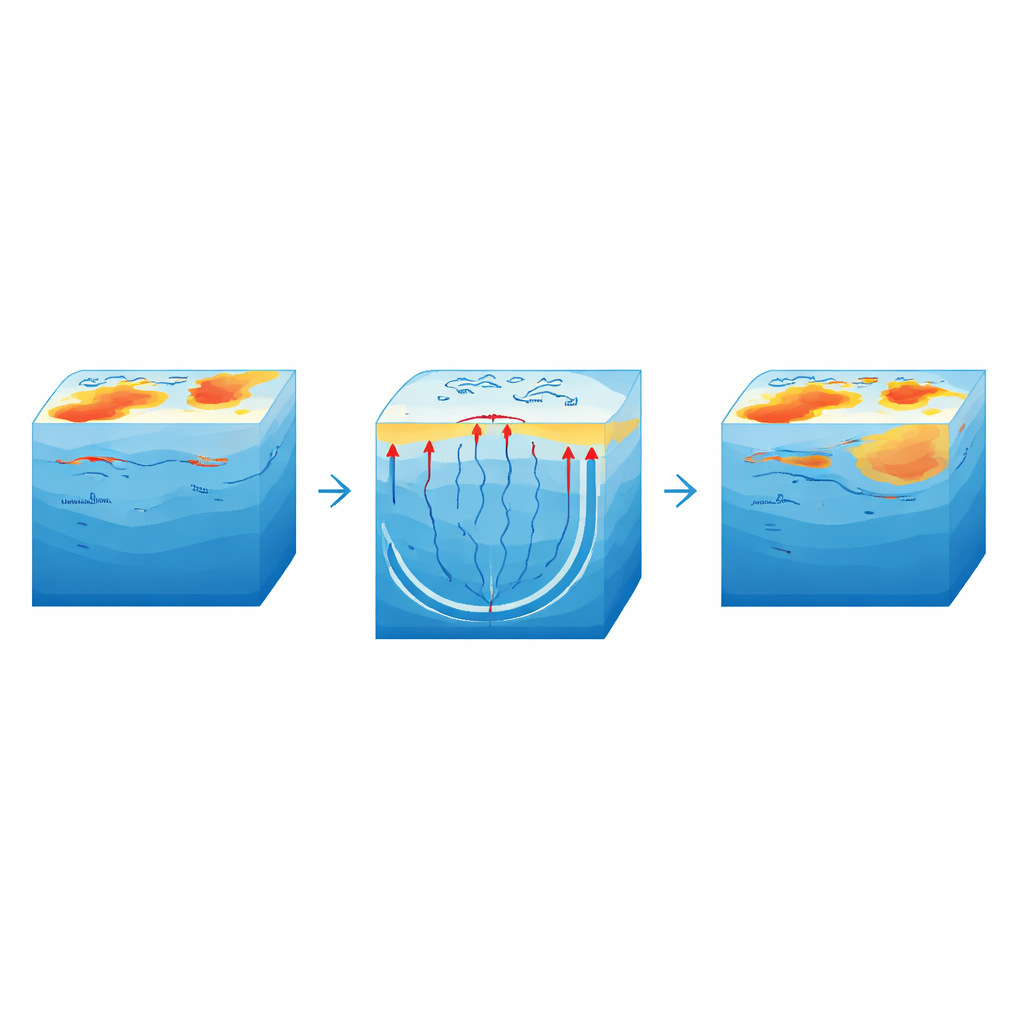
The study also explores how predictable marine heatwaves might be on timescales of several years to decades. Using statistical tools, the authors identify slow, large-scale patterns in the frequency, duration, and intensity of heatwaves. In the dynamic ocean, the North Atlantic stands out: there, marine heatwave behavior shows a long-lasting signal tied to the Atlantic Meridional Overturning Circulation, a vast system of currents that transports warm water northward and cold water southward at depth. Changes in this “conveyor belt” alter how much heat is stored in different parts of the basin and reshape where and how often marine heatwaves occur, especially south of Greenland and along the Gulf Stream. Because this overturning evolves slowly, it carries a kind of thermal memory that can give rise to multi-year predictability.
What this means for the future
Overall, the work shows that ocean dynamics do far more than passively respond to a warming planet. They strengthen marine heatwaves in some regions, weaken them in others, and imprint slow, predictable rhythms on the climate system—particularly in the North Atlantic. For society, this means that successful forecasts of future ocean heat extremes must capture not only greenhouse gas–driven warming and atmospheric patterns, but also the deep, shifting currents beneath the surface. Harnessing that knowledge could improve early warnings for vulnerable ecosystems and coastal communities as marine heatwaves continue to rise in a changing climate.
Citation: Ren, X., Liu, W. & Zhang, L. Ocean dynamics shape marine heatwaves and their predictability. Nat Commun 17, 2896 (2026). https://doi.org/10.1038/s41467-026-69509-7
Keywords: marine heatwaves, ocean circulation, El Niño, Atlantic overturning, climate predictability