Clear Sky Science · en
Synergistic nitrogen and endohedral MoCl5 doping for ultrahigh-conductivity carbon nanotube fibers
Why new wires matter for everyday tech
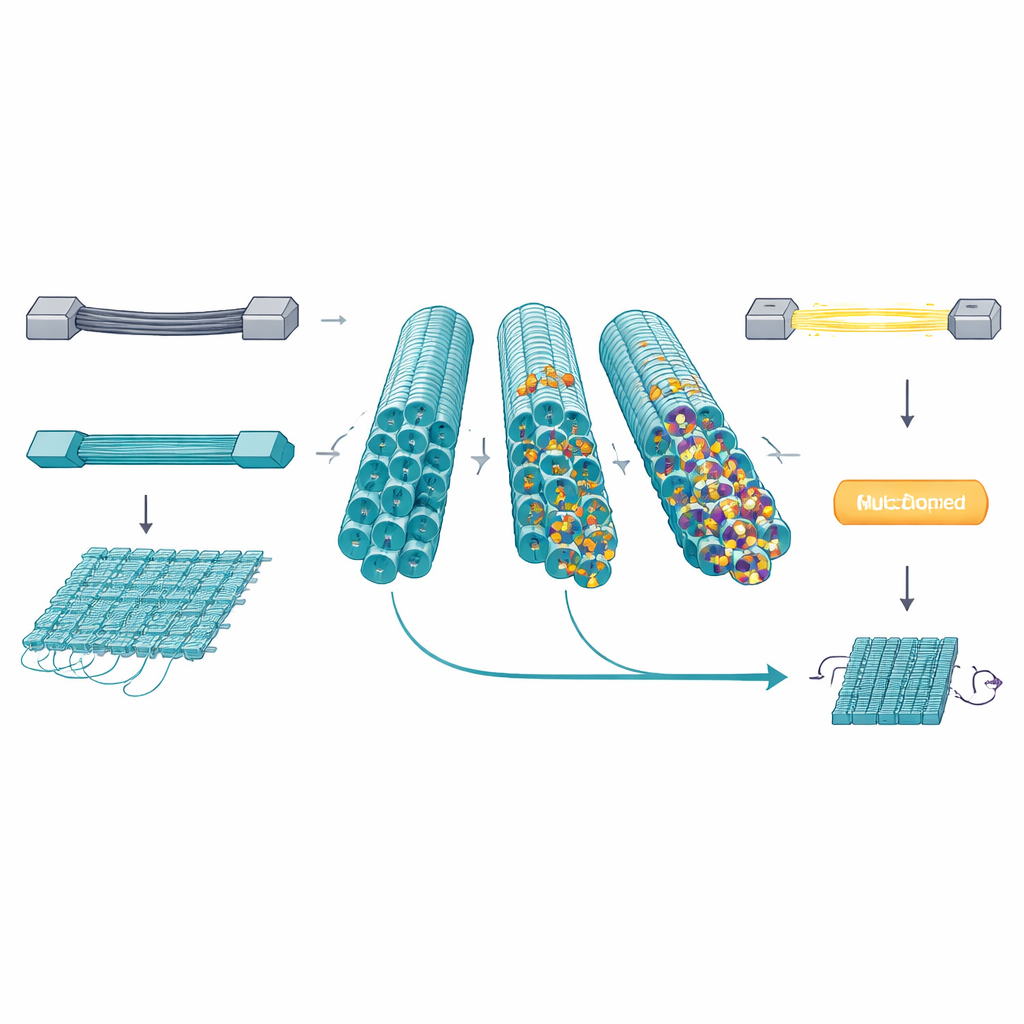
From phone chargers to smart jackets, modern life depends on thin, flexible wires that can move electricity safely and efficiently. Today we mostly rely on heavy metal wires such as copper and aluminum, which work well but are dense, can break when bent repeatedly, and corrode in harsh environments. This article explores a new way to build lighter, stronger, and more durable wires from bundles of carbon nanotubes—tiny straw-like tubes of carbon—by cleverly adding a combination of nitrogen atoms and a metal salt called molybdenum pentachloride. The result is a fiber that can outperform copper in key measures while remaining flexible enough to weave into fabrics.
Turning tiny tubes into useful threads
The researchers start with carbon nanotube fibers, which are made by spinning trillions of nanotubes into long, aligned threads. In theory, each individual nanotube can carry electricity extremely well, but when bundled into a fiber, gaps and weak connections between tubes slow the flow of charge. Earlier efforts to fix this focused on squeezing the tubes closer together or adding metal coatings, but those methods either did not fully close the performance gap with copper or suffered from poor long-term stability. The challenge was to raise the number of mobile charge carriers in the fiber without damaging its structure or making it fragile.
A two-step recipe for better conduction
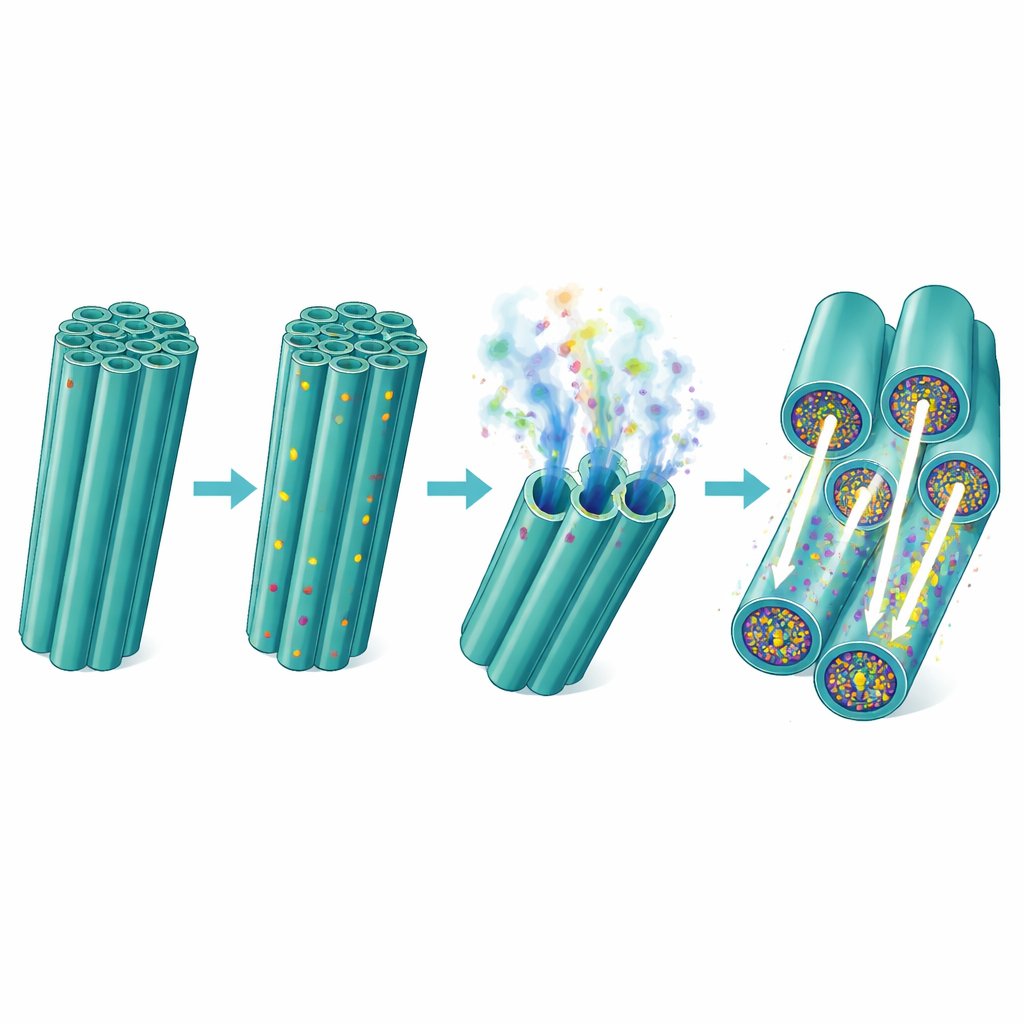
The team devised a two-step "doping" strategy—adding controlled impurities that tune the electronic properties of the material. First, they used a gentle plasma treatment to insert nitrogen atoms into the walls of the nanotubes. This step created a small number of defects on the tube surfaces, which by themselves only modestly improved conductivity but served as anchor points for the next ingredient. Second, they exposed these nitrogen-treated fibers to vapors of molybdenum pentachloride (MoCl5). Guided by the new defect sites, MoCl5 molecules not only stuck to the tube surfaces but also moved inside the hollow cores of the nanotubes, becoming trapped there. This “endohedral” filling produces strong charge transfer from the carbon to the dopant, greatly increasing the density of charge carriers while largely preserving the orderly fiber structure.
Beating copper at its own game
By combining nitrogen and MoCl5 in this way, the researchers created fibers with remarkable performance. The co-doped fibers reached an electrical conductivity of about 27 million siemens per meter and a specific conductivity—conductivity divided by density—more than 15 percent higher than that of copper and several times higher than many other metals. They could carry over 1200 amperes per square millimeter before failing, surpassing copper wires of similar size, and maintained high tensile strength and flexibility. Tests showed that the internal MoCl5 stays well protected inside the nanotube cores, which helps the fibers keep their properties even after exposure to heat, bending, and common solvents. Compared with fibers doped only on the outside, the endohedral design clearly boosted both stability and performance.
From lightweight heaters to shielding fabrics
Because these carbon nanotube fibers are thin, light, and flexible, they can be bundled into cables or woven directly into textiles. The authors demonstrated a multifilament fiber that powered several lightbulbs, as well as a fabric-like heater that quickly reached nearly 400 degrees Celsius at low voltages while cooling just as fast when the power was removed. They also wove the fibers into cloth that strongly blocks electromagnetic radiation in the microwave range used for wireless communication. A two-layer fabric achieved shielding better than 90 decibels, enough to prevent a smartphone from charging wirelessly when covered by the textile. This combination of mechanical strength, bendability, and electrical performance hints at future clothing, cables, and devices that are lighter and more robust than today’s metal-based solutions.
What this means for future electronics
In simple terms, the study shows that carefully placing the right molecules inside carbon nanotubes can turn a lightweight thread into a super conductor-like wire that outperforms copper while staying flexible and stable. The nitrogen step prepares the nanotubes to welcome the MoCl5 guests, and the confinement of these molecules inside the tubes protects them from the environment. Together, these effects boost the number of charge carriers without sacrificing the strength or order of the fiber. As the process is scalable and works with other dopants as well, it opens a path toward mass-produced, ultralight electrical wiring and smart textiles for applications ranging from wearable heaters and sensors to advanced shielding for sensitive electronics.
Citation: Sun, T., Huang, J., Yu, B. et al. Synergistic nitrogen and endohedral MoCl5 doping for ultrahigh-conductivity carbon nanotube fibers. Nat Commun 17, 3110 (2026). https://doi.org/10.1038/s41467-026-69498-7
Keywords: carbon nanotube fibers, flexible conductors, electromagnetic shielding, doping engineering, smart textiles