Clear Sky Science · en
Joint communication and sensing with structured beams carrying orbital angular momentum
Bringing Sensing and Streaming Together
Modern wireless networks are being pushed to their limits by video streaming, cloud gaming, and swarms of connected devices. At the same time, future networks are expected not just to move data, but also to be aware of their surroundings—detecting obstacles, tracking objects, and monitoring the environment. This paper shows how a special kind of twisted radio beam can do both jobs at once: carry high-speed data and act like a precise radar, without sacrificing performance on either task.
Twisted Beams with a Hidden Pattern
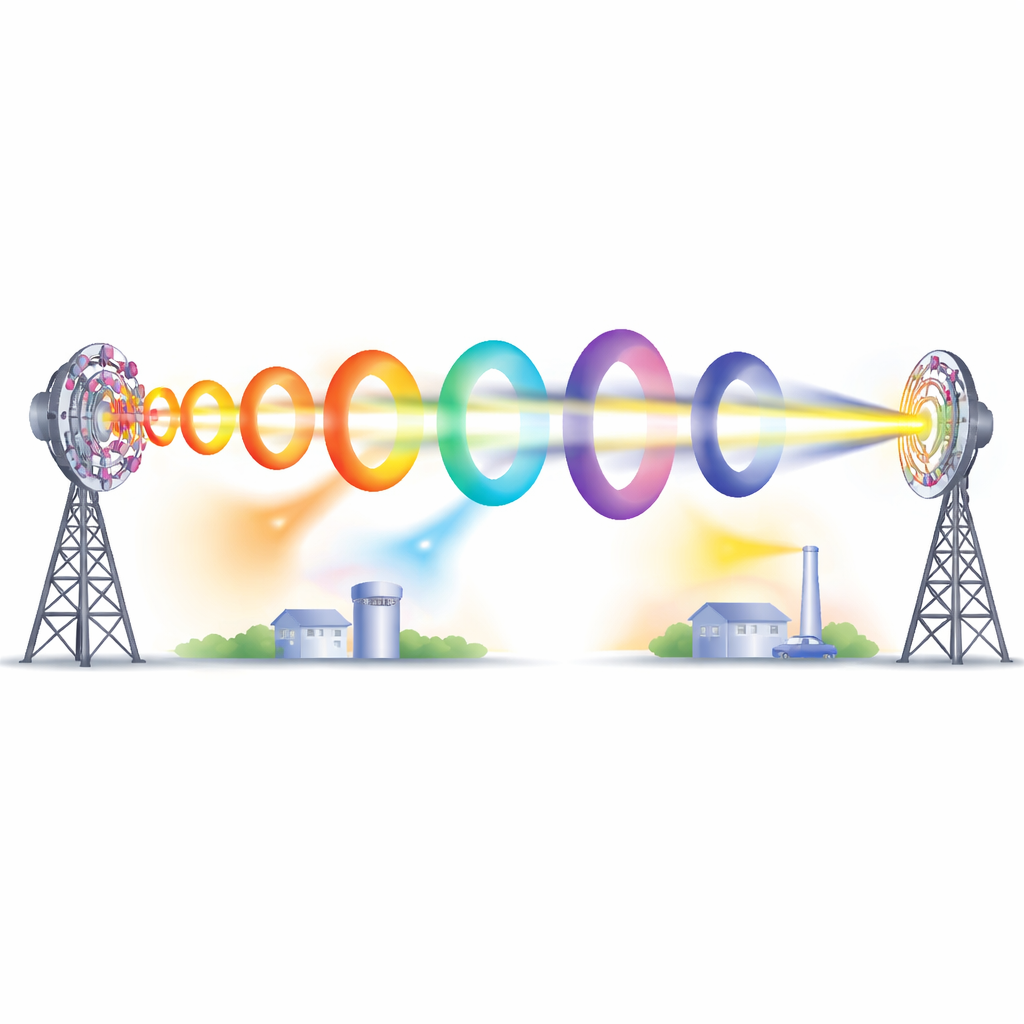
Instead of using ordinary radio waves that spread out smoothly, the authors work with beams that spin as they move forward, forming a corkscrew-like pattern. In cross-section, these beams look like bright rings with a dark hole in the middle, and engineers can choose from many distinct "twist patterns." Each pattern behaves like a separate channel, so several data streams can ride on different twists of the same frequency band. These structured beams have already been explored for boosting data rates and for fine-grained imaging, but until now, they have mostly been used either for communication or for sensing—not both at the same time.
Why Communication and Sensing Normally Clash
To maximize throughput, wireless systems want to transmit many of these twist patterns at once, each carrying its own stream of information. Sensing, however, prefers to probe the environment with one clean pattern at a time so that the reflections can be cleanly associated with a specific beam. When multiple twisted beams bounce off an object together, their reflections get mixed in a complicated way. That mixture depends on how the patterns interfere and where the object is located. Untangling that without losing the original data streams is a central challenge the paper addresses.
Reusing the Same Beams in a Smarter Way
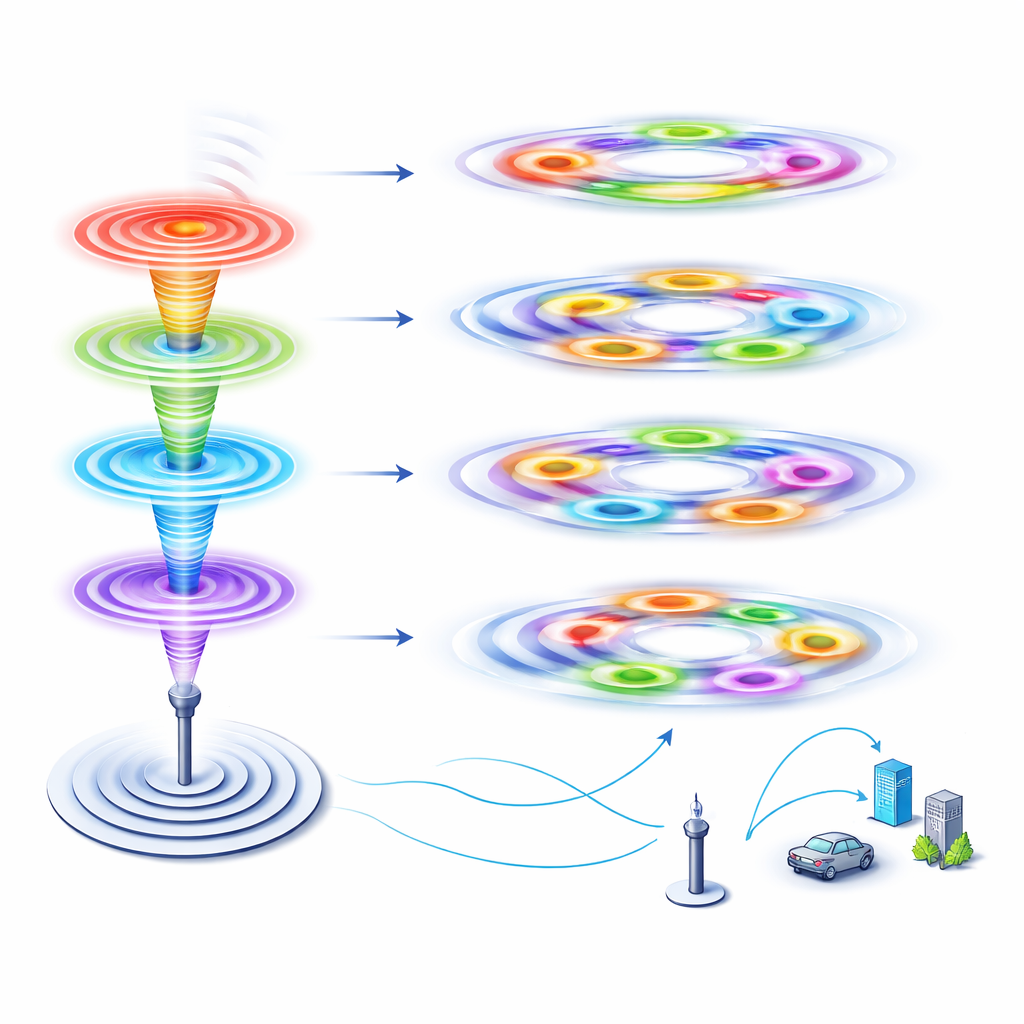
The key insight of the study is that, for the data link, what really matters is how many distinct twist patterns are active, not which exact ones are used at any given moment—as long as the receiver is designed to capture them. This gives the system freedom to shuffle which twists are turned on over time, a strategy the authors call mode hopping. They arrange several circular antenna rings, each able to generate a chosen twist pattern, and in every time frame they pick a new combination of patterns. To the communication receiver, these are still clean, independent channels. To a nearby sensing receiver that listens to the echoes from objects in the scene, each new combination creates a different interference pattern in space, like shining the environment with a rapidly changing stencil of light.
Listening to the Echoes as a Signature
Every object in the environment reflects this changing illumination in its own way, depending on its angle and position around the transmitter. Over many frames, the sensing receiver records a time series of echoes, each corresponding to a different choice of twist combinations. The authors model in detail how these reflections should look for hypothetical target locations and precompute a large library of such "signatures." In experiments, they then compare the measured echo pattern to this library to infer where objects must be. Because the environment is usually sparse—only a few strong reflectors near a base station—they use techniques that favor solutions with only a handful of likely target locations, sharpening the resulting location map.
Real-World Tests at Very High Frequencies
To show that this approach is practical, the researchers build a testbed operating around 120 gigahertz, a frequency range of interest for future ultra-fast links. Carefully designed passive surfaces create multiple twisted beams at once, and additional surfaces at the receiver pull the individual data streams back apart. In sensing tests with small metal plates placed at different angles, the system can estimate elevation angles with errors well below a degree and azimuth angles within a few degrees under realistic noise levels. It can also distinguish between two separate targets whose angles differ by only a small amount, approaching the theoretical resolution limit for this type of beam. Meanwhile, the same twisted beams deliver multiple data streams totaling several gigabits per second, with error rates that change very little as the twist combinations are shuffled for sensing.
What This Means for Future Networks
The work shows that structured, twisted radio beams can be engineered to both move large amounts of data and precisely locate objects, all in the same frequency band and at the same time. Instead of dedicating some resources to communication and others to sensing, the same beams are re-used intelligently: their bright central rings feed a stable high-capacity link, while their weaker side rings illuminate the surroundings and encode location information in the echoes. This joint design could help future millimeter-wave and sub-terahertz networks act as both data highways and environmental sensors, supporting applications from wireless backhaul that can foresee blockages to smart infrastructure that is constantly aware of what is happening nearby.
Citation: Shen, R., Ghasempour, Y. Joint communication and sensing with structured beams carrying orbital angular momentum. Nat Commun 17, 2832 (2026). https://doi.org/10.1038/s41467-026-69493-y
Keywords: orbital angular momentum, millimeter wave wireless, joint communication and sensing, beamforming, wireless backhaul