Clear Sky Science · en
Stress pinch points from glacial loading modulate magma ascent and storage in continental arcs
Ice, Volcanoes, and a Hidden Connection
People tend to think of glaciers and volcanoes as separate worlds: one made of ice, the other of fire. This study shows they are tightly linked. By examining a volcano in southern Chile that sat beneath a major ice sheet during the last Ice Age, the authors reveal how the sheer weight of ice can change where magma travels and sits underground. Those changes, in turn, help control how often a volcano erupts and how explosive those eruptions can be.
When Climate Squeezes the Earth’s Crust
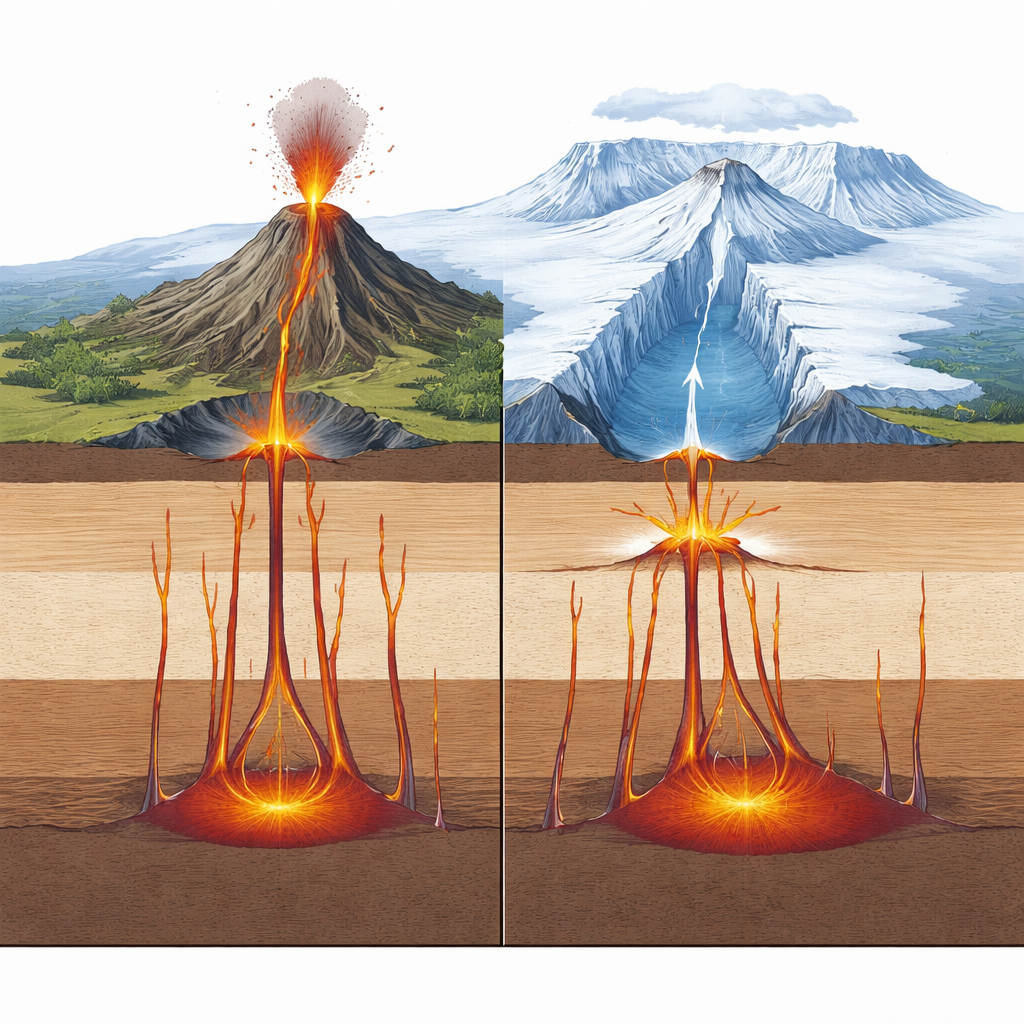
As ice sheets grow and shrink over tens of thousands of years, they press down on the land beneath them and then release that pressure when they melt. Earlier work showed that this loading and unloading can affect volcanism where Earth’s outer shell is thin, such as at mid-ocean ridges and Iceland, mainly by changing how much rock melts in the mantle. But most of the world’s above-water volcanoes sit in continental arcs, where the crust is much thicker. Here, the direct effect of ice on mantle melting is weaker, yet geological records still show that eruption rates and magma types track ice ages and warm periods. That pattern hints that the key action happens higher up, inside the crust where magma travels and pools on its way to the surface.
A Natural Laboratory in the Chilean Andes
The researchers focus on Mocho-Choshuenco, a large volcano in the Southern Volcanic Zone of the Andes. During the last Ice Age, the nearby Patagonian Ice Sheet buried the surrounding valleys beneath up to 1.5 kilometers of ice, while ice over the summit stayed relatively thin. Detailed dating of eruptions over the past 300,000 years shows that during peak glaciation, Mocho-Choshuenco’s eruption rate dropped sharply and even paused for several thousand years, then surged after the ice retreated. Rock analyses also reveal that, during the ice maximum, magma feeding eruptions was stored a few kilometers deeper than before—and that after deglaciation, more evolved, silica-rich magmas erupted explosively before activity shifted back toward less evolved compositions.
A Stress “Pinch Point” that Chokes Magma Pathways
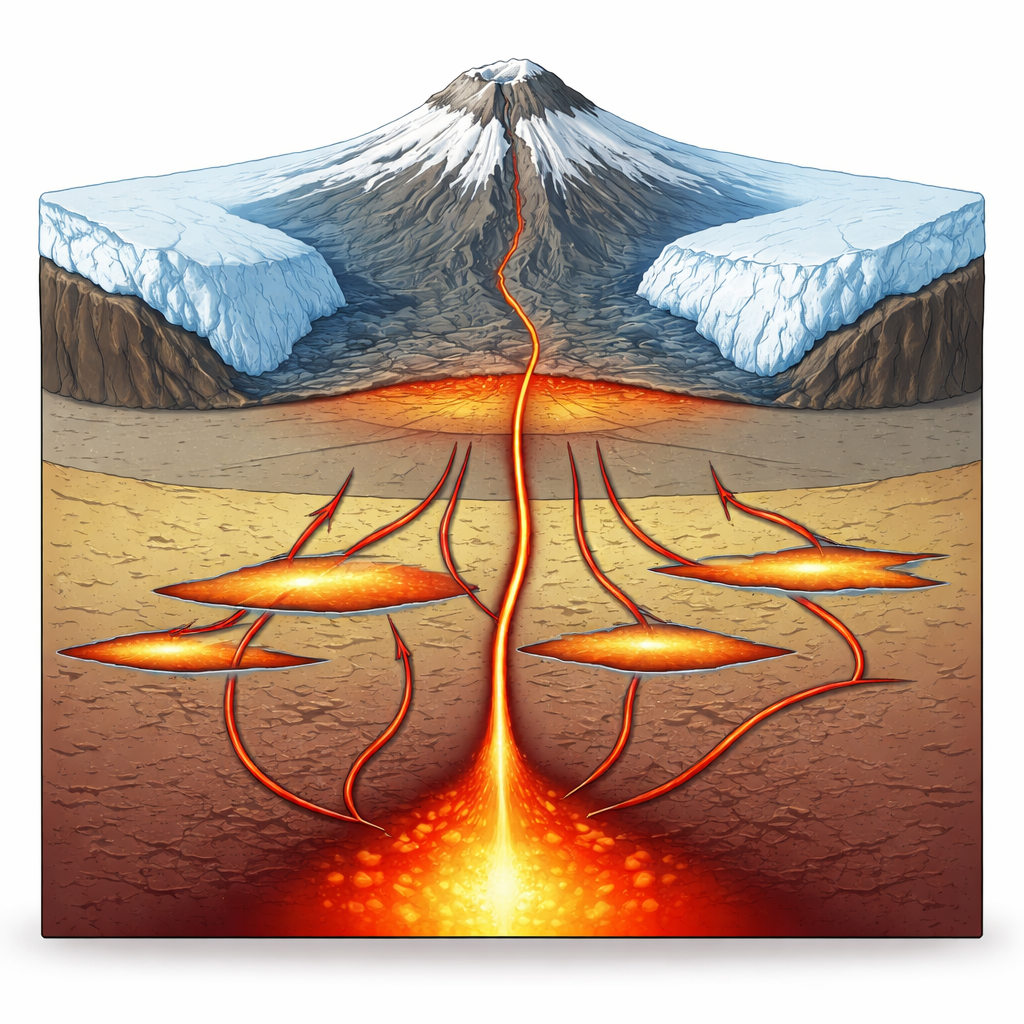
To explain these observations, the authors build a three-dimensional model that combines realistic ice thickness, rugged topography, and the physics of magma-filled cracks known as dikes. In their calculations, the thick ice pooled in valleys around the volcano does not simply push straight down; it produces a zone in the mid-crust where compressive stress is locally strongest and changes rapidly with depth. This narrow band, located about 9 to 13 kilometers below sea level—coinciding with known magma storage depths—acts as a mechanical “pinch point.” Dikes rising from deeper crust that would normally feed shallower magma pockets tend to slow, spread sideways, and stall several kilometers deeper when the ice load is present. Dikes that start above this zone, by contrast, behave much as they would without ice. The result is that glacial loading quietly shuts off the supply of fresh magma to the upper reservoir without requiring any change in melt production deeper down.
From Quiet Deep Storage to Post-Ice Explosions
With their usual recharge cut off during peak glaciation, shallow magma bodies beneath Mocho-Choshuenco gradually cool, crystallize, and chemically evolve. Meanwhile, repeated dike arrests at 10 to 15 kilometers depth warm and partially melt the crust there, assembling a new, deeper reservoir that can still feed limited activity. Once the ice sheet retreats and the stress pinch point relaxes, rising dikes again reach the upper levels, tapping these long-isolated, evolved magmas. This sequence naturally explains both the deeper storage during the glacial period and the burst of powerful, silica-rich eruptions—including large caldera-forming events—soon after deglaciation, before the system settles back into a more typical pattern of intermediate-depth, less evolved eruptions.
Why This Matters for Today’s Warming World
The study proposes a simple but far-reaching idea: even modest changes in surface loading by ice can reorganize magma pathways in continental arcs, encouraging deeper, longer-lived magma storage during glacial times and raising the odds of large explosive eruptions as ice sheets shrink. This mechanism may help explain why records of volcanic ash worldwide show rhythms that match the timing of ice ages. It also suggests that ongoing loss of ice from many volcanic regions could, in the long run, make some volcanoes both more active and more explosively dangerous, by suddenly unlocking magma that has been quietly evolving in the mid-crust for thousands of years.
Citation: Townsend, M., Moreno-Yaeger, P., Harp, A. et al. Stress pinch points from glacial loading modulate magma ascent and storage in continental arcs. Nat Commun 17, 2964 (2026). https://doi.org/10.1038/s41467-026-69485-y
Keywords: glacial loading, arc volcanism, magma transport, Andes volcanoes, climate–volcano interaction