Clear Sky Science · en
Investigating room temperature ferroelectric nematogens and their structure-property relationships
Why new liquid crystals matter
Modern screens, sensors and data-storage devices rely on liquid crystals—fluids whose molecules line up like tiny matchsticks. A newly discovered type, the ferroelectric nematic phase, combines the fluidity of a liquid with a built-in electric polarity, offering ultra-fast switching and novel energy and memory applications. This paper explores how to design such materials so that they work close to everyday room temperatures, making them far more practical for real-world technologies.
From ordinary liquid crystals to polar fluids
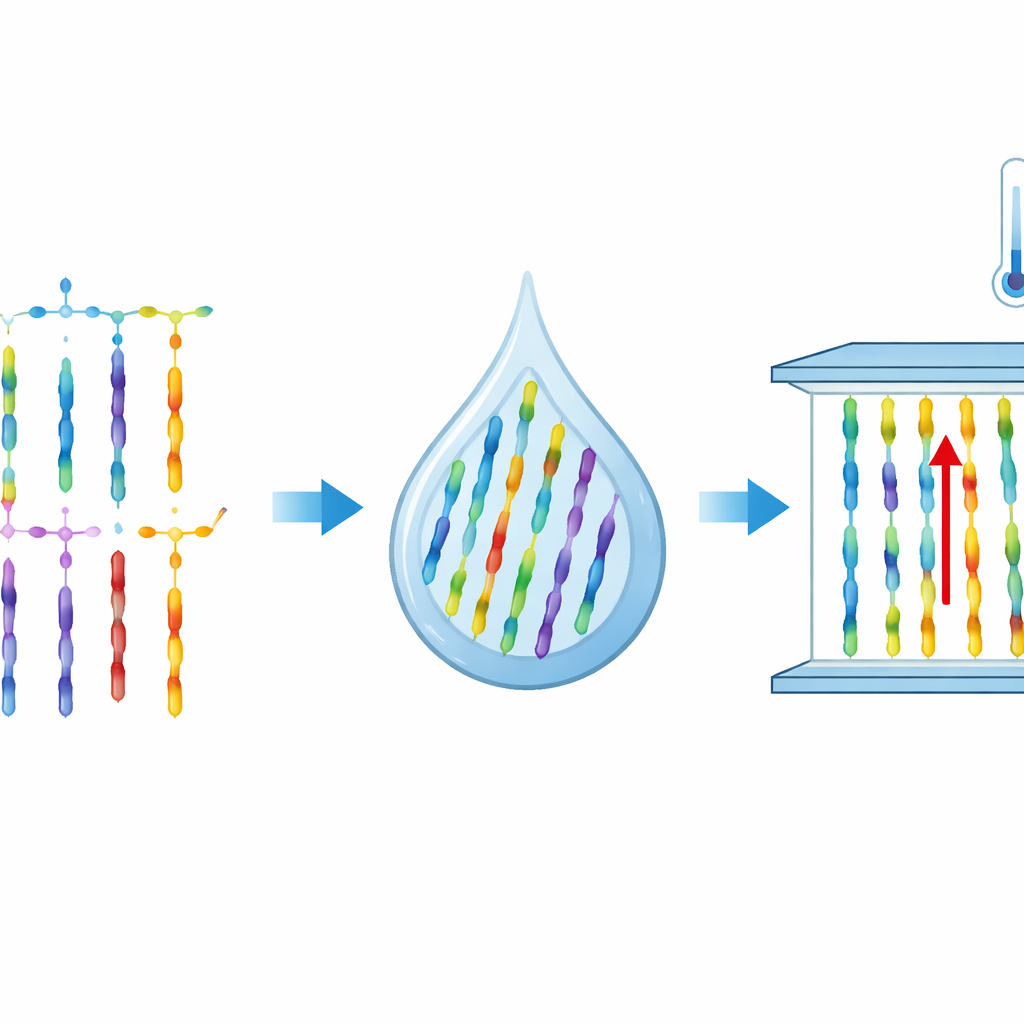
Conventional liquid crystals used in displays form a nematic phase, where rod-shaped molecules roughly point in the same direction but have no overall “up” or “down.” In the ferroelectric nematic phase, by contrast, the molecules not only align but also all point the same way, giving the liquid a built-in electric polarization similar to that of a solid ferroelectric crystal. Because this state is highly sensitive to electric and magnetic fields, it could underpin faster electro-optic devices, efficient energy-storage elements and advanced optical components. Until recently, however, only a handful of special molecules could form this polar liquid phase, and almost never near room temperature.
Building a library of tailored molecules
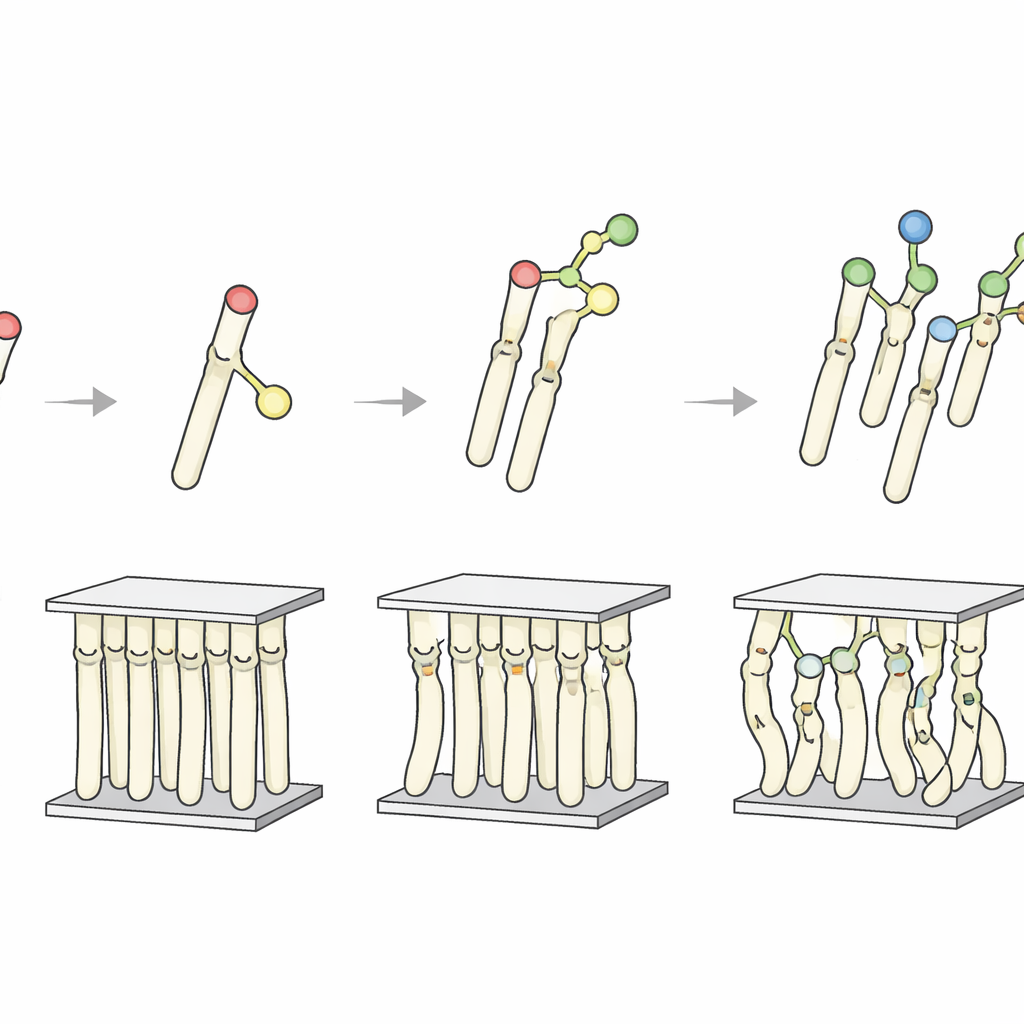
The authors focused on a proven molecular “template” called RM734 and systematically modified it to understand how small structural tweaks affect behavior. They created twelve related series, comprising 70 new compounds that all form the ferroelectric nematic phase. The variations included changing the chemical group at one end of the molecule, moving or adding side chains along the rigid core, adding or removing fluorine atoms, and altering the length of side chains. These changes subtly reshaped the molecules and redistributed electrical charges within them. The result is a rich library that lets researchers link specific design choices to key properties such as the temperature at which the polar liquid appears and how easily its polarization can be switched.
Finding room-temperature polar liquids
Using polarized optical microscopy, thermal analysis and electrical measurements, the team mapped how each compound behaves as it is heated and cooled. Most of the new materials transform directly from a disordered liquid into the ferroelectric nematic phase, bypassing the conventional nematic state altogether. Remarkably, 19 of the compounds switch into the polar phase below 30 °C, a dramatic increase over the single pure compound previously known to do so. Many remain in the polar state when cooled to room temperature without crystallizing, which is important for devices that must operate reliably over time. By comparing trends across the series, the authors show how longer side chains and extra side groups generally lower the temperature at which the polar phase appears, while certain fluorine substitutions tend to stabilize it.
Balancing speed and stability
Beyond the phase temperatures, the researchers examined how quickly the materials’ polarization responds to an applied electric field. They monitored how molecules collectively reorient, measured as a characteristic delay time that reflects the fluid’s rotational viscosity. Molecules with long or multiple side chains pack more tightly and experience greater crowding, which slows their rotation and raises the viscosity. Removing a small side group, shortening a chain or shifting it along the core can reduce this crowding and speed up switching by an order of magnitude. Because the same structural changes that tune the transition temperature also tune viscosity, molecular design becomes a powerful way to choose between very fast, responsive materials and slower, more stable ones that hold their electric state for longer.
Design rules for future devices
This study shows that careful control over molecular shape and charge distribution can reliably produce ferroelectric nematic liquids that work near room temperature. By adjusting side-chain length, position, end groups and fluorination pattern, the authors demonstrate how to lower or raise the temperature of the polar phase and how to control how quickly it switches. For non-specialists, the key message is that small chemical details determine whether a liquid can behave like an electrically polar crystal and whether it does so at everyday temperatures. These new design rules bring practical ferroelectric liquid-crystal devices—combining speed, tunability and long-term stability—much closer to reality.
Citation: Tufaha, N., Stepanafas, G., Cruickshank, E. et al. Investigating room temperature ferroelectric nematogens and their structure-property relationships. Nat Commun 17, 2965 (2026). https://doi.org/10.1038/s41467-026-69484-z
Keywords: ferroelectric nematic, liquid crystals, room temperature materials, molecular design, electro-optic devices