Clear Sky Science · en
Electrochemical initiation and chemical reaction cascades in dual-stage thermal runaway in sulfide-based all-solid-state batteries
Why solid-state batteries are not automatically safer
Solid-state batteries are often hailed as the next big thing in energy storage, promising electric cars and devices that are both powerful and safe. Because they replace flammable liquid with a solid material, many assume they cannot catch fire as easily. This study shows that assumption is too simple. The authors uncover how certain solid-state batteries can still undergo dangerous, even explosive overheating—and how careful design of the tiny contact zone inside the battery can greatly reduce this risk.
A closer look at the heart of the battery
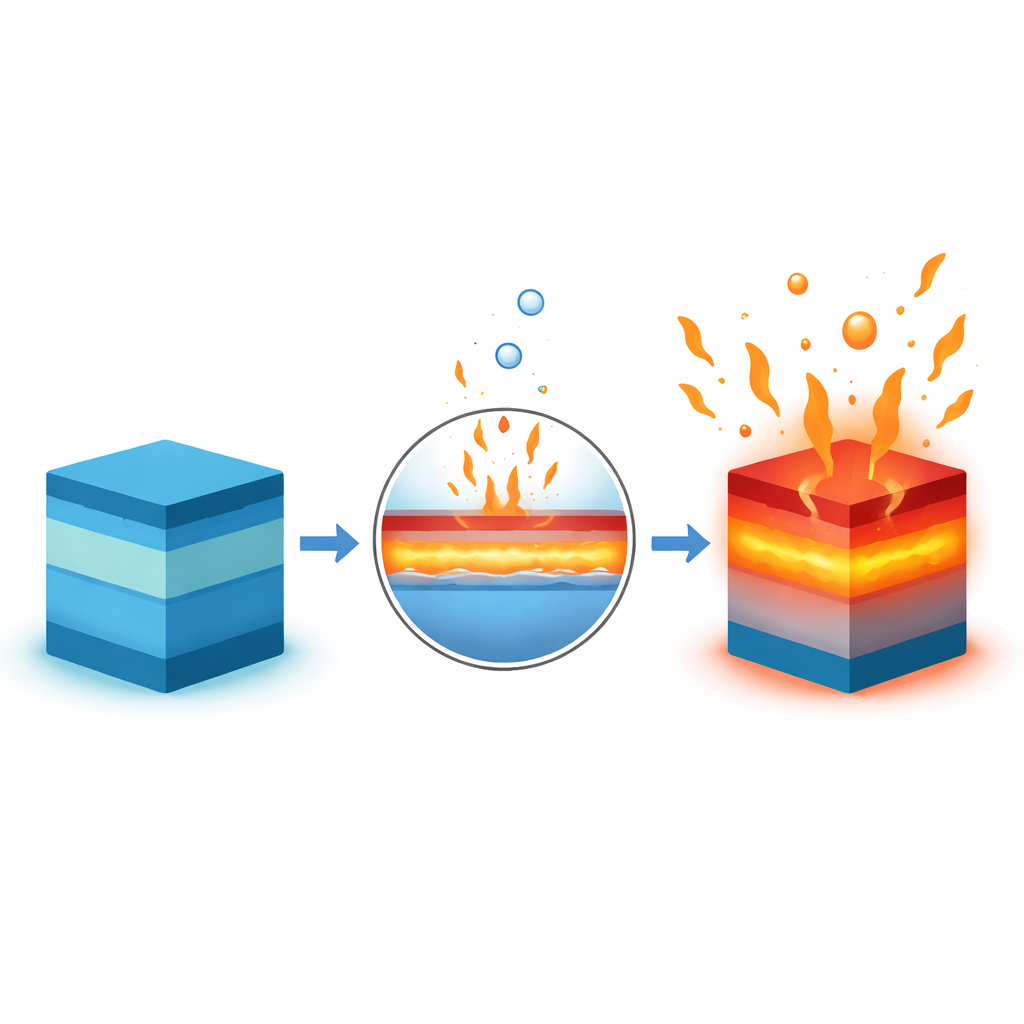
The work focuses on sulfide-based all-solid-state batteries, which use a sulfur-containing solid to move lithium ions between electrodes. These batteries pair a nickel-rich oxide positive side (often called NCM811) with a sulfide solid electrolyte such as Li6PS5Cl (LPSC). On paper, each ingredient is thermally stable to several hundred degrees Celsius, far above normal operating temperatures. Yet pack-level tests have shown that such cells can heat up, fail rapidly, and even spread fire faster than some conventional lithium-ion packs. This contradiction prompted the researchers to look beyond bulk materials and examine what happens at the thin, fragile boundary where the positive electrode touches the solid electrolyte.
Two stages of dangerous heating
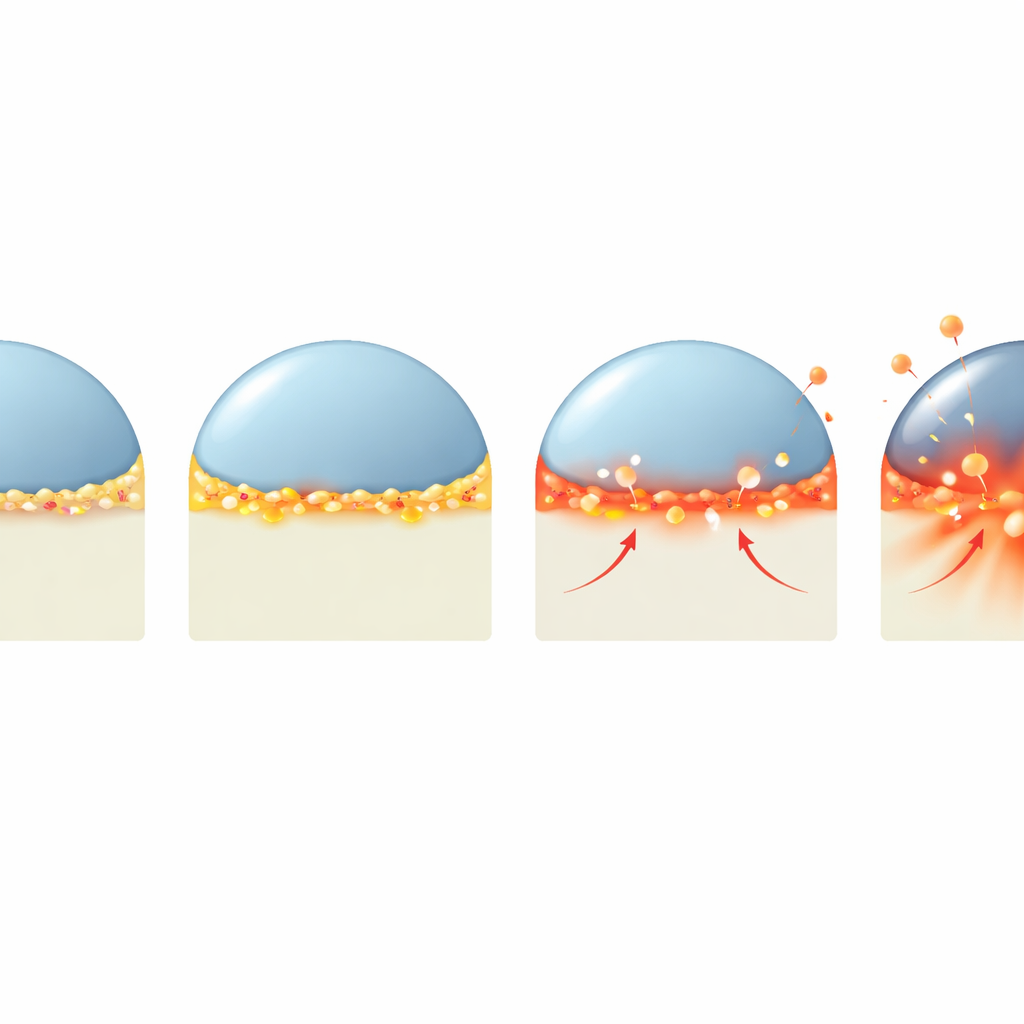
By combining advanced calorimetry, gas analysis, X-ray methods and electron microscopy, the team mapped how heat and gases are released as the battery is pushed to high temperatures. They discovered a universal two-stage failure process. In the first stage, which begins below about 160–200 °C, a thin reaction layer that had formed during normal charging starts to break down. This layer, rich in sulfur–sulfur and phosphorus–sulfur links, reacts strongly with the highly charged positive electrode and conductive carbon. The reactions release heat along with gases such as sulfur dioxide, oxygen and carbon dioxide. Although the amount of material involved is small, the heat release is intense and localized at the interface, igniting the rest of the system.
From interface spark to full-blown thermal runaway
Once this first stage has raised the temperature, a second stage sets in. Now the bulk positive electrode and the sulfide electrolyte react directly with each other. Sulfur migrates into the oxide and oxygen migrates out, forming nickel sulfides, lithium sulfide and phosphate compounds. These solid–solid reactions release even more heat, accelerating the temperature rise and driving the cell into full thermal runaway. Importantly, similar two-step behavior was found not only for LPSC, but also for other widely studied sulfide electrolytes such as LGPS and LSPSC. In all cases, it was not the untouched solid electrolyte that posed the greatest danger, but the electrochemically altered interfacial layer created during battery operation.
Engineering a calmer interface
Recognizing that the interface is the true weak link, the researchers tested strategies to stabilize it. Simple oxide coatings on the positive electrode delayed some reactions but did not eliminate hazardous gas release or self-heating. They then pursued a more fundamental change: adjusting the chemistry of the sulfide environment so it interacts less aggressively with oxygen from the oxide. Guided by electronic-structure calculations and bonding principles, they introduced a lithium germanium sulfide (Li4GeS4) component, whose germanium–sulfur framework is less prone to forming strong bonds with oxygen. When blended into the composite positive electrode, this material reduced the formation of reactive sulfur species, weakened the early interfacial reactions, and greatly cut gas evolution.
What this means for future safe batteries
With the germanium-based interface design, cells showed a much higher temperature before self-heating began and before they reached full thermal runaway, while still delivering good cycling performance. To a lay reader, the key message is that safety in solid-state batteries is not guaranteed simply by using solid materials. Instead, it depends critically on controlling the tiny boundary region where different materials meet and exchange atoms and electrons. By revealing a dual-stage failure pathway and showing that smart interface chemistry can break this chain reaction, the study offers a blueprint for designing next-generation solid-state batteries that truly live up to their safety promise.
Citation: Wu, Y., Zhang, S., Sun, Y. et al. Electrochemical initiation and chemical reaction cascades in dual-stage thermal runaway in sulfide-based all-solid-state batteries. Nat Commun 17, 2928 (2026). https://doi.org/10.1038/s41467-026-69472-3
Keywords: solid-state batteries, thermal runaway, battery safety, sulfide electrolytes, interfacial engineering