Clear Sky Science · en
Turbulent dynamo in the terrestrial magnetosheath
Why this space weather story matters
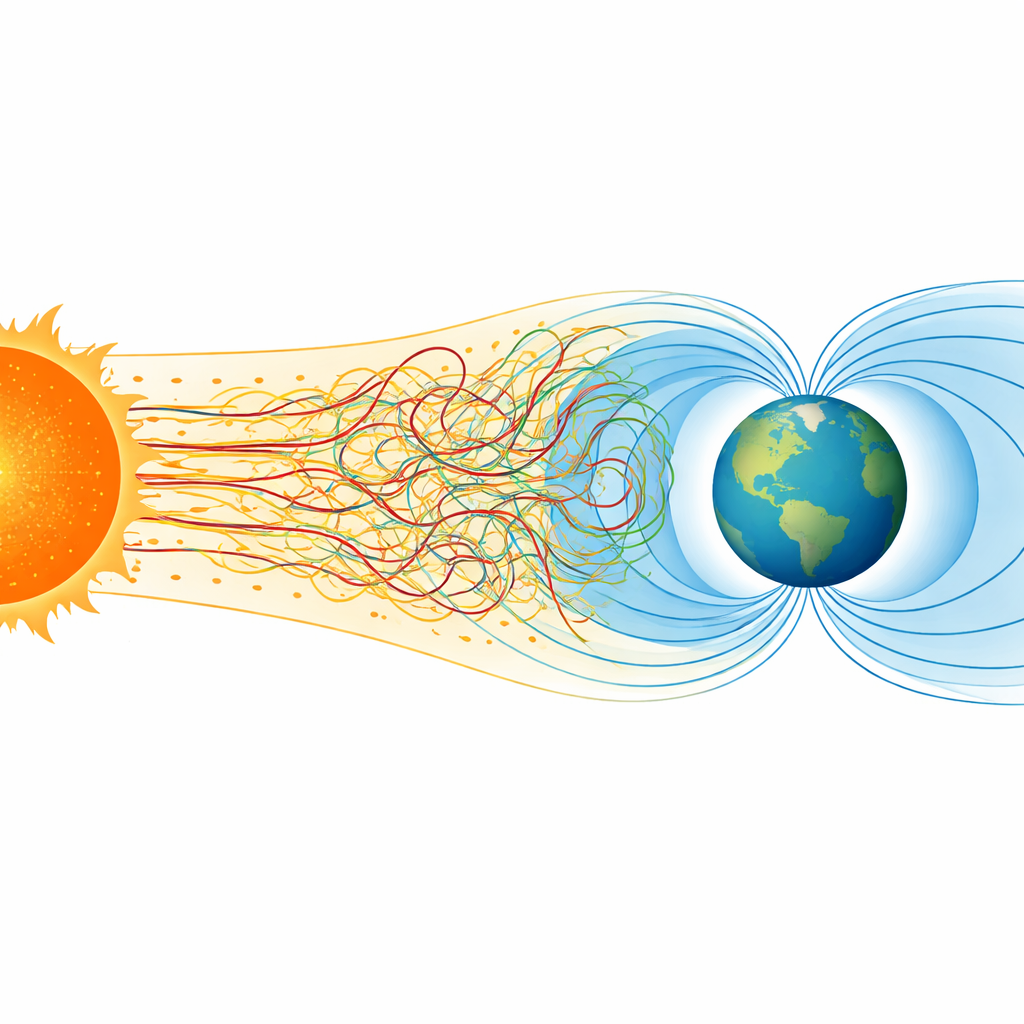
Earth is wrapped in an invisible magnetic shield that protects us from the constant stream of charged particles blowing from the Sun. But this shield is not a rigid shell; it is a restless, roiling plasma environment where magnetic fields are continually twisted, stretched, and sometimes rebuilt from scratch. This paper shows, for the first time with direct space measurements, that a key magnetic process long studied in theory and the lab—the turbulent dynamo—operates naturally in the region just outside Earth’s magnetic shield, called the magnetosheath. Understanding this process helps explain how cosmic magnetic fields are born and strengthened throughout the universe.
A busy boundary around Earth
When the solar wind crashes into Earth’s magnetic field, it cannot simply pass through. Instead, it slows down and diverts, forming a bow shock similar to the wave that builds up in front of a fast-moving ship. Between that shock and the inner magnetic boundary lies the magnetosheath, a turbulent buffer zone filled with super‑hot, nearly collision‑free plasma. In this region, the spacecraft of NASA’s Magnetospheric Multiscale (MMS) mission fly in a tight pyramid formation, allowing scientists to measure not just the magnetic field and particle motions at one point, but also how those quantities change from place to place on scales of only a few kilometers. This unique multi‑point capability turns the magnetosheath into a natural laboratory for testing ideas about how turbulence can generate and amplify magnetic fields.
How turbulence builds magnetic fields
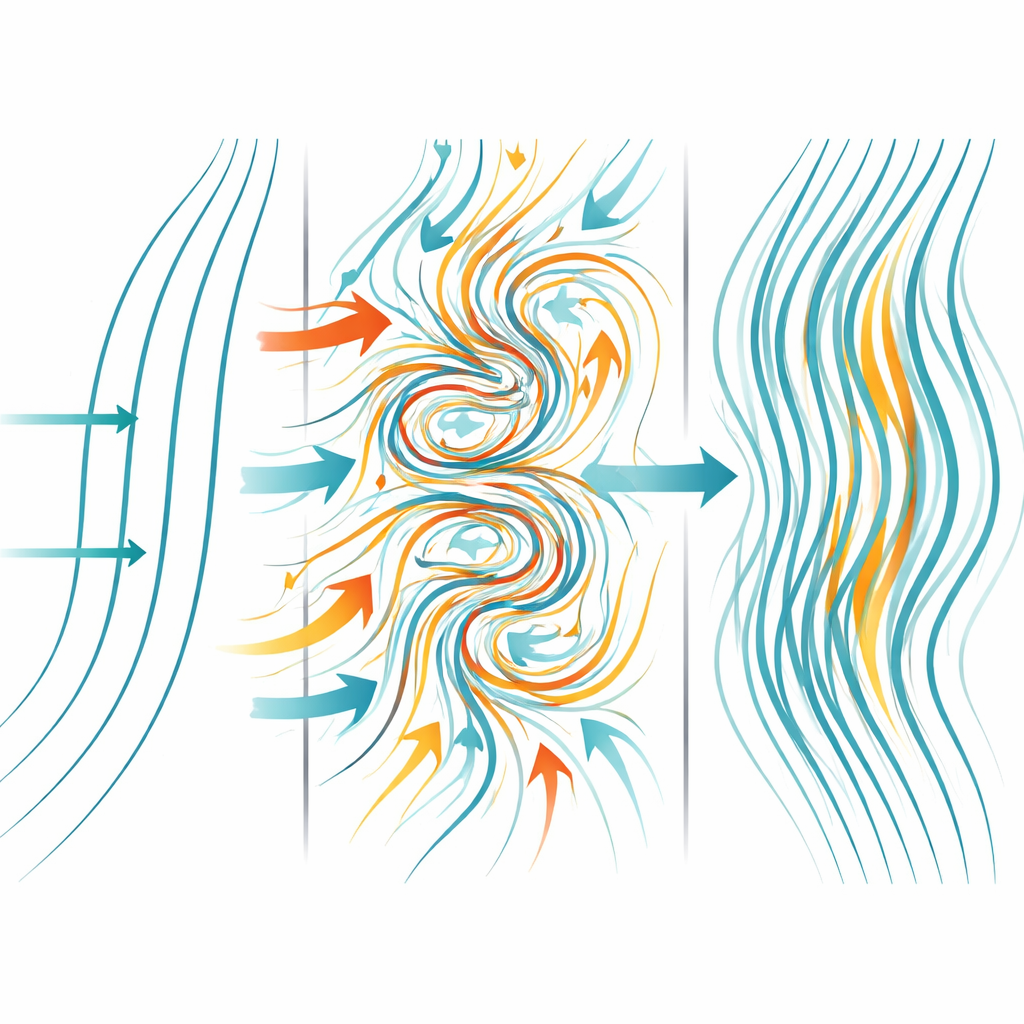
The basic idea of a dynamo is simple: flowing, electrically conducting fluid can stretch and fold magnetic field lines, converting kinetic energy of motion into magnetic energy. In everyday fluids, collisions between particles help smooth out this process, but in the magnetosheath collisions are rare. Instead, the plasma’s behavior is governed by collective electromagnetic forces and by how particles spiral around field lines. The authors focus on a “small‑scale dynamo,” in which the magnetic field is strengthened at scales comparable to, or smaller than, the size of the turbulent swirls themselves. Using the MMS tetrahedron, they estimate how rapidly the plasma flow stretches magnetic field lines along their direction and compresses or expands them across their direction—two key ingredients that theory predicts should control the local growth or decay of magnetic strength.
Seeing stretched and folded magnetic patterns
From several minutes of high‑resolution data in a strongly disturbed magnetosheath, the team builds up a statistical picture of the magnetic geometry. They find that regions where the field lines bend sharply tend to have weaker magnetic strength, while long, nearly straight segments tend to be stronger. This inverse link between curvature and field strength matches the “stretch‑and‑fold” pattern found in computer simulations of turbulent dynamos. They also measure characteristic length scales along and across the magnetic field and infer that the plasma behaves as if it has a very large magnetic Prandtl number—a regime where tiny, viscous‑scale motions of the flow can efficiently amplify magnetic fields. Such behavior is thought to be important in hot, diffuse environments like galaxy clusters, yet had not previously been confirmed so clearly in space.
Instabilities that help the dynamo work
In a collisionless plasma, simple theory says that as the magnetic field changes, particles should adjust in a way that actually slows or prevents further amplification. For the dynamo to succeed, this built‑in resistance must be relaxed. The authors show that this happens through pressure anisotropy: the particle pressure along the field lines differs from that across them. When the magnetic field weakens in folded regions, one class of instability known as the firehose appears, encouraging particles to stream along the field and further distort it. When the field strengthens in stretched regions, another class of waves called mirror modes grows, trapping particles in magnetic “bottles.” These instabilities effectively act like collisions, scattering particles and breaking the constraints that would otherwise shut down the dynamo. Detailed case studies of two short time intervals reveal these behaviors unfolding along the spacecraft path, tying together changes in field strength, flow gradients, and particle distributions into a coherent dynamo picture.
A new testbed for cosmic magnetism
By combining precise multi‑spacecraft measurements with modern dynamo theory, the study demonstrates that the magnetosheath naturally hosts a turbulent dynamo operating on very small scales in a collisionless environment. To a non‑specialist, this means that the same type of magnetic “engine” thought to shape the fields of stars, galaxies, and galaxy clusters is actively running just outside Earth’s magnetic shield, where we can probe it in detail. The work positions the magnetosheath as a powerful testbed for checking and refining computer simulations of cosmic dynamos, and it clarifies how turbulence, wave activity, and thin current sheets jointly convert flow energy into magnetic structures and heat. In the long run, these insights bring us closer to a unified understanding of how magnetic fields throughout the universe are generated, maintained, and woven into the fabric of space plasmas.
Citation: Vörös, Z., Roberts, O.W., Narita, Y. et al. Turbulent dynamo in the terrestrial magnetosheath. Nat Commun 17, 2909 (2026). https://doi.org/10.1038/s41467-026-69469-y
Keywords: space plasma turbulence, magnetosheath, turbulent dynamo, Earth magnetic field, solar wind interaction