Clear Sky Science · en
Photogated two conductive pathways of donor-acceptor Stenhouse adducts in single-molecule junctions
Light as a tiny on-off switch
Every electronic device, from your phone to future quantum computers, ultimately depends on how easily electrons can move. As engineers try to shrink circuits down to the size of single molecules, they need ways to steer these electrons with the same flexibility that today’s chips use transistors. This study shows how a special class of color-changing molecules can act as light-controlled switches, guiding electrons along two different routes inside a single molecule—much like redirecting cars between two lanes on a microscopic highway.
A molecule that loves both light and electricity
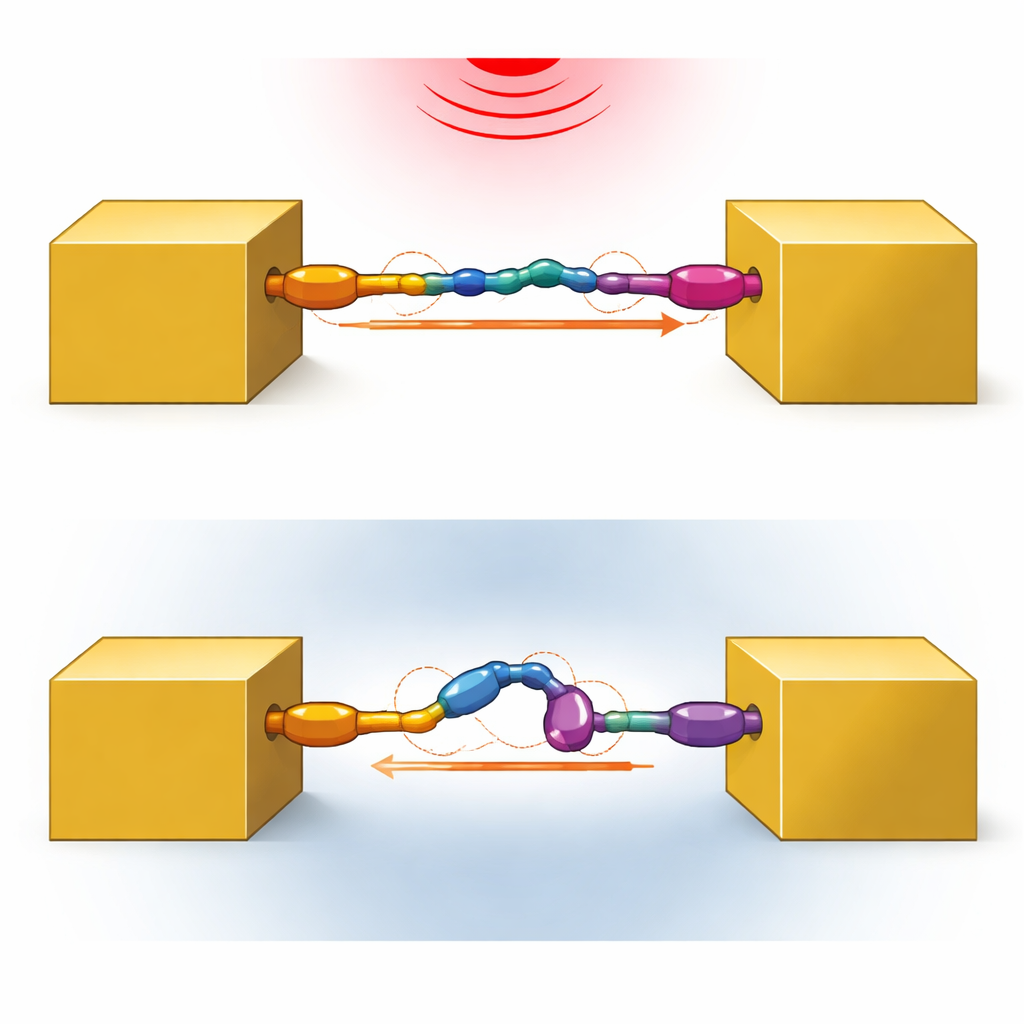
The researchers focus on donor-acceptor Stenhouse adducts, or DASAs—molecules best known for changing color under visible light. DASAs consist of three key parts: an electron-rich “donor”, an electron-poor “acceptor”, and a connecting bridge between them. When illuminated with red light, these molecules reversibly twist from an extended, linear shape into a more compact, ring-like shape, and then relax back in the dark. Crucially, the team attached sulfur-containing “anchors” to different parts of the molecules so they could clamp a single DASA between two gold electrodes and measure how easily electrons crossed this molecular bridge one molecule at a time.
Two microscopic roads for electrons
By carefully choosing where to place the anchoring groups, the scientists were able to isolate two distinct electrical pathways. In one design, called SSDA, electrons travel mainly through the fixed donor portion of the molecule; the rest of the structure behaves like a side branch that can subtly tune the current. Here, shining red light nudges the molecule from its linear to its cyclic form, slightly redistributing electrons and increasing the conductance by about 50 percent. In another design, SDAS, the anchors sit at opposite ends of the whole molecule, forcing electrons to use the long bridge that connects donor and acceptor. For this path, light-driven bending of the bridge disrupts its continuous network of bonds and makes it harder for electrons to pass, cutting the conductance by roughly a factor of four.
Zooming in on how the paths change
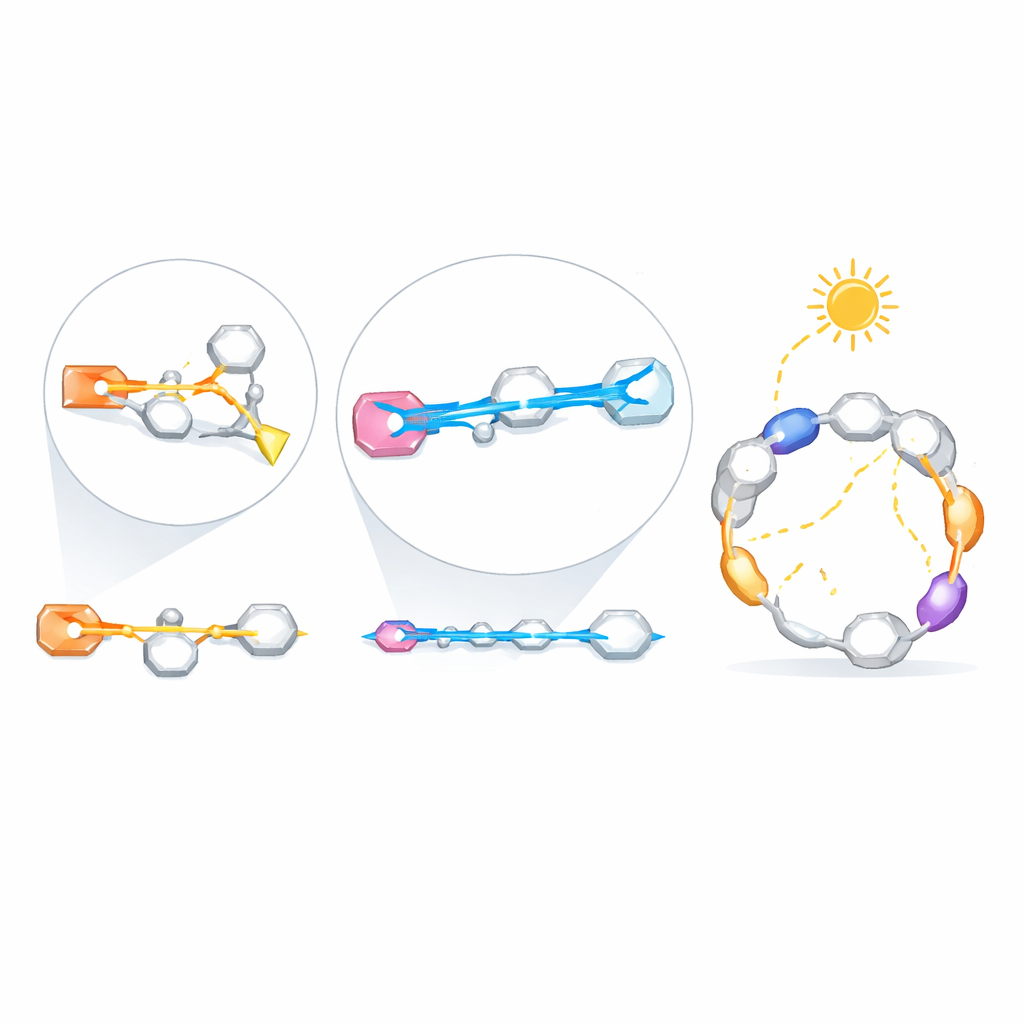
To understand these contrasting behaviors, the team combined precision measurements with computer simulations. Quantum-chemical calculations showed how the highest occupied molecular orbital—the region where the most active electrons reside—spreads across the molecule in the linear form but becomes more localized after light-induced bending. In the donor-focused SSDA, the main route remains almost unchanged, and light mostly sharpens the electron density along that fixed path. In SDAS, however, the central bridge is directly reshaped: in the straight form, electrons move mainly along chemical bonds; in the bent form, they must increasingly “tunnel” through space between separated segments. Noise analysis of the current confirmed this shift from bond-based transport toward more capacitive, through-space behavior when the molecule curls up.
Two switches combined in one tiny device
The most striking result comes from a third molecule, SSDAS, engineered with three anchoring sites. This design allows either the donor route or the bridge route to form between the gold electrodes in a single junction, so both channels can be probed under identical conditions. Measurements revealed two distinct conductance levels, corresponding to the two paths, and showed that red light drives them in opposite directions at once: the donor pathway becomes slightly more conductive, while the bridge pathway becomes substantially less so. As a result, the contrast between the “high” and “low” conductance states grows from about one and a third orders of magnitude in the linear form to nearly three orders of magnitude in the cyclic form.
Toward light-driven molecular logic
To a non-specialist, the key message is that a single molecule can host two independently controllable electrical channels that respond differently to the same beam of visible light. By choosing where electrons enter and leave the molecule, and by using light to reshape its internal structure, the researchers can selectively boost one pathway while suppressing another. This dual control hints at future molecular components capable of multi-level conductance, optical logic operations, and adaptive responses, all powered by gentle red light instead of harsh ultraviolet. While integrating such junctions into practical circuits remains a challenge, the work outlines a clear blueprint for building more complex, responsive electronics one molecule at a time.
Citation: Sun, F., Jiang, S., Zhang, H. et al. Photogated two conductive pathways of donor-acceptor Stenhouse adducts in single-molecule junctions. Nat Commun 17, 2842 (2026). https://doi.org/10.1038/s41467-026-69459-0
Keywords: molecular electronics, photoswitchable molecules, single-molecule conductance, donor-acceptor Stenhouse adducts, light-controlled nanoswitches