Clear Sky Science · en
Emergent surface magnetic ordering and surface electronic dipole layers in a two-dimensional spin=1/2 La2CuO4 film
Why the skin of a crystal matters
When we shrink materials down to just a few atomic layers, their outermost surface can behave very differently from the interior. This study looks at an ultrathin film of La2CuO4, a well-known parent compound of high-temperature superconductors, and discovers that its surface develops its own magnetic and electrical personality at room temperature. Understanding and controlling such “skin-deep” behavior could help scientists design future electronic and spin-based devices that use only a few layers of atoms.
A familiar material in an unfamiliar form
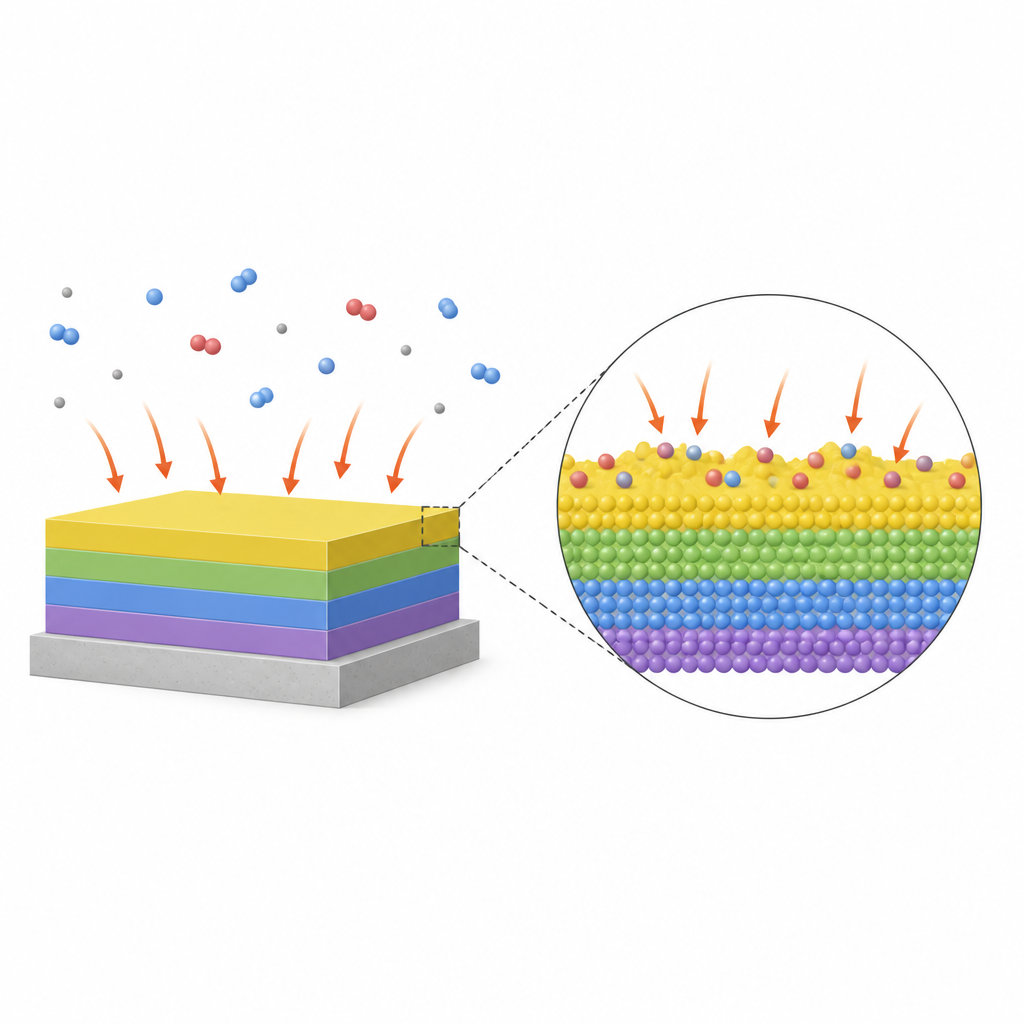
La2CuO4 is a classic copper-oxide material whose bulk form is an electrical insulator with a regular pattern of oppositely aligned magnetic moments. It is built from repeating copper-oxygen layers that host the electronic states thought to be crucial for high-temperature superconductivity when the material is doped. In this work, researchers grow a film only four unit cells thick, using highly controlled techniques that add atoms layer by layer on a crystal substrate. They carefully verify that the film is clean, well ordered, and only a few nanometers thick, so that any unusual behavior they detect can truly be traced to the surface layers rather than defects or contamination.
New ways to listen to surface atoms
Measuring magnetism and electronic structure at a surface just a few atoms thick is extremely challenging because signals from the underlying material usually drown them out. The team overcomes this by using grazing-incident soft X-ray scattering methods that skim the surface at very shallow angles. By tuning both the X-ray energy and the angle at which it hits the film, they can select which layers contribute most strongly to the signal. They focus on specific energy ranges that are sensitive to copper and oxygen, and to the so-called upper Hubbard band, a set of electronic states that reflect how strongly electrons interact with one another in this material.
A surface with its own magnetism and electric imbalance
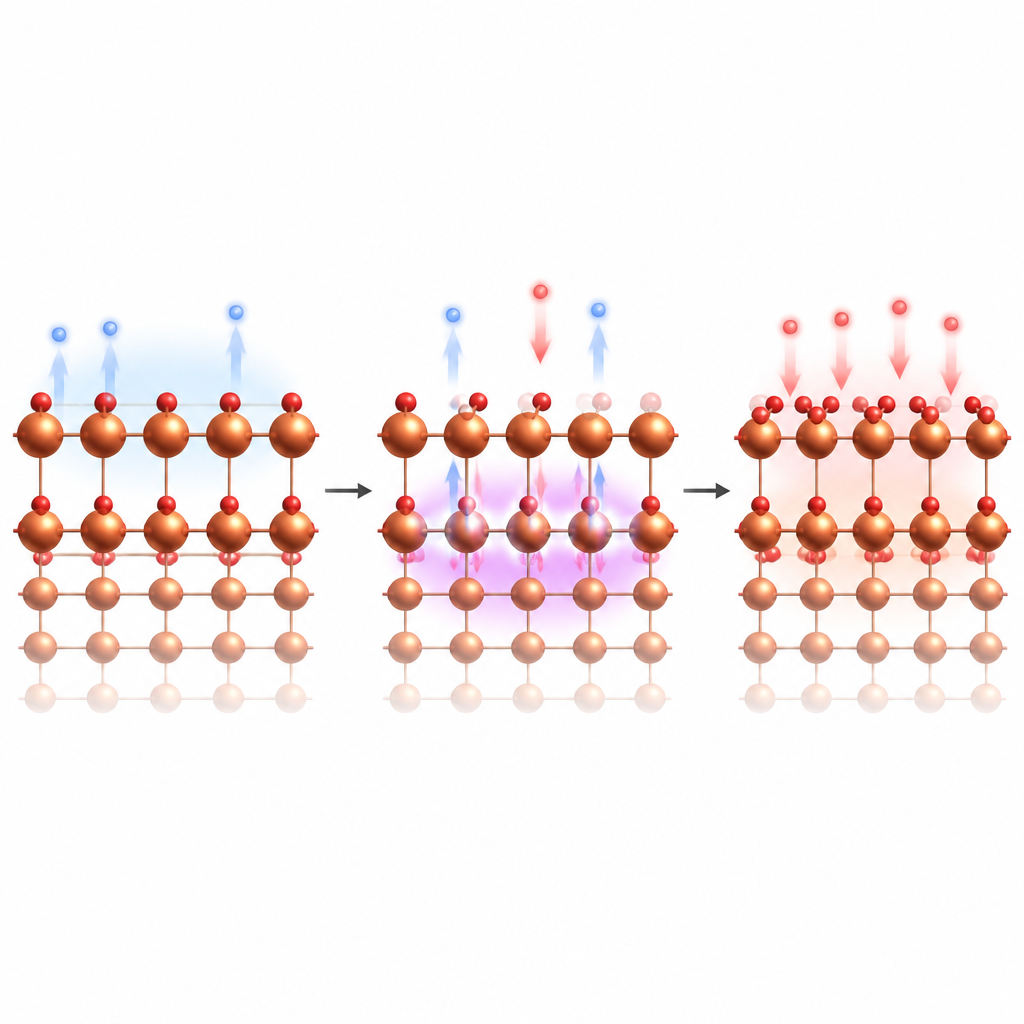
The measurements reveal an unexpected form of magnetic ordering confined to the top two or three copper-oxide layers, strongest around room temperature and much weaker both above and below. At the same time, the researchers see evidence that copper ions at the surface shift between two charge states, while extra positive charges and oxygen ions migrate into the layers just beneath the surface. This uneven distribution of charge between the surface and subsurface layers creates an electric dipole pointing from one layer to the other. In other words, the film develops a built-in electrical polarization near its surface that is tightly linked to the way the surface spins line up.
Temperature-driven motion of charges and ions
By heating and cooling the film and repeating their measurements, the team tracks how this surface behavior evolves. As the temperature drops from 320 kelvin to 300 kelvin, a mixture of copper charge states appears at the surface, the electric dipole strengthens, and surface magnetism becomes very strong and likely non-collinear, meaning the tiny magnetic moments no longer align in a simple up–down pattern. Cooling further to 37 kelvin, most of the magnetic copper at the surface converts to a nonmagnetic form, and both the special magnetic ordering and the dipole weaken. On reheating, the system does not retrace exactly the same path, showing a clear hysteresis loop that points to different rates for how holes and oxygen ions move in and out of the surface region.
What this means for future ultrathin devices
To a non-specialist, the key message is that the outer few atomic layers of this strongly interacting material act as an active, reconfigurable region whose magnetism and internal electric imbalance can be switched by changing temperature. Theory calculations support the idea that the surface gains new electronic states and enhanced magnetic moments that do not exist in the bulk. Together, the experiments and modeling show that carefully probing and engineering surfaces in complex oxides like La2CuO4 could open paths to devices where magnetism and electric polarization are controlled at the level of single atomic layers.
Citation: Jain, A., Diao, C., Ong, B.L. et al. Emergent surface magnetic ordering and surface electronic dipole layers in a two-dimensional spin=1/2 La2CuO4 film. Nat Commun 17, 4634 (2026). https://doi.org/10.1038/s41467-026-69457-2
Keywords: surface magnetism, ultrathin films, cuprate oxides, soft X-ray scattering, electronic dipole layers