Clear Sky Science · en
Perfectly harmonic spin cycloid and multi-Q textures in the Weyl semimetal GdAlSi
Hidden patterns in a quantum metal
In certain crystalline metals, electrons move as if they are massless particles from high‑energy physics, giving rise to unusual transport and magnetic effects. This study explores one such material, the Weyl semimetal GdAlSi, and shows that its magnetic atoms arrange themselves in an almost perfectly regular spiral pattern. By revealing how this spiral responds to an applied magnetic field, the work establishes GdAlSi as a clean playground for probing how exotic electronic states and complex magnetism influence one another in solids.
A crystal that bends the rules of symmetry
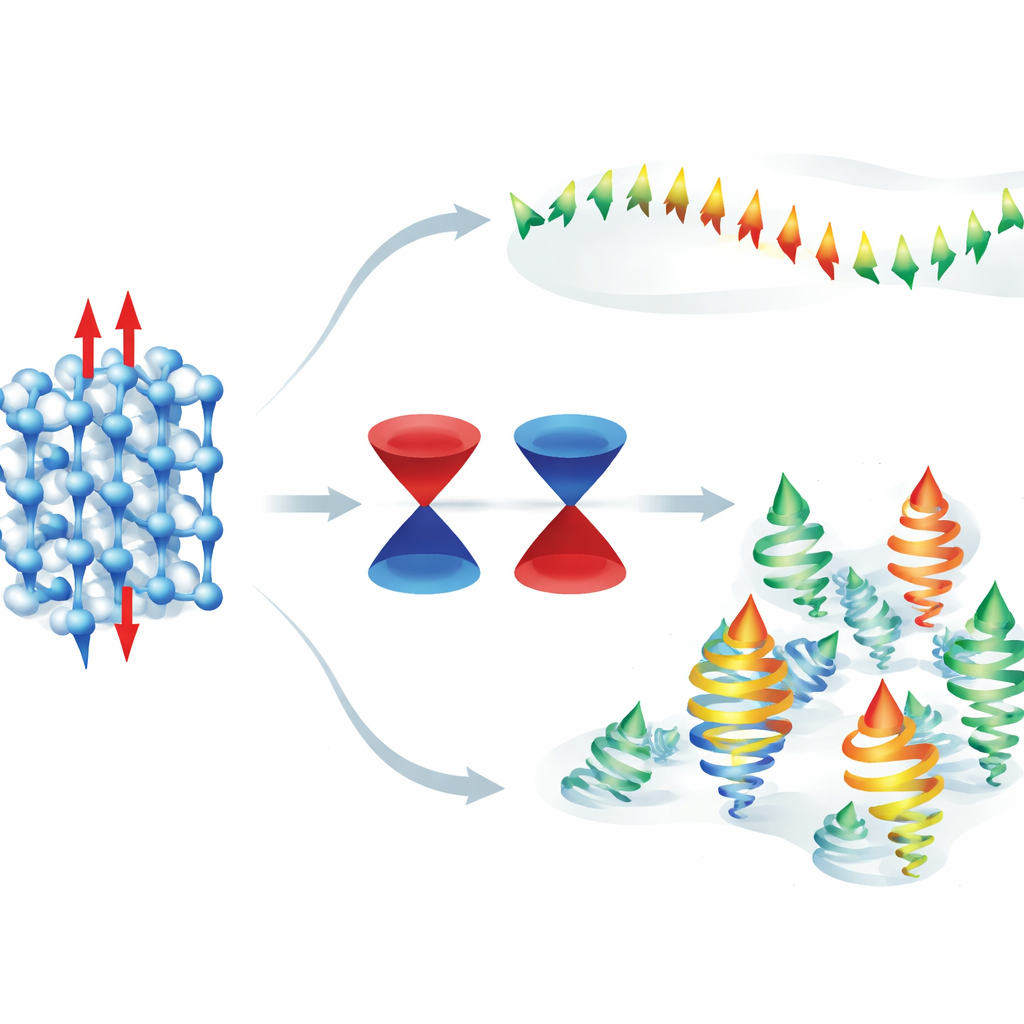
GdAlSi belongs to a family of compounds whose crystal lattice lacks an inversion center: the pattern of atoms does not look the same if space is turned inside out. This broken symmetry allows the electronic bands to touch at isolated points, forming Weyl nodes where electrons behave like chiral, relativistic particles. Earlier studies had suggested that related materials host a variety of magnetic states—from simple ferromagnets to more intricate spiral orders—but a textbook example of an undistorted magnetic helix in such a Weyl system had been missing. Because Gd ions carry nearly spherical magnetic moments, GdAlSi offers a rare opportunity to see what magnetism looks like when shaped mainly by the crystal’s symmetry rather than by the quirks of individual atoms.
A nearly perfect magnetic wave
Using resonant elastic X‑ray scattering, the authors examined how the magnetic moments of the Gd atoms are arranged at low temperature and zero magnetic field. Instead of aligning uniformly, the moments form a cycloid: as one moves through the crystal along a diagonal direction, each spin rotates smoothly within a fixed plane, tracing out a wave with a wavelength about six times the basic lattice spacing. Careful analysis of the scattered X‑ray polarization shows that this wave is extremely harmonic, meaning it is very close to a pure sinusoid without distortions or higher harmonics. This makes the magnetic structure exceptionally simple and well defined, a key requirement for connecting it cleanly to the behavior of Weyl electrons in the same material.
Magnetism tuned by an external field
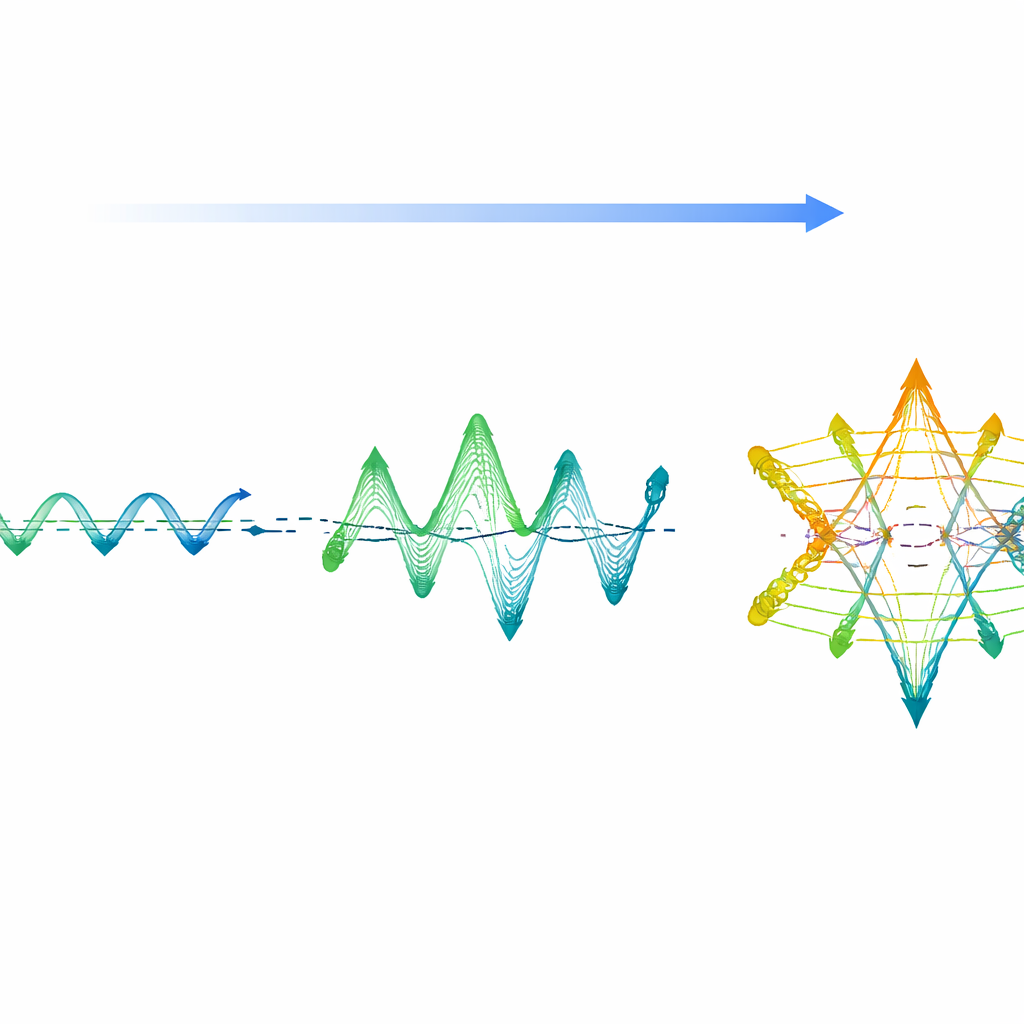
When a magnetic field is applied along a special diagonal of the crystal, the orderly cycloid does not merely tilt and align. Instead, it undergoes a series of transformations. At moderate fields, the original spiral persists as the dominant component, but an additional wave pattern appears in the component of the spins pointing along the field. This new pattern has a shorter period and repeats in an "up‑up‑down" fashion. Superimposing these two waves produces a noncoplanar arrangement in which the spins trace staggered cone shapes rather than lying in a single plane. The authors refer to this as a multi‑Q state, because it combines two distinct wavevectors within the same magnetic texture.
Uncovering the forces that shape the waves
To understand why these particular patterns are favored, the researchers built and tested theoretical models of the magnetic interactions. A simple picture based on competing exchange couplings between neighboring Gd moments explains why a spiral with the observed wavelength emerges. The polar nature of the crystal also allows a chiral interaction known as the Dzyaloshinskii–Moriya term, which promotes cycloidal spirals rather than screw‑like helices. However, reproducing the field‑induced multi‑Q state requires adding anisotropic exchange: a directional dependence of the coupling that encourages spins to organize into more intricate, noncoplanar textures. Numerical simulations of an effective momentum‑space Hamiltonian that includes these ingredients successfully mirror the experimental phase diagram and scattering signatures.
Why this matters for future quantum materials
Together, the experiments and calculations show that GdAlSi is a model system where a pristine magnetic spiral coexists with Weyl electrons and evolves into a controlled multi‑wave pattern under an applied field. Because the magnetic wavevector happens to connect pairs of Weyl nodes, adjusting the magnetic texture offers a way to selectively modify electronic states at different points in momentum space, potentially opening partial gaps or reshaping Fermi arcs. The clarity of the harmonic cycloid, combined with the tunable multi‑Q state, makes GdAlSi a powerful platform for exploring how topological electrons and complex magnetism interact—an essential step toward designing materials in which exotic quantum transport can be steered by engineered spin patterns.
Citation: Nakano, R., Yamada, R., Bouaziz, J. et al. Perfectly harmonic spin cycloid and multi-Q textures in the Weyl semimetal GdAlSi. Nat Commun 17, 3056 (2026). https://doi.org/10.1038/s41467-026-69452-7
Keywords: Weyl semimetal, helimagnetism, spin textures, topological materials, magnetic interactions