Clear Sky Science · en
NUT1-Exo70A1 Regulates Xylem Vessel Development and Influences Water Use Efficiency in Maize
Why this research matters for future harvests
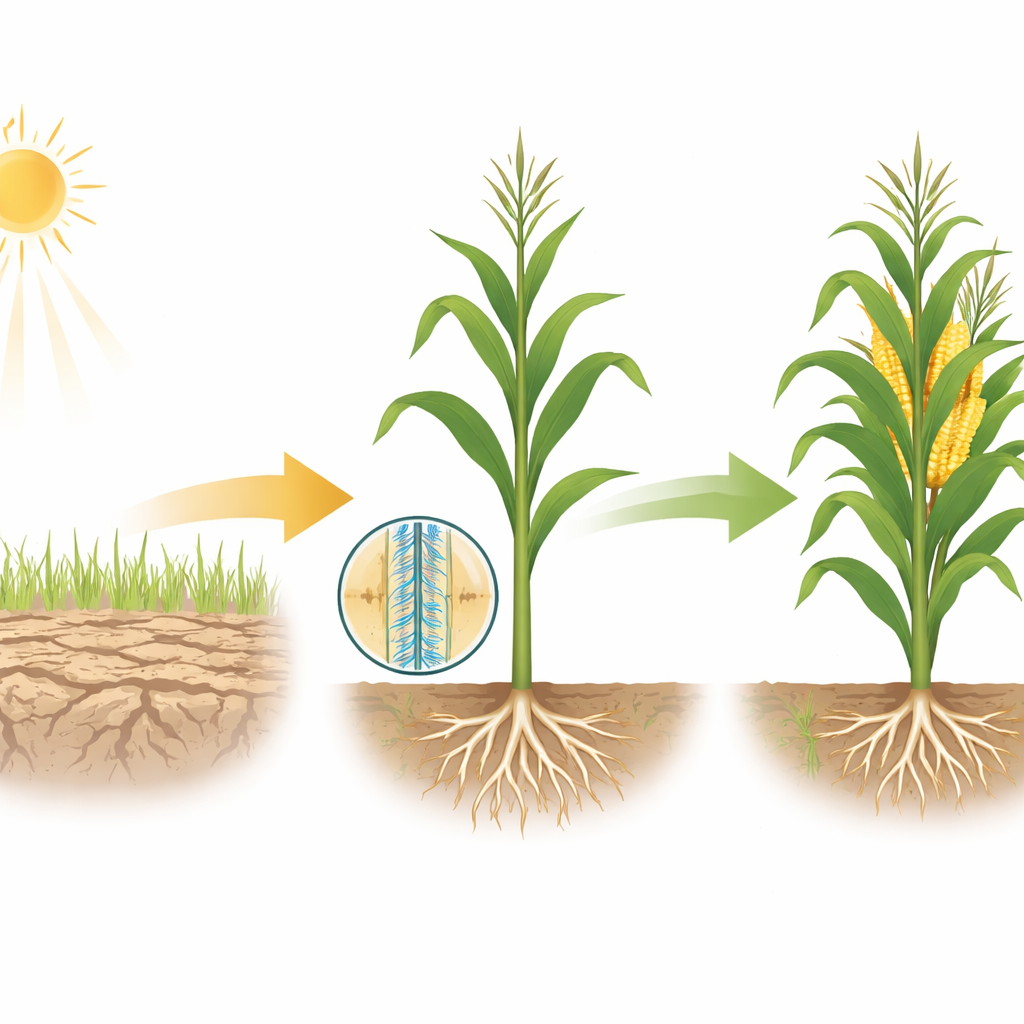
Maize, or corn, feeds people and livestock around the globe, but it is extremely vulnerable to drought. As climate change intensifies dry spells and agriculture already uses most of the world’s freshwater, farmers urgently need crops that grow more grain from every drop of water. This study uncovers a genetic “plumbing upgrade” inside maize stems and roots that strengthens the plant’s internal water pipes and, in field trials, raises yield and water use efficiency under both normal and dry conditions.
Plants as living water towers
Like a city depends on pipes and pumps, a maize plant relies on xylem vessels—long, hollow tubes that pull water from soil to leaves. These vessels are lined with a reinforced inner layer called the secondary cell wall, arranged in rings, spirals, or pits that prevent collapse under the strong suction created by transpiration. If this reinforcement is faulty, vessels can buckle, water flow slows, and upper leaves wilt even when soil is still moist. The authors began with a mutant maize line, called drought-sensitive 1, that looked normal most of the day but repeatedly drooped at midday and died more readily under simulated drought, hinting at a hidden failure in the plant’s water-transport system.
Finding the hidden valve gene
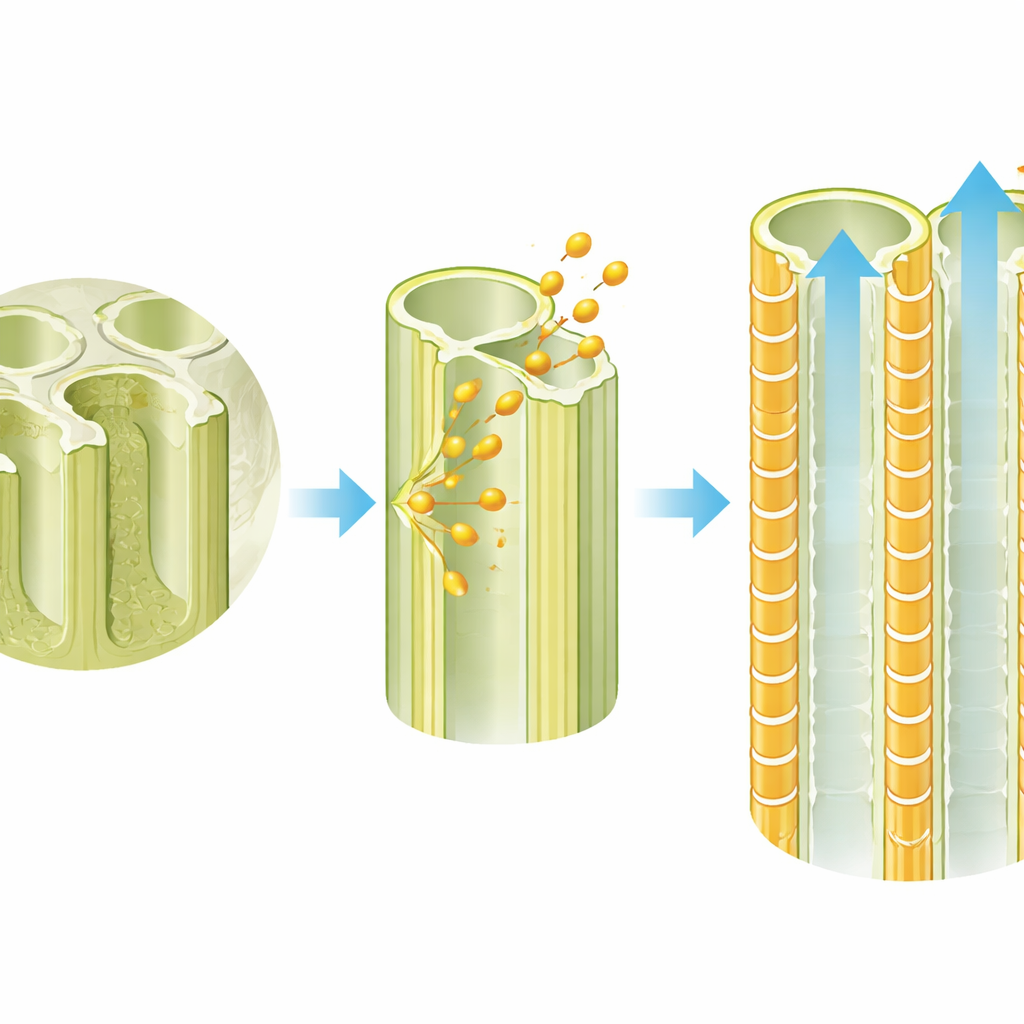
By mapping the mutation behind the drought-sensitive plants, the team identified a gene they named DS1, which encodes a protein called Exo70A1. This protein is part of the exocyst complex, a set of molecular “docking clamps” that guide tiny delivery vesicles to precise spots on the cell’s outer membrane. In maize engineered to lack Exo70A1, xylem vessels in roots and stems were fewer, narrower, shorter, and poorly reinforced; over 90% of vascular bundles showed undeveloped water pipes. Measurements confirmed that these plants had much lower hydraulic conductivity—their roots and stems could not move water upward efficiently—leading to lower leaf water content and stunted growth. In contrast, plants engineered to produce extra Exo70A1 developed larger and longer vessels with thicker, more frequent wall thickenings and showed faster movement of a tracking dye through their stems and leaves.
A master switch in the plant’s plumbing blueprint
The researchers then asked what switches Exo70A1 on in the right cells. They focused on a transcription factor called NUT1, previously linked to early xylem development. Using a series of biochemical tests, they showed that NUT1 physically binds to specific sequences in the Exo70A1 promoter—the stretch of DNA that controls when the gene is active—and directly boosts its activity. In maize plants where NUT1 was disabled, expression of Exo70A1 dropped sharply in the central vascular tissues of roots and stems. These NUT1-deficient plants closely mimicked the Exo70A1 knockouts: their xylem vessels were shorter and more weakly patterned, water transport was impaired, and leaves and tassels wilted or scorched under high demand. Crucially, reintroducing extra Exo70A1 into NUT1 mutants largely restored xylem structure, water flow, and plant stature, placing Exo70A1 as a key working component downstream of NUT1.
From stronger pipes to bigger harvests
Discovering a better water pipe is useful only if it pays off in the field. The team tested Exo70A1-overexpressing maize for two seasons in a dry region of northwest China under both full irrigation and reduced-water regimes delivered by drip systems. Compared with standard plants, those with boosted Exo70A1 had thicker, stronger stems with more cellulose and lignin, longer xylem vessels, and greater overall biomass. When water use was carefully recorded, these plants produced more stalk and leaf mass per unit water and, importantly, consistently higher grain yields per unit water—improving both biomass and grain water use efficiency. The advantages persisted when Exo70A1-enhanced lines were crossed into a commercial hybrid background, suggesting that this trait can be combined with existing high-yield breeding lines.
What this means for future crops
In accessible terms, the study shows that maize plants can be made to grow “wider, smoother pipes” inside their stems and roots by turning up a specific molecular module: the NUT1 switch that activates the Exo70A1 delivery system. This upgrade allows water to move more easily to the upper canopy, supporting stronger growth and higher yields even when irrigation is limited. Because the basic components of xylem and the exocyst complex are shared across many plant species, the NUT1–Exo70A1 module represents a promising target for breeding or engineering crops that produce more food with less water—an increasingly critical goal in a warming, water-stressed world.
Citation: Zhu, T., Wang, Y., Wang, Y. et al. NUT1-Exo70A1 Regulates Xylem Vessel Development and Influences Water Use Efficiency in Maize. Nat Commun 17, 2816 (2026). https://doi.org/10.1038/s41467-026-69436-7
Keywords: maize drought tolerance, xylem vessels, water use efficiency, Exo70A1, crop improvement