Clear Sky Science · en
Soft photo-ionotronics
Smart squishy materials for future gadgets
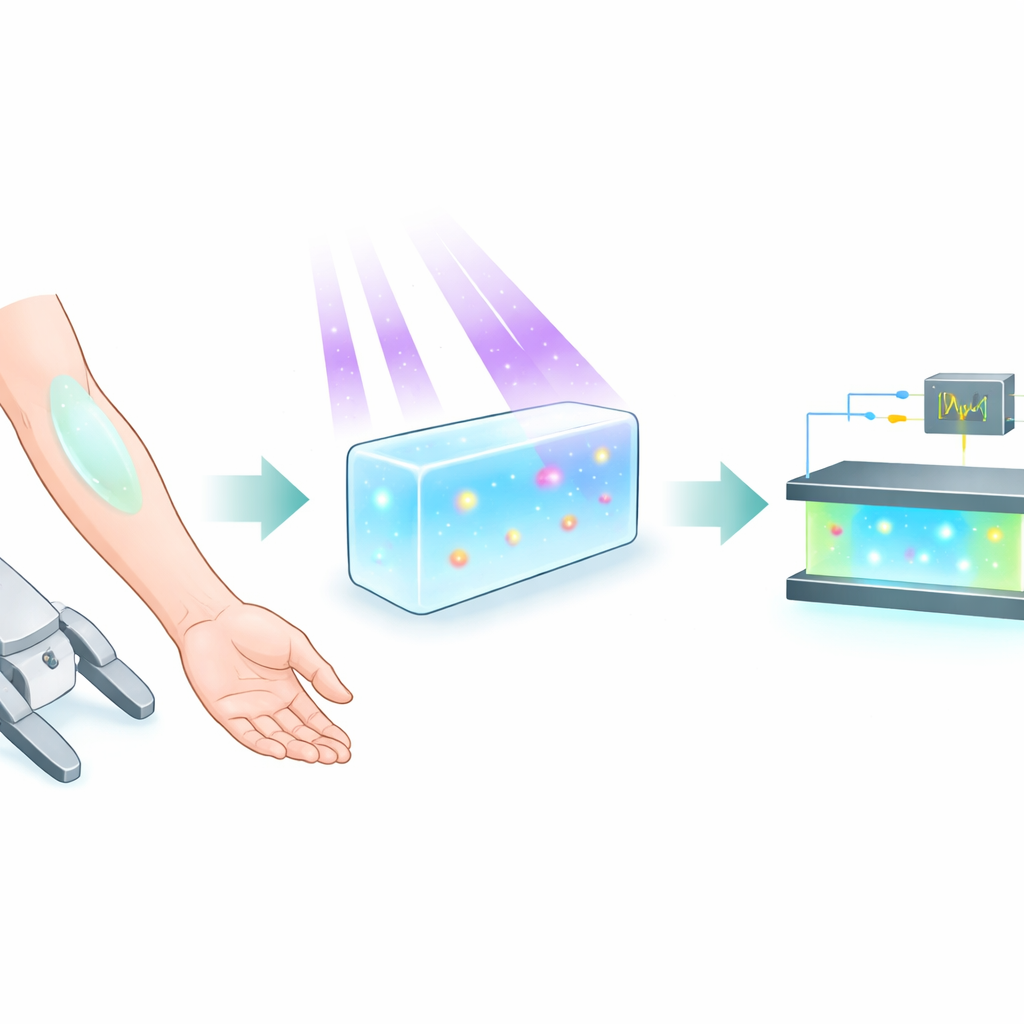
Our bodies and our machines speak very different electrical languages: living tissues send signals mostly with ions in salty water, while phones and computers rely on electrons in rigid wires and chips. This paper introduces a new kind of soft material that helps bridge that gap. It behaves a bit like living tissue—squishy, stretchable, and gentle—yet its ability to carry ionic charge can be powerfully switched on with light, opening paths toward soft sensors, wearable electronics, and flexible circuits that can be written and erased much like drawings on a page.
Turning light into moving charge
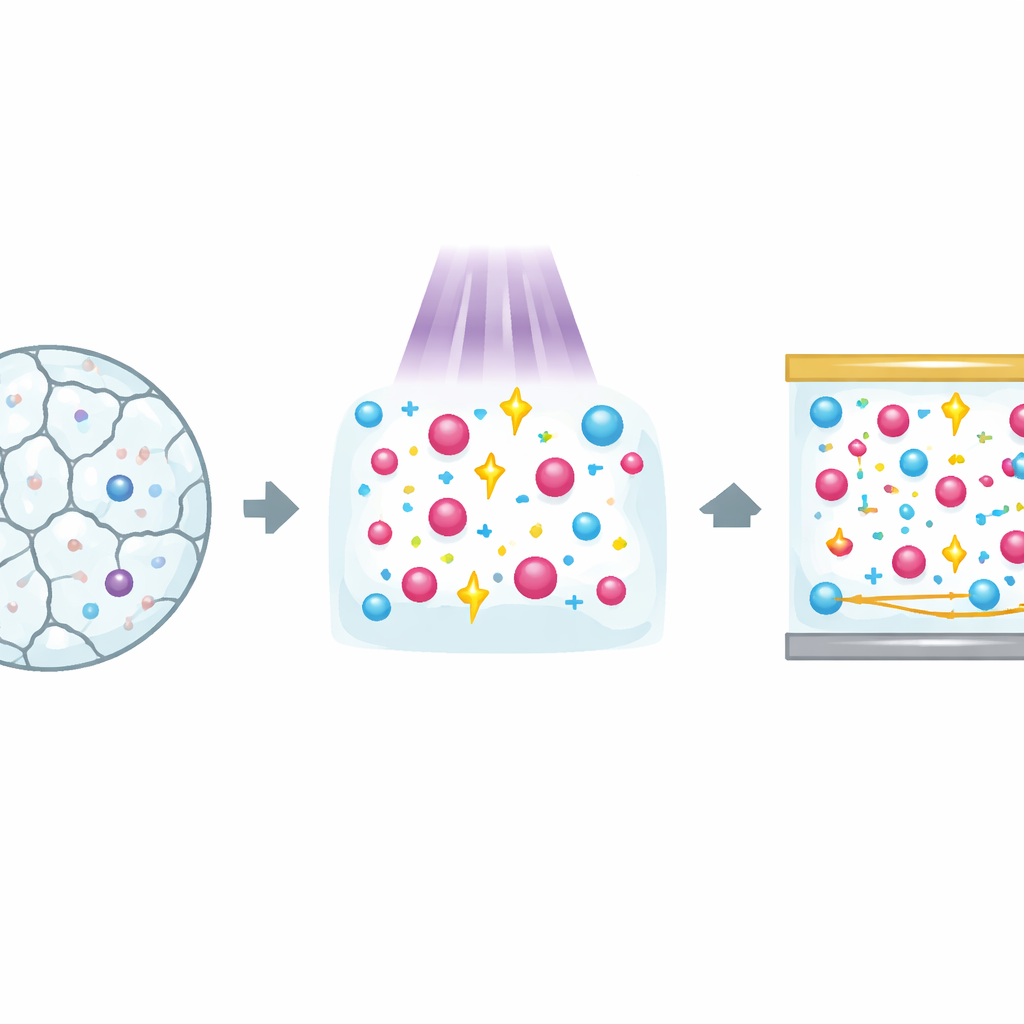
The core idea rests on special light-sensitive molecules called photo-ion generators. Before they see light, these molecules are neutral and do not conduct much electricity. When illuminated with ultraviolet light, they break apart into charged fragments—ions—that can move through a liquid or gel and suddenly make it much more conductive. By choosing neutral starting molecules instead of ones that are already charged, the researchers can create enormous jumps in how easily ions flow, sometimes more than a thousand-fold, simply by switching on a lamp. They studied several such molecules in a common solvent and found that one in particular, known in the lab as MBT, combined strong response, good solubility, and relatively gentle light requirements.
From liquid solutions to soft glowing gels
To turn this light-triggered chemistry into a usable material, the team infused ordinary polyurethane rubber with the photo-ion solution. The rubber absorbs the liquid and swells, much like a sponge soaking up water, forming what they call a photo-ionic gel. In the dark, this gel is soft but largely insulating. After exposure to light, the embedded molecules split into ions, and the gel becomes a much better ionic conductor. Although the jump in conductivity inside the gel is smaller than in pure liquid—because ions move more slowly in a thick, rubbery environment—it is still dramatic, often more than a hundred-fold, and enough to make a clear electrical difference.
Tuning softness and strength
Because the gel is built from a familiar rubber, its feel and toughness can be tuned by choosing different starting elastomers and by controlling how much photo-ion solution is absorbed. As more liquid is taken up, the material becomes softer, approaching the feel of human skin, but it also stretches less before breaking. The researchers explored several commercial polyurethanes, ranging from very soft to relatively stiff, and showed that in all cases the added chemistry can deliver large light-controlled conductivity changes while keeping the overall softness in the same range as biological tissues. This combination of gentle mechanics and strong electrical response is unusual: many existing soft conductors either feel too stiff or change their signal only weakly.
Drawing and holding paths for electricity
One striking feature of these gels is that light can write narrow, long-lasting conductive paths inside an otherwise insulating sheet. By shining a narrow band of ultraviolet light through a mask, the team created a strip that was about a centimeter wide and far more conductive than its surroundings. The ions created in this illuminated region spread only slowly over time, so the patterned path remains sharp and functional for days. This stability suggests that such gels could hold “soft circuits” drawn by light without immediately blurring away, a key requirement for practical devices.
Soft sensors and light-written circuits
To show what these properties make possible, the researchers built simple devices. When they compressed a photo-patterned gel between electrodes, its conductance changed strongly with small mechanical strains, turning it into a highly sensitive pressure or strain sensor that works even under gentle stresses. In another demonstration, they embedded several small light-emitting components inside a single gel block. By briefly scanning a light spot across the gel, they could draw temporary conductive tracks that connected a power source to one component or another on demand, effectively routing signals in a soft, stretchable circuit without any rigid wires.
What this means for everyday technology
In plain terms, this work shows how to make soft, rubbery materials whose ability to carry ionic charge can be turned on and shaped with beams of light. Because the gels are as compliant as tissues yet capable of large, stable conductivity changes, they offer a promising platform for next-generation wearables, medical patches, soft robots, and flexible displays that communicate more like living systems do. Future versions could become reversible, switching on and off repeatedly, paving the way for fully light-controlled ionic logic elements and truly adaptive soft electronics.
Citation: Liu, X., Adelmund, S.M., Safaee, S. et al. Soft photo-ionotronics. Nat Commun 17, 3053 (2026). https://doi.org/10.1038/s41467-026-69427-8
Keywords: soft electronics, ion-conducting gels, light-activated materials, wearable sensors, photoresponsive polymers