Clear Sky Science · en
Quantum coupling in colloidal homodimers of epitaxially attached CdSe@CdS dot@platelets probed on single-particle level
Building Tiny Molecules from Tiny Crystals
Modern electronics already rely on structures so small that millions can fit on the head of a pin. This study goes a step further, showing how to make and study “artificial molecules” built from even smaller pieces called quantum dots. These designer structures behave like simplified versions of real molecules, but are made from semiconductor crystals in liquid solution. Understanding and controlling them could open new ways to manipulate light for displays, communication, and quantum technologies. 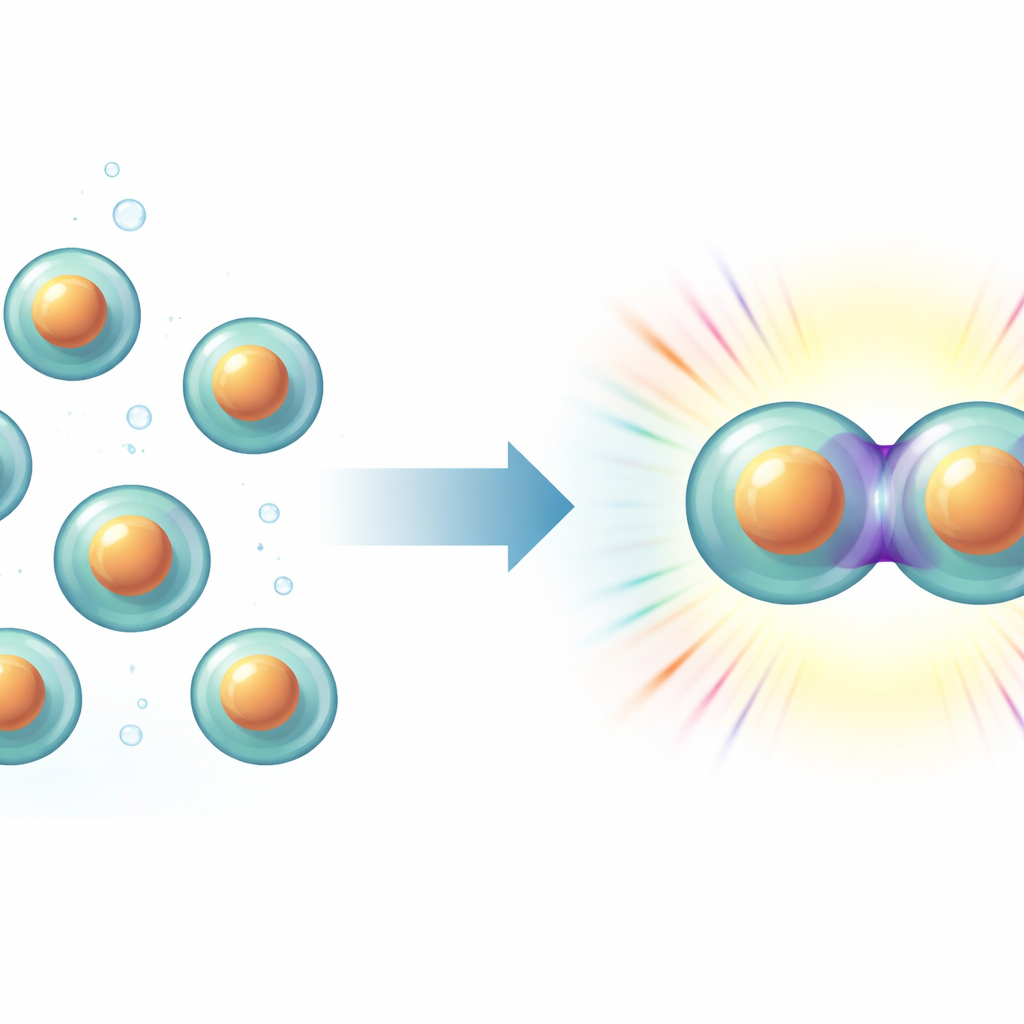
From Artificial Atoms to Artificial Molecules
Semiconductor quantum dots are nanometer-scale crystals that confine electrons and holes so tightly that they act like artificial atoms, with discrete energy levels rather than continuous bands. For decades, scientists have dreamed of taking the next step: coupling two such dots into an artificial molecule whose electrons can spread over both partners, forming bonding and antibonding states much like in a real diatomic molecule. Previous attempts, often grown on solid wafers, produced only very small energy splittings between these states—too small to stand out against the random jostling of atoms at room temperature. As a result, the molecule-like features could usually be seen only at cryogenic temperatures.
Clicking Nanocrystals Together with Atomic Precision
The authors solve a key fabrication problem by developing a solution-based method that fuses two carefully prepared quantum dots together along a specific crystal direction. Their building blocks are cadmium selenide cores wrapped in cadmium sulfide shells shaped like tiny platelets. These platelets have large, flat side faces that are only weakly protected by surface molecules, making them available for controlled attachment. By heating the particles in a tailored mix of liquid amines, the team encourages two platelets to merge side-by-side along a chosen axis, creating a narrow, crystalline neck with hundreds of perfectly aligned atomic bonds. Because the core size and shell thickness are nearly identical from dot to dot, the resulting dimers are highly uniform in both overall size and internal spacing between the two cores.
Tuning the Distance Between Quantum Partners
By varying the thickness of the cadmium sulfide shells, the researchers can tune how far apart the two cadmium selenide cores sit inside each dimer. They systematically create samples with three different core spacings while keeping the neck dimensions essentially constant. Optical measurements on large ensembles show that when the cores are very close, the absorption and emission spectra shift and broaden in ways predicted for strongly coupled artificial molecules. When the cores are farther apart, the spectra look almost identical to those of independent dots, indicating that the two partners are no longer meaningfully interacting. This distance control lets the team compare truly coupled dimers with mere side-by-side pairs that behave like two separate “artificial atoms.” 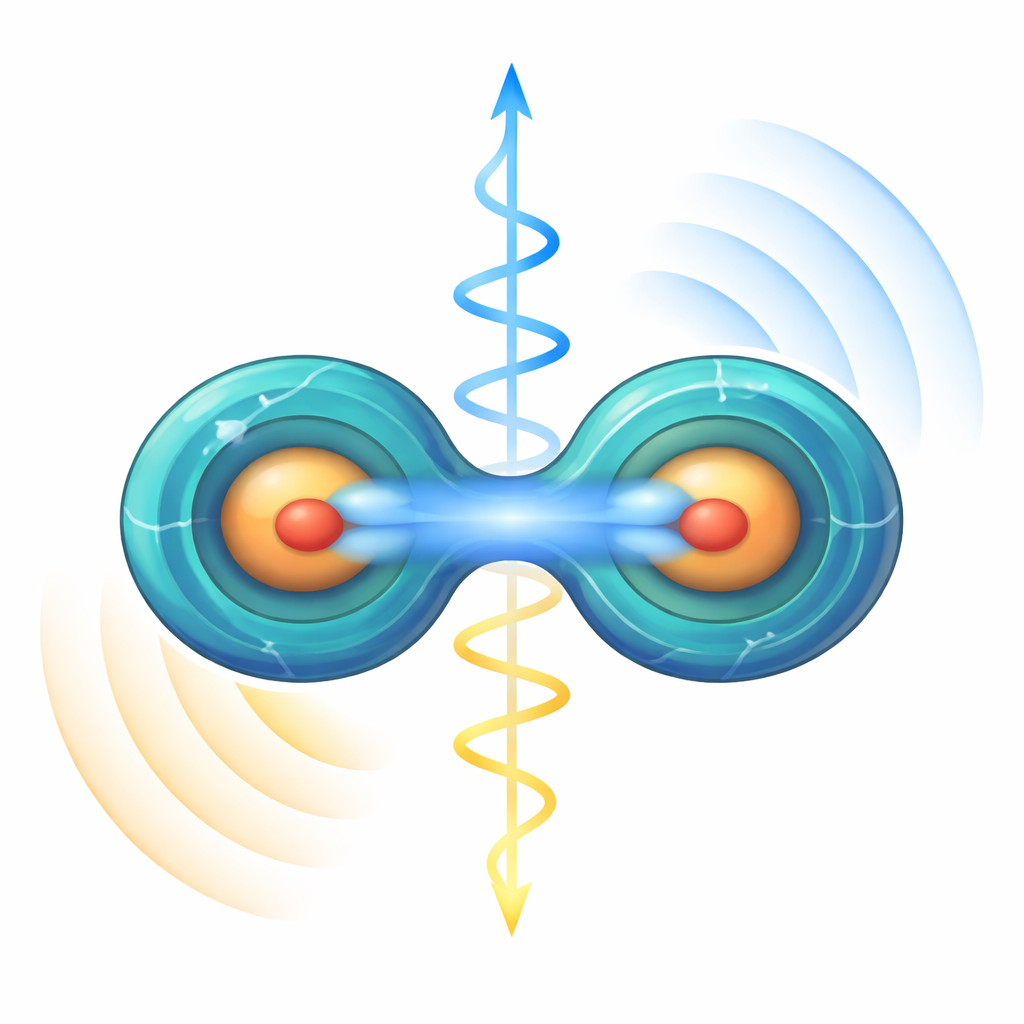
Watching Single Artificial Molecules Glow
To unambiguously reveal molecule-like behavior, the authors zoom in on individual dimers one at a time, correlating their microscope images with their emission spectra. Single quantum dots emit a single sharp peak of light. In contrast, every closely spaced dimer shows two distinct emission peaks separated by about 35 millielectronvolts—large enough to be clearly resolved at room temperature. These two peaks follow a thermal intensity pattern expected when electrons can occupy either a lower-energy bonding state or a higher-energy antibonding state. Moreover, the associated light from each peak is polarized along directions that are nearly perpendicular to each other, a hallmark of two different electronic transitions within one coupled system, rather than light from two unrelated dots.
Special Double-Excitation States
Beyond single excitations, the team probes biexcitons—situations where two electron–hole pairs exist in the same structure. For individual quantum dots, such double excitations usually vanish quickly through a nonradiative process known as Auger recombination. In the new dimers, however, careful time-resolved measurements reveal two distinct kinds of biexcitons. In one, the two holes sit in different cores while the electron density spreads over the entire dimer; this configuration lives for several nanoseconds and emits light with an unusually high probability. In the other, both holes collect in the same core, making Auger loss efficient again and the emission weak and short-lived. These observations match theoretical expectations for true artificial molecules with shared electronic states.
Why This Matters
Taken together, the controlled neck geometry, tunable core spacing, split and polarized emission peaks, and unusual biexciton behavior all point to the same conclusion: these epitaxially fused quantum-dot dimers function as room-temperature artificial molecules. The work shows that it is possible to assemble such structures in liquid solution with high yield and near-atomic precision, and to reliably access their molecule-like electronic states. This paves the way for building more complex “molecules” from quantum dots—such as trimers and larger networks—that could serve as customizable platforms for light-based computing, quantum information processing, and highly efficient light emitters and photocatalysts.
Citation: Lei, H., Qin, H., Lei, H. et al. Quantum coupling in colloidal homodimers of epitaxially attached CdSe@CdS dot@platelets probed on single-particle level. Nat Commun 17, 2900 (2026). https://doi.org/10.1038/s41467-026-69417-w
Keywords: quantum dot molecules, colloidal nanocrystals, artificial molecules, single-particle spectroscopy, quantum coupling